Ancient Greece · 351–322 BCE
Who Was Demosthenes? The Philippics Against Philip of Macedon
In short
- Philip II of Macedon built a professional army and expanded into Greece from 359 BCE.
- Demosthenes' Philippics, from 351 BCE, urged Athens to act; he united Athens and Thebes against Philip, but they lost at Chaeronea in 338 BCE.
- After a last failed revolt, Demosthenes took poison in 322 BCE rather than surrender to Antipater.
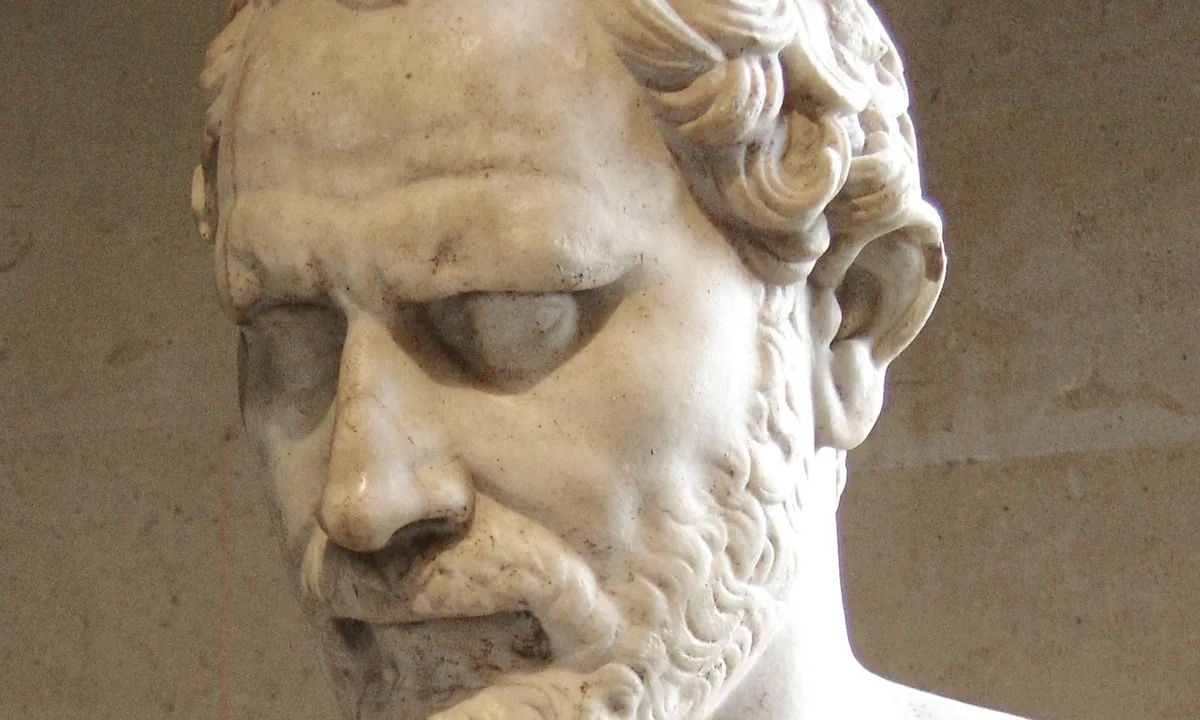
Last time: the restored Athenian democracy put Socrates to death in 399 BCE.
In October 322 BCE soldiers climbed to a temple of Poseidon on a small island off the coast of Greece to arrest the most famous orator of Athens. He asked for a moment to write a letter, Plutarch says, put his pen in his mouth as he often did when thinking, and bit on it. The poison, by the most common account, was hidden inside.
A weak voice and a stolen fortune
Demosthenes was born in 384 BCE, the son of a wealthy sword-maker. His father died when he was seven, and his guardians squandered much of the fortune. To get it back he studied law and rhetoric, and in his early twenties he took them to court and won.
Plutarch says he trained a weak voice and a stammer by speaking with pebbles in his mouth, reciting while running uphill and shouting over the noise of the sea. These stories may be embroidered, but his speeches survive, and they made him the most admired orator of antiquity.
The king from the north
Macedon, a kingdom north of Greece, had long been weak and divided. In 359 BCE Philip II became king. As a teenager he had been a hostage in Thebes, then the strongest city in Greece, and he had watched its army closely.
He drilled a professional army, armed his infantry with the sarissa, a pike over five metres long, and paid for it with gold from the mines of Thrace. City by city he moved south and east: Amphipolis in 357 BCE, then Methone, where an arrow cost him an eye, and in 348 BCE Olynthus, which he razed to the ground.

The Philippics
In 351 BCE Demosthenes delivered the first of his speeches against Philip, later called the Philippics. Athenians, he said, were treating the war like a spectator sport, reacting to each new piece of news instead of acting. He wanted a standing force, paid for by citizens, and citizens serving in it.
Others, led by the orator Aeschines, argued that Athens should make terms. In 346 BCE it did, but the peace did not hold, and Demosthenes went on warning that Philip meant to master all Greece.
Chaeronea, 338 BCE
Demosthenes' great success was diplomatic: in 339 BCE he brought Thebes, Athens' old enemy, into an alliance against Philip. In August 338 BCE their armies met Philip's at Chaeronea in Boeotia.
Philip won completely. His 18-year-old son Alexander commanded the wing that broke the Thebans. Demosthenes, who fought in the ranks, survived the rout and was chosen to give the funeral speech for the Athenian dead. Philip made the Greek cities members of a League of Corinth under his leadership.

The last stand
Philip was murdered in 336 BCE, and Alexander crushed every hope of revolt. In 330 BCE Athens awarded Demosthenes a golden crown for his services; Aeschines challenged it, and lost so heavily that he left Athens.
When Alexander died in 323 BCE, Athens rose again. The Macedonian general Antipater won, and demanded Demosthenes. He fled to the temple of Poseidon on the island of Kalaureia and took poison there in October 322 BCE. Forty years later Athens set up his statue in the agora.

In their own words
“What? Do you want to go round asking one another, 'Is there any news?' Could there be any stranger news than that a man of Macedonia is defeating Athenians in war, and ordering the affairs of the Hellenes? 'Is Philip dead?' 'No, but he is sick.' And what difference does it make to you?”
Demosthenes, First Philippic (Oration 4) 10–11, 351 BCE
Translation by A. W. Pickard-Cambridge (1912). Some scholars date the speech to 352 BCE.
Why it happened
- Philip II built a professional army and paid for it with Thracian gold.
- The Greek cities, exhausted by decades of wars among themselves, were divided over how to respond.
- Athens relied on citizen assemblies and hired troops, and was slow to act, as Demosthenes complained.
What happened next
- After Chaeronea, Macedon controlled Greece through the League of Corinth.
- Philip's army passed to Alexander, who used it to conquer the Persian Empire. Read the story →
- Demosthenes' speeches became models of oratory for Roman and later writers.
Why it still matters
In 44–43 BCE the Roman orator Cicero attacked Mark Antony in fourteen speeches and called them his Philippics, after Demosthenes. Like Demosthenes, he paid with his life: Antony had him killed in 43 BCE. The word still means a bitter public denunciation.
Key people
- Demosthenes
- Athenian orator and statesman (384–322 BCE) who led the opposition to Macedon
- Philip II
- King of Macedon (359–336 BCE) who made it the leading power in Greece
- Aeschines
- Athenian orator who favoured peace with Philip, Demosthenes' great rival
- Alexander
- Philip's son, who commanded a wing at Chaeronea at 18
- Antipater
- Macedonian general who crushed Athens' revolt in 322 BCE and demanded Demosthenes' surrender
Key terms
- Philippic
- One of Demosthenes' speeches against Philip; today, any fierce verbal attack.
- Sarissa
- The long pike of the Macedonian infantry, over five metres long, held with both hands.
- Rhetoric
- The art of persuasive public speaking, essential for anyone who wanted influence in a democracy.
- League of Corinth
- The union of Greek states Philip created after Chaeronea, with himself as its leader.
Test yourself
What were the Philippics?
- Laws limiting the power of Macedonian kings
- Demosthenes' speeches warning Athens against Philip
- Treaties between Philip and the Greek cities
- Philip's letters to the Athenian Assembly
Show the answer
Demosthenes' speeches warning Athens against Philip. From 351 BCE Demosthenes gave a series of speeches urging Athens to act against Philip II. The word now means any fierce verbal attack.
The full lesson in the app ends with 5 questions like this one.
Connected stories
- Alexander the Great: From Macedon to India: Philip's army and League of Corinth were the springboard for Alexander's invasion of Persia.
- The Ides of March: Cicero named his speeches against Mark Antony, Caesar's lieutenant, the Philippics, after Demosthenes.
Frequently asked questions
Why did Demosthenes oppose Philip of Macedon?
Philip II built a professional army and paid for it with Thracian gold. The Greek cities, exhausted by decades of wars among themselves, were divided over how to respond. Athens relied on citizen assemblies and hired troops, and was slow to act, as Demosthenes complained.
What happened after Chaeronea?
After Chaeronea, Macedon controlled Greece through the League of Corinth. Philip's army passed to Alexander, who used it to conquer the Persian Empire. Demosthenes' speeches became models of oratory for Roman and later writers.
What were the Philippics?
Demosthenes' speeches warning Athens against Philip. From 351 BCE Demosthenes gave a series of speeches urging Athens to act against Philip II. The word now means any fierce verbal attack.
What is the main primary source for “Demosthenes and the Philippics”?
Demosthenes, First Philippic (Oration 4) 10–11 (351 BCE). Translation by A. W. Pickard-Cambridge (1912). Some scholars date the speech to 352 BCE.
Sources
- Demosthenes, First Philippic, Olynthiacs and On the Crown
- Plutarch, Life of Demosthenes
- Ian Worthington, Demosthenes of Athens and the Fall of Classical Greece (2013)
- Ian Worthington, Philip II of Macedonia (2008)
Images are credited under each picture. Paintings and photographs come from public collections via Wikimedia Commons; scenes with no surviving image are marked as illustrations.
