Ancient Egypt · 196 BCE; deciphered 1822
What Is the Rosetta Stone and Why Is It Important?
In short
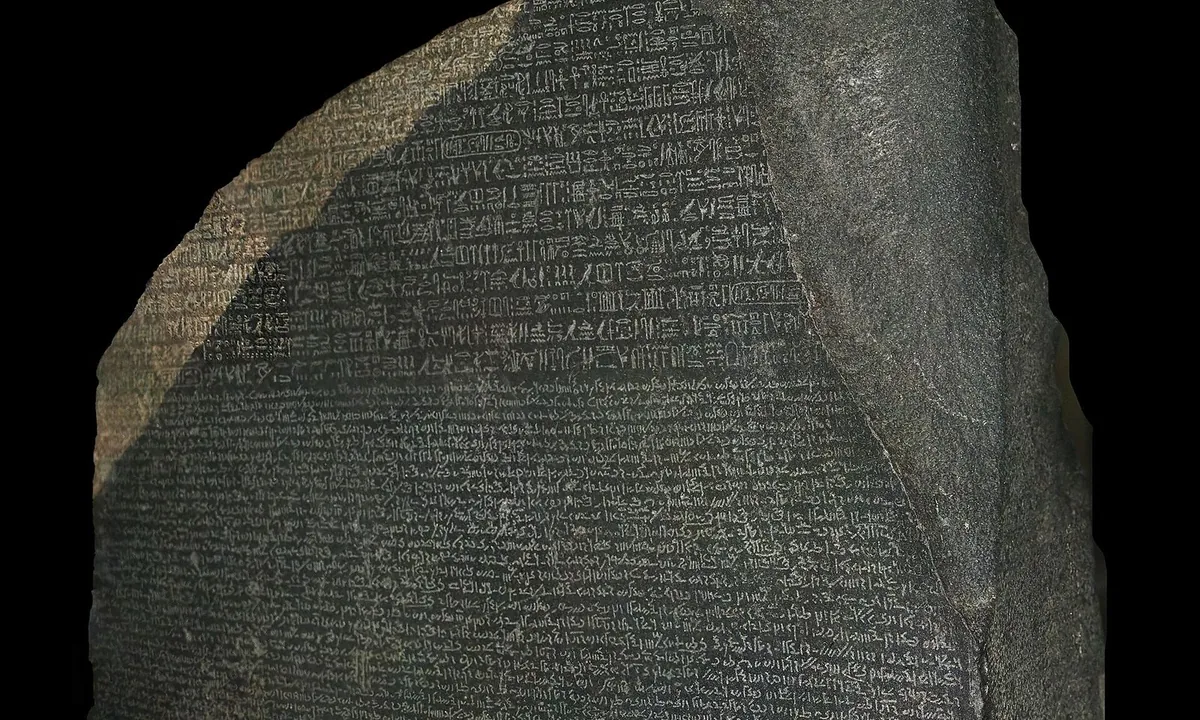
- The Rosetta Stone is a decree of 196 BCE written in hieroglyphs, Demotic and Greek.
- French soldiers found it in 1799; the British took it in 1801 and it has been in the British Museum since 1802.
- Using the Greek and his knowledge of Coptic, Champollion showed in 1822 that hieroglyphs record sounds as well as ideas.
In September 1822 a young French scholar is said to have run down a Paris street to his brother's office, shouted “I've got it!”, and fainted. What he had got was a way into a script no one had been able to read for some 1,400 years.
A script that fell silent
Hieroglyphs were in use from about 3200 BCE. For daily business, scribes wrote quicker scripts: hieratic, and later Demotic. After Alexander the Great conquered Egypt in 332 BCE, it was ruled by the Greek-speaking Ptolemies, and Greek became the language of government.
Hieroglyphs survived in temples, known to fewer and fewer priests. The last dated inscription was carved at Philae on 24 August 394 CE. Once the temples closed, nobody could read them. Later writers decided they were mystical symbols, not a way of writing sounds, and that error held scholars back for centuries.

One decree, three scripts
On 27 March 196 BCE, priests gathered at Memphis issued a decree honouring the thirteen-year-old king Ptolemy V: he had cut taxes, pardoned rebels and given gifts to the temples, so his statue would stand in every temple. Copies were to be set up across Egypt.
One copy, carved on a slab of granodiorite, gave the same text in hieroglyphs, for the gods; Demotic, the everyday script; and Greek, the language of the rulers. Centuries later it was reused as building material in a fort near the Delta town of Rashid, known to Europeans as Rosetta.

Found by soldiers, kept by rivals
In July 1799, during Napoleon's invasion of Egypt, French soldiers rebuilding that fort found the stone. An officer, Pierre-François Bouchard, saw that it bore three scripts and that the Greek could be read. The stone is incomplete: most of the hieroglyphic text, at the top, has broken away. The scholars who had come with the army made copies.
When the French surrendered to the British in 1801, the treaty handed over the stone and other finds. It went to the British Museum in 1802 and has been there ever since, except for safekeeping in an underground railway tunnel during the First World War.
The race to read it
The Greek told scholars what the other texts said. The hard part was how. The English polymath Thomas Young made real progress after 1814: he showed that the ovals called cartouches held royal names, and worked out some sound values from “Ptolemy”.
Jean-François Champollion went further. He knew Coptic, the last form of the Egyptian language, written in Greek letters. Comparing the names Ptolemy and Cleopatra, then reading Ramses and Thutmose in copies of other inscriptions, he saw that hieroglyphs mixed sound signs with signs for whole words. On 27 September 1822 he presented his system to the Academy in Paris, in his “Letter to M. Dacier”.

The voices come back
Champollion's method opened up 3,000 years of Egyptian writing: temple walls, tomb texts, letters, accounts, love poems and tax receipts. Egyptology as a discipline began with it. He died in 1832, aged 41, before he could finish his grammar.
The stone itself is now the most visited object in the British Museum, and a disputed one. Egyptian archaeologists and campaigners have repeatedly called for it to be returned to Egypt.
In their own words
“This decree shall be set up on a stele of hard stone, in sacred and native and Greek letters, and set up in each of the first, second, and third (rank) temples at the image of the ever-living king.”
Egyptian priests assembled at Memphis, The Memphis Decree (Rosetta Stone), Greek text, last lines, 27 March 196 BCE
Translation by Edwyn Bevan, The House of Ptolemy (1927). “Sacred” letters are hieroglyphs and “native” letters Demotic: the clause that made the stone a key to the scripts.
Why it happened
- Greek rule made a bilingual decree necessary, so the same text was written in three scripts.
- Napoleon's 1798 expedition brought soldiers and scholars to the Delta.
- Champollion's knowledge of Coptic let him link signs to the sounds of the Egyptian language.
What happened next
- Egyptologists could read inscriptions like Ramses II's Kadesh texts and Hatshepsut's temple walls. Read the story →
- Cleopatra's name was one of the keys Champollion used, read from an obelisk at Philae. Read the story →
- The stone became a symbol of the debate over returning objects taken in colonial times.
Why it still matters
In 2022, the bicentenary of Champollion's breakthrough, Egyptian archaeologists led a petition signed by tens of thousands of people asking the British Museum to return the Rosetta Stone. The museum, whose trustees are barred by law from giving away objects in its collection, has kept it on display.
Key people
- Ptolemy V Epiphanes
- Greek king of Egypt (204–180 BCE), honoured by the decree at age thirteen
- Pierre-François Bouchard
- French officer who recognised the stone's importance in July 1799
- Thomas Young
- English scientist who identified royal names in cartouches and some sound values
- Jean-François Champollion
- French scholar (1790–1832) who deciphered hieroglyphs in 1822
Key terms
- Hieroglyphs
- Egypt's picture script, mixing signs for sounds with signs for whole words and ideas.
- Demotic
- A fast cursive script for everyday Egyptian, used from about 650 BCE.
- Cartouche
- An oval loop drawn around a royal name in hieroglyphs.
- Coptic
- The last stage of the Egyptian language, written in Greek letters and still used in the Coptic Church.
Test yourself
Which three scripts appear on the Rosetta Stone?
- Hieroglyphs, Demotic and Greek
- Hieroglyphs, Latin and Greek
- Hieratic, Coptic and Greek
- Hieroglyphs, cuneiform and Demotic
Show the answer
Hieroglyphs, Demotic and Greek. Hieroglyphs for sacred texts, Demotic for everyday Egyptian, and Greek, the language of the Ptolemaic government. That makes two languages in three scripts.
The full lesson in the app ends with 5 questions like this one.
Connected stories
- Alexander the Great: From Macedon to India: Alexander's conquest put Greek-speaking kings on Egypt's throne, which is why the decree needed a Greek version.
- Ramses II: Kadesh, a Peace Treaty and a Giant Ego: Champollion read Ramses's name in a cartouche from Abu Simbel, one of his first proofs.
- Cleopatra: The Last Queen of Egypt: Ptolemy V was an ancestor of Cleopatra VII, the last ruler of the same dynasty.
Frequently asked questions
Why was the Rosetta Stone written in three scripts?
Greek rule made a bilingual decree necessary, so the same text was written in three scripts. Napoleon's 1798 expedition brought soldiers and scholars to the Delta. Champollion's knowledge of Coptic let him link signs to the sounds of the Egyptian language.
Why is the Rosetta Stone important?
Egyptologists could read inscriptions like Ramses II's Kadesh texts and Hatshepsut's temple walls. Cleopatra's name was one of the keys Champollion used, read from an obelisk at Philae. The stone became a symbol of the debate over returning objects taken in colonial times.
Which three scripts appear on the Rosetta Stone?
Hieroglyphs, Demotic and Greek. Hieroglyphs for sacred texts, Demotic for everyday Egyptian, and Greek, the language of the Ptolemaic government. That makes two languages in three scripts.
What is the main primary source for “The Rosetta Stone: Cracking the Code of the Pharaohs”?
Egyptian priests assembled at Memphis, The Memphis Decree (Rosetta Stone), Greek text, last lines (27 March 196 BCE). Translation by Edwyn Bevan, The House of Ptolemy (1927). “Sacred” letters are hieroglyphs and “native” letters Demotic: the clause that made the stone a key to the scripts.
Sources
- Carol Andrews, British Museum, The Rosetta Stone (1981)
- Jean-François Champollion, Lettre à M. Dacier relative à l'alphabet des hiéroglyphes phonétiques (1822)
- Andrew Robinson, Cracking the Egyptian Code: The Revolutionary Life of Jean-François Champollion (2012)
- Ilona Regulski (ed.), British Museum, Hieroglyphs: Unlocking Ancient Egypt (2022)
Images are credited under each picture. Paintings and photographs come from public collections via Wikimedia Commons; scenes with no surviving image are marked as illustrations.
