Ancient Egypt · c. 3100 BCE
Who United Upper and Lower Egypt? Narmer and the First Pharaohs
In short
- Before c. 3100 BCE Egypt was divided into the valley (Upper Egypt) and the Delta (Lower Egypt).
- The Narmer Palette shows a southern king wearing both crowns, but it is propaganda, not a news report.
- Unification was probably a gradual process; later legend credited it to a single founder, Menes.
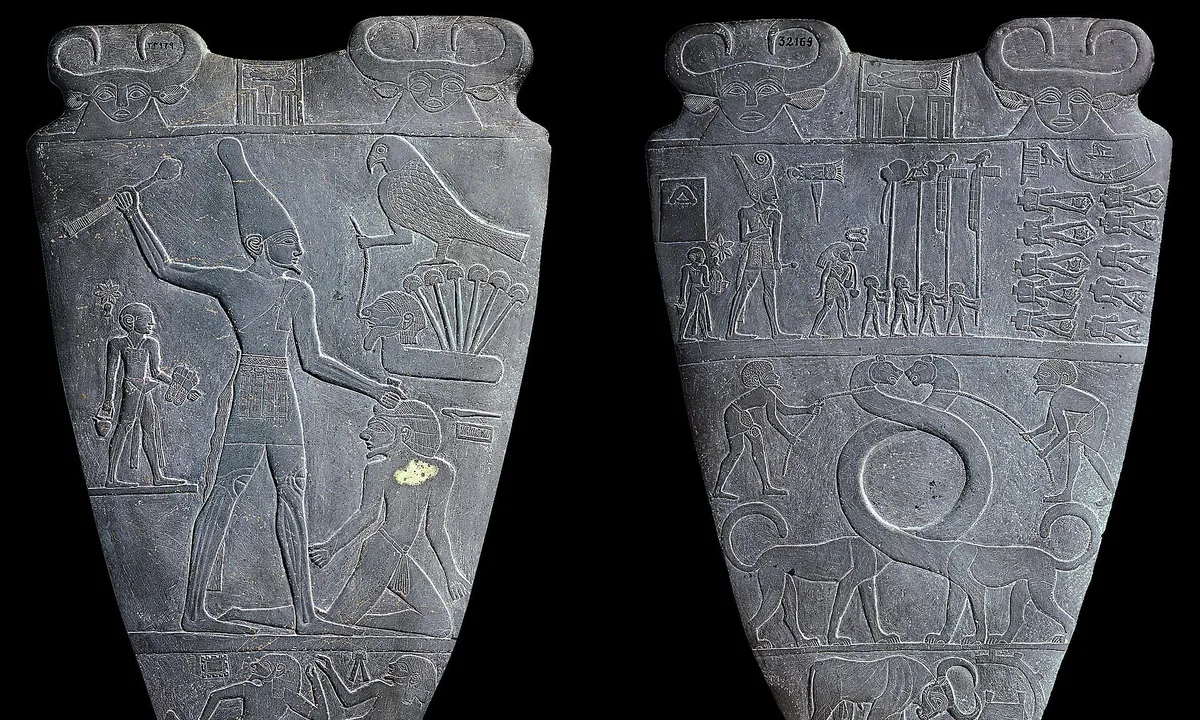
In the winter of 1897–98, two British archaeologists digging in the ruined temple of Hierakonpolis found a slab of dark stone. On one face, a king in a tall white crown grips a kneeling man by the hair and raises a mace. On the other, the same king wears a different crown. Egypt has been arguing about what he did ever since.
Two lands along one river
Before about 3100 BCE, Egypt was not one country. The long, narrow valley in the south and the broad, marshy Delta in the north had their own rulers, their own gods and, later, their own crowns: the tall white crown of the south and the red crown of the north.
Because the Nile flows north, the south is “Upper” Egypt and the north is “Lower” Egypt, a detail that confuses almost everyone who looks at a map. Over the century or so before Narmer, the southern towns of Naqada, This and Hierakonpolis grew richer and swallowed their neighbours.
A king carved in stone
The slab found by James Quibell and Frederick Green is a ceremonial palette, about 64 centimetres tall: a giant version of the small stone dishes Egyptians used for grinding eye paint. Nobody ground anything on this one. It was a monument.
The king's name sits at the top, written with two signs: a catfish (nar) and a chisel (mer). On one side Narmer wears the white crown and smites an enemy. On the other he wears the red crown and inspects rows of beheaded bodies, their heads placed between their feet.

Conquest, or a picture of one?
The obvious reading is that Narmer, a southern king, conquered the north and wore both crowns. Many Egyptologists are more cautious. The palette shows what the king wanted remembered; it may record a real victory, a symbolic one, or the finishing touch to a takeover that had been going on for generations.
Archaeology points to a slow process. Southern pottery and burial customs spread into the Delta well before Narmer, and earlier kings, sometimes called “Dynasty 0”, already ruled large parts of the valley. Narmer may have completed the job rather than started it.
Menes, Narmer and a hippopotamus
Later Egyptians remembered the first king as Menes. Herodotus heard that “Min” dammed the Nile to found the city of Memphis. The priest Manetho, writing around 280 BCE, said Menes ruled 62 years and was carried off by a hippopotamus. That is legend.
Was Menes Narmer? Seal impressions from the royal cemetery at Abydos, made a few generations after his death, list the early kings in order, and Narmer comes first. Some scholars think Menes was his successor, Aha, instead. The name may never be pinned to one man.

A capital at the hinge
A united Egypt needed a centre. Memphis, near modern Cairo, was founded where the valley opens into the Delta, the hinge between the two lands. Its name in early times was Ineb-hedj, “the White Walls”.
From there, kings ran a country more than a thousand kilometres long, collecting grain, recording it in the new hieroglyphic script and burying themselves in ever-larger tombs. The idea of “the Two Lands” as one kingdom, symbolised by the double crown, lasted for the next 3,000 years.
In their own words
“The priests told me that Min was the first king of Egypt, and that first he separated Memphis from the Nile by a dam. … Then, when this first king Min had made dry land of what he thus cut off, he first founded in it that city which is now called Memphis…”
Herodotus, Histories 2.99, c. 430 BCE
Translation by A. D. Godley (Loeb Classical Library, 1920). Herodotus repeats what priests told him some 2,600 years after the events; “Min” is his form of Menes.
Why it happened
- Southern towns grew rich from farming and trade and absorbed their neighbours over several generations.
- The Nile linked the whole country, so control of the valley meant control of its traffic and grain.
- Kings used war, display and religion to claim authority over both halves of the land.
What happened next
- A united, centrally run state could organise the labour to build the pyramids. Read the story →
- Memphis became the royal capital of the Old Kingdom.
- “Lord of the Two Lands” stayed a royal title down to the Ptolemies. Read the story →
Why it still matters
The Narmer Palette is among the first documents in the world to record a ruler's name, and a star exhibit of the Egyptian Museum in Cairo. Every textbook picture of “the first pharaoh” comes back to this one slab of siltstone, which is why historians keep arguing about what it really shows.
Key people
- Narmer
- Southern king of c. 3100 BCE shown wearing both crowns; first in the earliest lists of kings
- Menes
- The first king in later Egyptian and Greek tradition; probably Narmer or his successor Aha
- Aha
- Narmer's successor, buried at Abydos; some scholars identify him with Menes
- James Quibell
- British archaeologist who found the Narmer Palette at Hierakonpolis with Frederick Green in 1897–98
Key terms
- Upper and Lower Egypt
- The south (the valley) and the north (the Delta). The Nile flows north, so “upper” means south.
- Palette
- A stone slab for grinding eye paint; large carved ones like Narmer's were ceremonial monuments.
- Serekh
- A rectangle showing a palace façade, used to frame the earliest kings' names, usually topped by the falcon god Horus.
- Double crown
- The red crown of Lower Egypt and the white crown of Upper Egypt combined, worn by kings of the united land.
Test yourself
Why is the south of Egypt called “Upper” Egypt?
- Its kings ranked higher than the northern kings
- It lies on higher ground than the Mediterranean coast
- Greek mapmakers drew Egypt with south at the top
- The Nile flows north, so the south is upstream
Show the answer
The Nile flows north, so the south is upstream. “Upper” means upstream. The Nile flows from south to north, so the valley in the south is Upper Egypt and the Delta in the north is Lower Egypt.
The full lesson in the app ends with 5 questions like this one.
Connected stories
- The Nile: How a River Made Egypt: A single river that linked every town made one kingdom possible.
- How the Great Pyramid Was Built: The united state Narmer helped create later had the labour and grain to build the Great Pyramid.
- The Founding of Rome: Legend and Evidence: Like Romulus, Menes is a founder remembered by later legend; unlike Romulus, Narmer left his name in his own lifetime.
Frequently asked questions
How did Upper and Lower Egypt become one kingdom?
Southern towns grew rich from farming and trade and absorbed their neighbours over several generations. The Nile linked the whole country, so control of the valley meant control of its traffic and grain. Kings used war, display and religion to claim authority over both halves of the land.
What happened after Egypt was unified?
A united, centrally run state could organise the labour to build the pyramids. Memphis became the royal capital of the Old Kingdom. “Lord of the Two Lands” stayed a royal title down to the Ptolemies.
Why is the south of Egypt called “Upper” Egypt?
The Nile flows north, so the south is upstream. “Upper” means upstream. The Nile flows from south to north, so the valley in the south is Upper Egypt and the Delta in the north is Lower Egypt.
What is the main primary source for “Narmer and the Two Lands”?
Herodotus, Histories 2.99 (c. 430 BCE). Translation by A. D. Godley (Loeb Classical Library, 1920). Herodotus repeats what priests told him some 2,600 years after the events; “Min” is his form of Menes.
Sources
- Herodotus, Histories, Book 2.99
- Toby Wilkinson, Early Dynastic Egypt (1999)
- Ian Shaw (ed.), The Oxford History of Ancient Egypt (2000), chapter 4
- J. E. Quibell, Hierakonpolis I (1900)
Images are credited under each picture. Paintings and photographs come from public collections via Wikimedia Commons; scenes with no surviving image are marked as illustrations.
