Ancient Greece · 482–454 BCE
What Was the Delian League? Aristides and the Athenian Empire
In short
- Aristides “the Just” was ostracised in 482 BCE, recalled to fight Persia, and fought at Salamis and Plataea.
- In 478/7 BCE the Aegean cities made Athens their leader against Persia; Aristides set each one's tribute and the treasury was kept on Delos.
- Athens forced members to stay and moved the treasury home in 454 BCE: the alliance had become an empire.
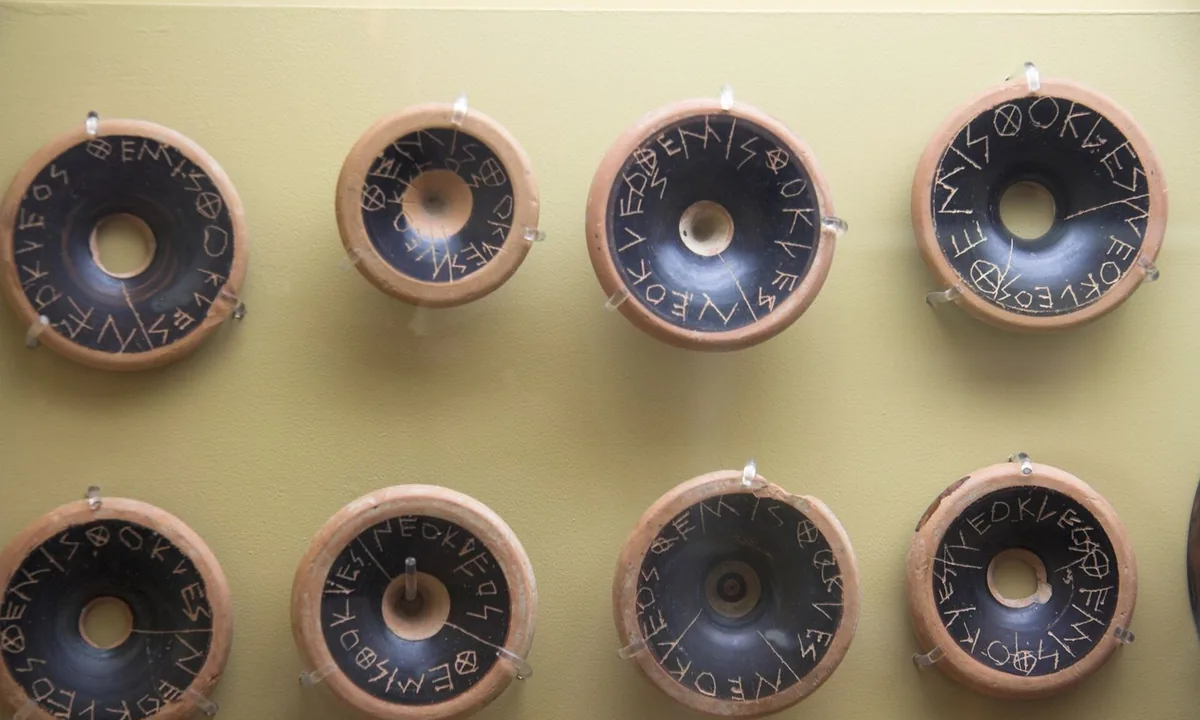
During an ostracism vote, Plutarch says, a farmer who could not write handed his piece of pottery to a stranger and asked him to scratch “Aristides” on it. What had Aristides done to him? Nothing, said the farmer; he was just tired of hearing him called “the Just”. The stranger, who was Aristides, wrote his own name.
The Just
Aristides, son of Lysimachus, was the opposite of Themistocles: cautious, incorruptible, a man of the landowning class. The two clashed for years, and in 482 BCE, as the navy was being built, the Athenians ostracised Aristides.
Plutarch wrote down the story of the farmer about 600 years later, and no one knows if it happened. The votes themselves survive: archaeologists have found thousands of ostraka. In a well on the north slope of the Acropolis lay some 190 cast against Themistocles, many written in the same few handwritings, as if prepared in advance for voters.

Recalled for the emergency
With Xerxes on the march, Athens recalled everyone it had ostracised. Aristides fought at Salamis, landing troops on the islet of Psyttaleia, and in 479 BCE he commanded the 8,000 Athenian hoplites at Plataea. The rivals of the 480s now worked together: Themistocles ran the war at sea, Aristides the politics at home.
Persia had been driven from Greece, but not from the Aegean. The Greek cities of Ionia were rebelling against Persian rule and needed protection.
Sparta's general goes too far
In 478 BCE the Spartan regent Pausanias, the victor of Plataea, led the allied fleet to Cyprus and Byzantium. Thucydides says he behaved more like a tyrant than a general, and Sparta recalled him to face charges, among them plotting with Xerxes. Later, back at Byzantium, he went about in Persian dress with a bodyguard of Medes and Egyptians.
The Ionians asked Athens to take command instead. Sparta, a land power with little wish for long overseas wars, let them go.
An alliance on Delos
The new alliance met on the sacred island of Delos, so historians call it the Delian League. Each member supplied ships or paid money, called phoros, “tribute”. Aristides was trusted to set each city's share; Thucydides gives the first total as 460 talents a year.
Athenian officials, the Treasurers of the Greeks, kept the money in the temple on Delos. The members swore their oath by dropping lumps of iron into the sea: the alliance would last until the iron floated.

From alliance to empire
More and more members found it easier to pay than to build ships, so Athens built them. When Naxos tried to leave, around 470 BCE, the Athenian fleet forced it back; Thucydides calls it the first allied city enslaved against the rules. Around 466 BCE Cimon, son of Miltiades, led the League's fleet to a great victory over Persia at the river Eurymedon in southern Asia Minor. With Persia beaten back, some allies wondered why they still paid, but when Thasos tried to leave in 465 BCE it too was forced back.
In 454 BCE the treasury moved from Delos to Athens, and a sixtieth of each year's tribute went to the goddess Athena. Aristides did not see it: he had died around 467 BCE so poor, Plutarch says, that the city paid his daughters' dowries.

In their own words
“…it was he who made the first assessment of tribute from the various allied states, two years after the battle of Salamis, in the archonship of Timosthenes; and it was he who took the oath of offensive and defensive alliance with the Ionians, on which occasion they cast the masses of iron into the sea.”
Aristotle (attributed), The Athenian Constitution 23.5, c. 330 BCE
Translation by F. G. Kenyon. “He” is Aristides; the archonship of Timosthenes is 478/7 BCE.
Why it happened
- Persia still threatened the newly freed Greek cities of the Aegean.
- The Spartan commander Pausanias behaved so arrogantly that the allies turned to Athens.
- Athens had the largest fleet in Greece, built for Salamis.
What happened next
- The treasury moved to Athens in 454 BCE, and tribute helped pay for Pericles' building programme. Read the story →
- Allies who tried to leave, like Naxos and Thasos, were forced back: the alliance became an empire.
- Sparta's alarm at Athens' growing power led to the Peloponnesian War. Read the story →
Why it still matters
The Delian League's old argument, about who pays for common defence and who decides, runs through NATO, founded in 1949. In 2014 its members agreed to aim to spend 2% of their national income on defence, and whether allies meet that target is still argued over at its summits.
Key people
- Aristides
- Athenian statesman (c. 530–c. 467 BCE) called “the Just”, who set the allies' first tribute
- Themistocles
- His rival, builder of the fleet that won at Salamis
- Pausanias
- Spartan regent, victor of Plataea, whose arrogance drove the allies to Athens
- Cimon
- Son of Miltiades, who led the League's fleets against Persia in the 470s and 460s BCE
Key terms
- Delian League
- The modern name for the alliance Athens led against Persia from 478/7 BCE, with its treasury first on Delos.
- Phoros
- “Tribute”: the money allied cities paid each year instead of supplying ships.
- Talent
- A large unit of silver, about 26 kg: enough to pay a trireme's crew for about a month.
- Ostrakon
- A piece of broken pottery used as a ballot in ostracism votes.
Test yourself
Where was the alliance's treasury kept when it was founded?
- In Athens
- In Sparta
- On the island of Delos
- In Corinth
Show the answer
On the island of Delos. The money and the meetings were on Delos, a sacred island of Apollo, which is why historians call it the Delian League. The treasury moved to Athens in 454 BCE.
The full lesson in the app ends with 5 questions like this one.
Connected stories
- Pericles and the Golden Age of Athens: Tribute from the League helped pay for the Parthenon.
- The Peloponnesian War: Why Athens and Sparta Fought: Thucydides saw Athens' growing empire, and Sparta's fear of it, as the real cause of the war.
- From the Stamp Act to the Tea Party: Athens' allies paid tribute fixed in Athens, where they had no vote; American colonists rejected taxes set by a Parliament where they had no seats.
Frequently asked questions
Why was the Delian League formed?
Persia still threatened the newly freed Greek cities of the Aegean. The Spartan commander Pausanias behaved so arrogantly that the allies turned to Athens. Athens had the largest fleet in Greece, built for Salamis.
How did the Delian League become an Athenian empire?
The treasury moved to Athens in 454 BCE, and tribute helped pay for Pericles' building programme. Allies who tried to leave, like Naxos and Thasos, were forced back: the alliance became an empire. Sparta's alarm at Athens' growing power led to the Peloponnesian War.
Where was the alliance's treasury kept when it was founded?
On the island of Delos. The money and the meetings were on Delos, a sacred island of Apollo, which is why historians call it the Delian League. The treasury moved to Athens in 454 BCE.
What is the main primary source for “Aristides and the Delian League”?
Aristotle (attributed), The Athenian Constitution 23.5 (c. 330 BCE). Translation by F. G. Kenyon. “He” is Aristides; the archonship of Timosthenes is 478/7 BCE.
Sources
- Thucydides, History of the Peloponnesian War 1.94–99
- Aristotle (attributed), The Athenian Constitution, chapters 22–24
- Plutarch, Life of Aristides
- Russell Meiggs, The Athenian Empire (1972)
Images are credited under each picture. Paintings and photographs come from public collections via Wikimedia Commons; scenes with no surviving image are marked as illustrations.
