Ancient Egypt · c. 1353–1336 BCE
Akhenaten and Nefertiti: The Pharaoh Who Changed Egypt's Gods
In short
- Amenhotep IV renamed himself Akhenaten and made the sun disk, the Aten, the centre of Egyptian religion.
- He built a new capital at Amarna, where art and worship broke with tradition; Nefertiti shared his prominence.
- After his death his city was abandoned, the old gods returned and his name was erased.
In about 1346 BCE a king of Egypt sailed north to an empty bay of desert on the east bank of the Nile, about halfway between Thebes and Memphis. Nobody lived there, and no god had ever been worshipped there. He announced that his god had led him to it, and that he would build a city.
A king called Amenhotep
He came to the throne around 1353 BCE as Amenhotep IV, son of the wealthy Amenhotep III. His name meant “Amun is satisfied”. Amun, king of the gods, was worshipped at Karnak in Thebes by the richest priesthood in Egypt.
The new king favoured a different god: the Aten, the visible disk of the sun. Within his first five years he built huge Aten temples at Karnak, then changed his name to Akhenaten, roughly “effective for the Aten”. It was a clear signal that Amun was out.
One god, one city
Akhenaten's new capital, Akhetaten, “Horizon of the Aten”, is known today as Amarna. Boundary stelae carved into the cliffs mark its limits. Its temples had no roofs: the Aten was worshipped in open courts, directly under the sun, at hundreds of offering tables.
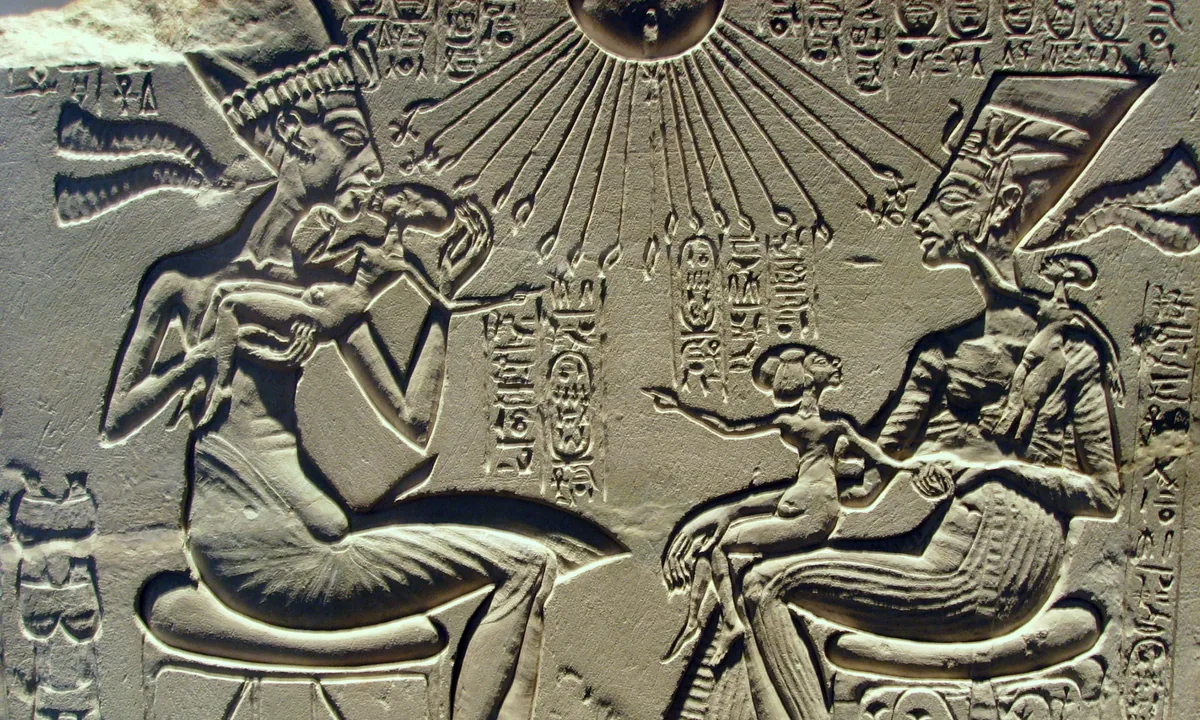
Other gods were not just neglected. Workmen were sent across Egypt to chisel out Amun's name, and sometimes the plural word “gods”. Whether this was true monotheism, belief in only one god, is still argued; what is clear is that the Aten was worshipped through the royal family alone, who were shown as the god's only link with humanity.

Nefertiti
Beside him stood his Great Royal Wife, Nefertiti, “the beautiful one has come”. She appears in Amarna art as almost his equal: offering to the Aten, riding in a chariot, even, on carved temple blocks, striking down enemies, a scene normally reserved for kings. Six daughters were born to the couple.
Around year 12 of the reign, Nefertiti fades from the record. She may have died, or she may have ruled under another name: a mysterious co-ruler called Neferneferuaten appears at the end of the reign, and many Egyptologists think it was her. The question is unresolved.

A new way of seeing
Art changed as fast as religion. Akhenaten was shown with a long face, heavy lips, narrow shoulders and a rounded belly, and his family in relaxed, intimate scenes: kissing their children, eating, playing. Whether this reflects his real body or a religious message is debated.
Amarna also left us its post. In 1887, local people digging at the site found clay tablets in cuneiform: letters from the kings of Babylon, Assyria, Mitanni and the Hittites, and from rulers in Canaan begging for troops. These Amarna letters are one of the first archives of international diplomacy.

Erased
Akhenaten died around 1336 BCE. Within a few years his city was abandoned, the old gods restored and the court back in Memphis and Thebes. His temples were taken apart and their small blocks reused as fill in later buildings, which is how many of his reliefs survived.
Later kings left him out of their lists of rulers. When he had to be mentioned in a legal document, he was “that enemy of Akhetaten”. The boy who restored the old gods was probably his own son.
In their own words
“How manifold are thy works! They are hidden from before (us), O sole God, whose powers no other possesseth. Thou didst create the earth according to thy heart while thou wast alone.”
Attributed to Akhenaten, The Great Hymn to the Aten, tomb of Ay at Amarna, c. 1345 BCE
Translation by J. H. Breasted, Development of Religion and Thought in Ancient Egypt (1912). The hymn is carved in the tomb of the official Ay; it is traditionally credited to Akhenaten himself, but its author is not named.
Why it happened
- Worship of the sun god had been growing under Amenhotep III.
- The priesthood of Amun at Thebes had become rich enough to rival the crown.
- Akhenaten's personal religious conviction, which he imposed with the full power of the state.
What happened next
- His son restored the old gods and changed his name from Tutankhaten to Tutankhamun. Read the story →
- Akhetaten was abandoned and Akhenaten's name was left out of the king lists.
- The Amarna letters became a key source for the diplomacy of the Late Bronze Age.
Why it still matters
The bust of Nefertiti, found by Ludwig Borchardt's German team in 1912, draws visitors to the Neues Museum in Berlin, and Egypt has repeatedly asked for it back. Egyptian campaigners argue it left the country through a lopsided division of finds; Berlin says the division was legal.
Key people
- Akhenaten
- Pharaoh (c. 1353–1336 BCE), born Amenhotep IV, who made the Aten the focus of Egyptian religion
- Nefertiti
- His Great Royal Wife, shown in unusually powerful roles; possibly ruled after him
- Amenhotep III
- His father, whose long, rich reign left Egypt at the height of its wealth
- Tutankhamun
- Probably Akhenaten's son; as king he restored the old gods
- Thutmose
- Sculptor whose Amarna workshop held the bust of Nefertiti
Key terms
- Aten
- The disk of the sun, worshipped by Akhenaten as the source of all life, shown with rays ending in hands.
- Amarna
- The modern name of Akhetaten, Akhenaten's capital, and of the art style of his reign.
- Monotheism
- Belief in a single god; whether Akhenaten's religion counts as monotheism is debated.
- Amarna letters
- About 380 cuneiform tablets of diplomatic correspondence found at Amarna in 1887.
Test yourself
What was the Aten?
- A jackal-headed god of the dead
- The visible disk of the sun
- The ram-headed king of the gods
- A falcon god of kingship
Show the answer
The visible disk of the sun. The Aten was the disk of the sun, shown with rays ending in hands that offer life to the royal family. Amun, whom Akhenaten rejected, was the king of the gods.
The full lesson in the app ends with 5 questions like this one.
Connected stories
- Hatshepsut: The Woman Who Became King: Like Hatshepsut, Akhenaten was erased by those who came after him.
- Tutankhamun: The Boy King and the Hidden Tomb: Tutankhamun reversed Akhenaten's religious reforms.
- Canossa: A King in the Snow: Akhenaten made himself the only link to his god; in 1077 a pope forced an emperor to kneel in the snow over who controlled the Church.
Frequently asked questions
Why did Akhenaten change Egypt's religion?
Worship of the sun god had been growing under Amenhotep III. The priesthood of Amun at Thebes had become rich enough to rival the crown. Akhenaten's personal religious conviction, which he imposed with the full power of the state.
What happened after Akhenaten died?
His son restored the old gods and changed his name from Tutankhaten to Tutankhamun. Akhetaten was abandoned and Akhenaten's name was left out of the king lists. The Amarna letters became a key source for the diplomacy of the Late Bronze Age.
What was the Aten?
The visible disk of the sun. The Aten was the disk of the sun, shown with rays ending in hands that offer life to the royal family. Amun, whom Akhenaten rejected, was the king of the gods.
What is the main primary source for “Akhenaten and Nefertiti: The Sun-Disk Revolution”?
Attributed to Akhenaten, The Great Hymn to the Aten, tomb of Ay at Amarna (c. 1345 BCE). Translation by J. H. Breasted, Development of Religion and Thought in Ancient Egypt (1912). The hymn is carved in the tomb of the official Ay; it is traditionally credited to Akhenaten himself, but its author is not named.
Sources
- Cyril Aldred, Akhenaten: King of Egypt (1988)
- Joyce Tyldesley, Akhenaten and Nefertiti: Egypt's Golden Couple (2005)
- William L. Moran (ed. and trans.), The Amarna Letters (1992)
- Erik Hornung, Akhenaten and the Religion of Light (1999)
Images are credited under each picture. Paintings and photographs come from public collections via Wikimedia Commons; scenes with no surviving image are marked as illustrations.
