Ancient Egypt · c. 1332–1323 BCE; tomb found 1922
How Did King Tut Die? Tutankhamun and His Tomb
In short
- Tutankhamun, probably Akhenaten's son, became king as a child and restored the old gods.
- He died at about nineteen; a leg fracture and malaria are the leading explanation, and murder is unproven.
- Howard Carter found his nearly intact tomb in 1922; the “curse” was a newspaper invention.
On 26 November 1922, Howard Carter made a small hole in a sealed doorway in the Valley of the Kings and held up a candle. Behind him, his patron Lord Carnarvon asked whether he could see anything. For a moment, Carter could not speak.
Born into a revolution
He was born around 1341 BCE as Tutankhaten, “living image of the Aten”, probably in Akhenaten's desert capital. DNA tests published in 2010 suggest his father was the man buried in tomb KV55, very likely Akhenaten, and his mother a full sister of that man.
He became king at about eight or nine years old, married to Akhenaten's daughter Ankhesenpaaten. Real power lay with older advisers, above all the official Ay and the general Horemheb.
Undoing his father's work
Within a few years the king and queen changed their names to Tutankhamun and Ankhesenamun, honouring Amun again. The court left Amarna. A stela set up at Karnak described the land in crisis, the temples abandoned and the gods turned away from Egypt, and announced their restoration.
Tutankhamun ruled for about nine or ten years. He was not a great conqueror or builder; his historical importance is that he presided over the return to the old order.

How did he die?
Tutankhamun died around 1323 BCE, aged about eighteen or nineteen. An X-ray in 1968 found bone fragments inside his skull, and a murder theory was born; later CT scans showed the damage most likely happened during embalming or Carter's examination.
The 2010 study found a broken left thigh bone that had not healed, signs of bone disease in his feet, and DNA of the parasite that causes severe malaria. Its authors concluded that bone disease and malaria, perhaps after a leg fracture, most likely killed him; others have suggested a chariot accident. There is no proof he was murdered, and no single answer.
“Wonderful things”
Tutankhamun was buried in a small tomb, KV62, possibly made for someone else. Robbers broke in soon after but were caught, and the tomb was resealed. About two centuries later, workmen cutting the tomb of Ramses VI dumped rubble and built huts over its entrance. That hid it.
Carter, funded by the Earl of Carnarvon, had searched the Valley for years. On 4 November 1922 his workmen found a step. Three weeks later he looked inside by candlelight. His famous reply, “wonderful things”, comes from his published book; his own notebook records something plainer. Clearing the more than 5,000 objects took him ten years. They included chariots, trumpets, a lock of his grandmother Tiye's hair and two tiny coffins holding stillborn babies, probably his daughters.

The curse that wasn't
On 5 April 1923, Lord Carnarvon died in Cairo of blood poisoning after an infected mosquito bite. Newspapers, shut out of the dig by Carnarvon's exclusive deal with The Times, filled the gap with tales of a pharaoh's curse.
No curse inscription was found in the tomb. Most of the people present at its opening lived for years; Carter himself died in London in 1939, seventeen years later. The real legacy was different: a nearly intact royal burial that showed the world what the richest tombs had held.

In their own words
“…as my eyes grew accustomed to the light, details of the room within emerged slowly from the mist, strange animals, statues, and gold—everywhere the glint of gold.”
Howard Carter, The Tomb of Tut.ankh.Amen, vol. 1, ch. 5, 1923
Written with A. C. Mace for publication a year after the discovery. The book has Carter answer “Yes, wonderful things”; his own journal for 26 November 1922 records “Yes, it is wonderful.”
Why it happened
- Akhenaten's religious revolution had disrupted temples, priests and the economy.
- A child on the throne left power with experienced officials who favoured the old order.
- Rubble and workmen's huts from a later royal tomb hid the entrance to KV62.
What happened next
- Amun and the traditional gods were restored, and Akhenaten's memory was condemned. Read the story →
- Tutankhamun's general Horemheb became king and was followed by the family of Ramses I. Read the story →
- The 1922 discovery set off a worldwide craze for Egypt in design, film and fashion.
Why it still matters
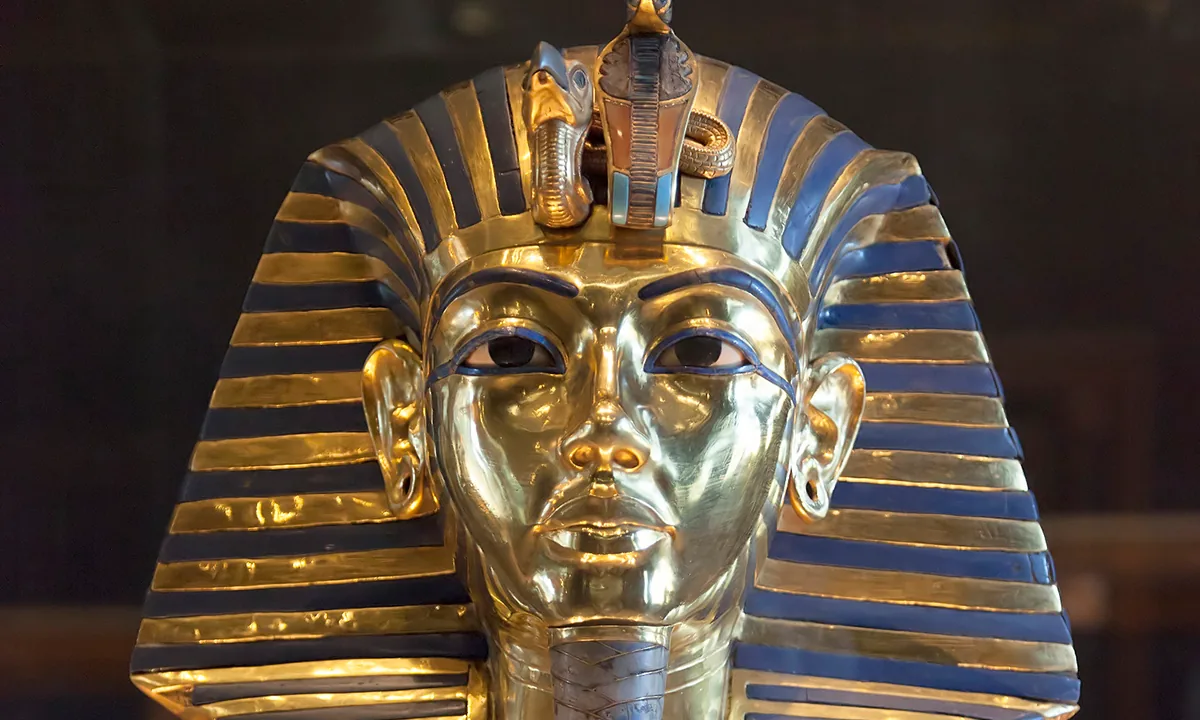
Tutankhamun's complete burial treasure went on display together for the first time at the Grand Egyptian Museum near the Giza pyramids, which formally opened in November 2025. The gold mask, the coffins and thousands of objects Carter catalogued now share one building.
Key people
- Tutankhamun
- Pharaoh c. 1332–1323 BCE, who restored the old gods after Akhenaten
- Ankhesenamun
- His wife, a daughter of Akhenaten and Nefertiti
- Ay
- Senior official who succeeded Tutankhamun as king
- Howard Carter
- British archaeologist who found the tomb in 1922 and spent ten years clearing it
- Lord Carnarvon
- Carter's patron, who funded the excavation and died in Cairo in April 1923
Key terms
- Valley of the Kings
- A desert valley on the west bank at Thebes (Luxor) where New Kingdom kings were buried c. 1550–1070 BCE.
- KV62
- The official number of Tutankhamun's tomb: the 62nd tomb recorded in the Kings' Valley.
- Restoration Stela
- A decree of Tutankhamun set up at Karnak announcing the return of the old gods and the repair of their temples.
- Malaria tropica
- The most dangerous form of malaria, whose parasite DNA was identified in Tutankhamun's mummy in 2010.
Test yourself
What does the 2010 study suggest contributed most to Tutankhamun's death?
- A blow to the back of the head
- Poison given by his successor Ay
- A leg fracture and bone disease, with malaria
- A wound from an arrow in battle
Show the answer
A leg fracture and bone disease, with malaria. The team found bone disease, an unhealed broken thigh bone and malaria parasite DNA. The skull fragments behind the old murder theory are now thought to come from embalming or later handling.
The full lesson in the app ends with 5 questions like this one.
Connected stories
- Akhenaten and Nefertiti: The Sun-Disk Revolution: Tutankhamun's reign was spent undoing his father's religious revolution.
- Mummies: Seventy Days to Eternity: His mummy, canopic shrine and coffins are the most complete royal burial ever found.
- The Rosetta Stone: Cracking the Code of the Pharaohs: Carter could read the names in the tomb thanks to Champollion's decipherment a century earlier.
Frequently asked questions
Why did Tutankhamun undo Akhenaten's reforms, and how did his tomb survive?
Akhenaten's religious revolution had disrupted temples, priests and the economy. A child on the throne left power with experienced officials who favoured the old order. Rubble and workmen's huts from a later royal tomb hid the entrance to KV62.
What did Tutankhamun change as king?
Amun and the traditional gods were restored, and Akhenaten's memory was condemned. Tutankhamun's general Horemheb became king and was followed by the family of Ramses I. The 1922 discovery set off a worldwide craze for Egypt in design, film and fashion.
Why did the king change his name from Tutankhaten to Tutankhamun?
To honour Amun as the old gods were restored. “Tutankhaten” honoured the Aten. The new name honoured Amun, signalling the end of Akhenaten's revolution.
What is the main primary source for “Tutankhamun: The Boy King and the Hidden Tomb”?
Howard Carter, The Tomb of Tut.ankh.Amen, vol. 1, ch. 5 (1923). Written with A. C. Mace for publication a year after the discovery. The book has Carter answer “Yes, wonderful things”; his own journal for 26 November 1922 records “Yes, it is wonderful.”
Sources
- Howard Carter and A. C. Mace, The Tomb of Tut.ankh.Amen, vol. 1 (1923)
- Nicholas Reeves, The Complete Tutankhamun (1990; 2nd ed. 2022)
- Zahi Hawass et al., Ancestry and Pathology in King Tutankhamun's Family, JAMA 303 (2010)
- Joyce Tyldesley, Tutankhamun: The Search for an Egyptian King (2012)
Images are credited under each picture. Paintings and photographs come from public collections via Wikimedia Commons; scenes with no surviving image are marked as illustrations.
