Ancient Egypt · c. 1479–1458 BCE
Who Was Hatshepsut? The Woman Who Became Pharaoh
In short
- Hatshepsut was regent for her young stepson Thutmose III, then had herself crowned king around 1472 BCE.
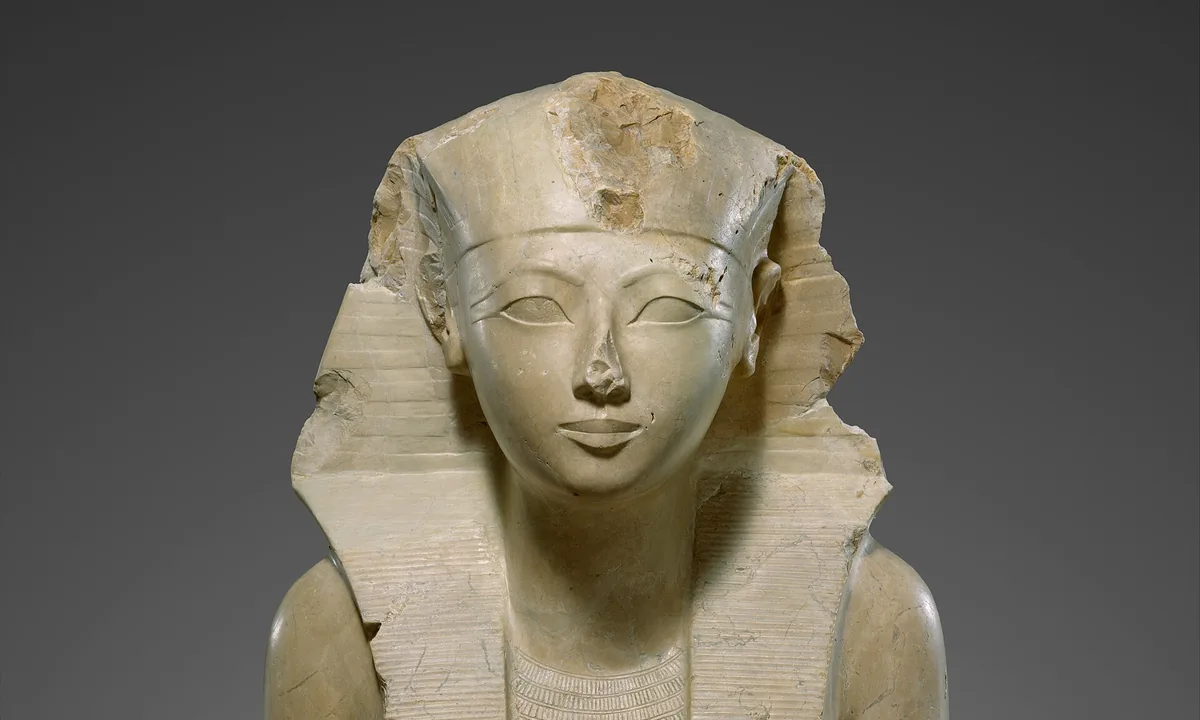
- She was shown with a king's regalia and false beard because Egypt had no image of a female ruler.
- Her images were erased some twenty years after her death, probably for political reasons rather than revenge.
Last time: Egyptian embalmers spent seventy days preparing a body for eternity.
Some twenty years after Hatshepsut died, workmen went through her temple with chisels. They hacked her face from statues, cut her name out of the walls and dumped her sphinxes in a quarry. For three thousand years it almost worked.
A queen without a son
Hatshepsut was the daughter of the warrior king Thutmose I. Following royal custom she married her half-brother, Thutmose II, and became his Great Royal Wife. They had a daughter, Neferure, but no son.
When Thutmose II died young, around 1479 BCE, the heir was his son by a lesser wife: Thutmose III, a small child. Hatshepsut ruled for him as regent, as queens had done before. That should have been the end of the story.
Putting on the crown
Within about seven years, Hatshepsut had herself crowned as king, with the full royal titles. Thutmose III was not removed: he remained co-king, but she was clearly the senior partner.
Egyptian had no word for a female king, and royal art had no image of one. At first she was shown as a woman wearing royal regalia; later, increasingly, with a man's body, a king's kilt and the ceremonial false beard. Her inscriptions still used feminine grammar. She was not pretending to be a man; she was using the only picture of kingship Egypt had.

Building and trading
Hatshepsut's reign was mostly peaceful and very rich. Her architect Senenmut built her a temple at Deir el-Bahari, Djeser-djeseru, “Holiest of Holies”: colonnaded terraces rising against the cliffs of western Thebes. At Karnak she raised obelisks almost 30 metres tall; one still stands. On her temple walls she had her own divine birth carved: the god Amun, in the form of her father, visiting her mother.
Her most famous venture was an expedition by ship to Punt, a land somewhere on the southern Red Sea coast. Her temple reliefs show the sailors bringing back myrrh trees in baskets, ebony, ivory, gold, panther skins and baboons.

Why erase her?
Hatshepsut died around 1458 BCE, and Thutmose III ruled alone for over thirty more years, leading campaigns deep into Syria. Late in his reign, about twenty years after her death, her images were destroyed and her name replaced with those of her husband and father.
Older books explained this as revenge by a stepson who hated her. The timing argues against that: he waited two decades. Many historians now think the aim was political, to remove an awkward precedent, a woman as king, and make sure the throne passed smoothly to his own son, Amenhotep II.
Found again
The erasure was thorough enough that Hatshepsut vanished from the king lists later Egyptians kept. Archaeologists of the 19th century had to piece her together from broken statues and scratched-out cartouches; the Met's excavators reassembled her sphinxes from fragments in the 1920s.
In 2007, Egyptian researchers announced that an unnamed mummy from a small tomb in the Valley of the Kings was Hatshepsut, matched by a tooth found in a box inscribed with her name. Not every scholar is convinced, but the woman someone tried to delete is now among the best-known rulers of Egypt.

In their own words
“Hear ye, all persons! ye people as many as ye are! I have done this according to the design of my heart. I have restored that which was ruins, I have raised up that which was unfinished since the Asiatics were in the midst of Avaris of the Northland…”
Hatshepsut, Inscription of the Speos Artemidos (rock temple of Pakhet, near Beni Hasan), c. 1470 BCE
Translation by J. H. Breasted, Ancient Records of Egypt, vol. II §303 (1906). The “Asiatics” are the Hyksos, foreign kings driven out about 70 years before her reign; she presents herself as the restorer of order.
Why it happened
- Thutmose II died leaving only a young son by a minor wife.
- As regent, Hatshepsut already controlled the court, the treasury and the priesthood of Amun.
- Stressing her royal blood as Thutmose I's daughter let her claim the throne in her own right.
What happened next
- Her trade and building programme made Thebes and Karnak the religious heart of the New Kingdom.
- Thutmose III later had her images erased, and she disappeared from the official king lists.
- About a century later another royal woman, Nefertiti, would hold unusual power beside her husband. Read the story →
Why it still matters
One of Hatshepsut's obelisks still stands at Karnak, and her rebuilt sphinxes and statues fill a gallery at the Metropolitan Museum of Art in New York. Each was assembled from fragments dug out of the pits where Thutmose III's workmen had thrown them.
Key people
- Hatshepsut
- Queen and then king of Egypt, c. 1479–1458 BCE
- Thutmose III
- Her stepson and co-king, who ruled alone after her and later had her images erased
- Senenmut
- Hatshepsut's steward and architect, linked to her temple at Deir el-Bahari
- Thutmose I
- Her father, a warrior king whose legitimacy she stressed in her own inscriptions
Key terms
- Regent
- Someone who rules on behalf of a monarch who is too young or unable to rule.
- Great Royal Wife
- The principal queen of an Egyptian king, ranking above his other wives.
- Damnatio memoriae
- A modern Latin term for deliberately erasing a person's name and images from the record.
- Punt
- A land of incense, gold and exotic animals, probably on the southern Red Sea coast of Africa or Arabia.
Test yourself
How did Hatshepsut first come to rule Egypt?
- She led an army against her brother
- The priests of Amun elected her
- She was regent for her young stepson
- Her father named her as his heir
Show the answer
She was regent for her young stepson. When Thutmose II died, his heir Thutmose III was a small child. Hatshepsut ruled for him as regent before having herself crowned king.
The full lesson in the app ends with 5 questions like this one.
Connected stories
- Akhenaten and Nefertiti: The Sun-Disk Revolution: Later kings also had rivals erased: Akhenaten's own name was removed from the king lists after him.
- Cleopatra: The Last Queen of Egypt: Some 1,400 years later Cleopatra VII ruled Egypt as queen, never needing to appear as a man.
- Magna Carta, 1215: Hatshepsut's power rested on royal blood and religion; Magna Carta tried to bind a king by written law.
Frequently asked questions
How did Hatshepsut become pharaoh?
Thutmose II died leaving only a young son by a minor wife. As regent, Hatshepsut already controlled the court, the treasury and the priesthood of Amun. Stressing her royal blood as Thutmose I's daughter let her claim the throne in her own right.
What happened to Hatshepsut after her death?
Her trade and building programme made Thebes and Karnak the religious heart of the New Kingdom. Thutmose III later had her images erased, and she disappeared from the official king lists. About a century later another royal woman, Nefertiti, would hold unusual power beside her husband.
How did Hatshepsut first come to rule Egypt?
She was regent for her young stepson. When Thutmose II died, his heir Thutmose III was a small child. Hatshepsut ruled for him as regent before having herself crowned king.
What is the main primary source for “Hatshepsut: The Woman Who Became King”?
Hatshepsut, Inscription of the Speos Artemidos (rock temple of Pakhet, near Beni Hasan) (c. 1470 BCE). Translation by J. H. Breasted, Ancient Records of Egypt, vol. II §303 (1906). The “Asiatics” are the Hyksos, foreign kings driven out about 70 years before her reign; she presents herself as the restorer of order.
Sources
- Joyce Tyldesley, Hatchepsut: The Female Pharaoh (1996)
- Catharine H. Roehrig (ed.), Metropolitan Museum of Art, Hatshepsut: From Queen to Pharaoh (2005)
- Kara Cooney, The Woman Who Would Be King (2014)
Images are credited under each picture. Paintings and photographs come from public collections via Wikimedia Commons; scenes with no surviving image are marked as illustrations.
