Ancient Egypt · c. 2600 BCE to the 4th century CE
Why Did the Egyptians Mummify Their Dead? The Mummification Process
In short
- Egyptians preserved bodies so that the soul (ka and ba) could return to them in the afterlife.
- Full mummification took seventy days: brain and organs removed, the body dried in natron, then oiled and wrapped.
- The heart stayed in the body to be weighed in judgement against the feather of truth.
Last time: tens of thousands of workers raised the Great Pyramid as a tomb for one king, Khufu.
The embalmer slid a long bronze hook up the dead man's nose, broke through the thin bone behind it and began to pull out the brain. It was the first step of seventy days of work, and in Egyptian belief the most important journey the man would ever take depended on getting it right.
Why keep a body?
Egyptians believed a person was made of several parts. Two of them, the ka (life force) and the ba (personality, shown as a bird with a human head), lived on after death but needed to return to the body. If the body rotted away, they had nowhere to come home to.
The desert taught them that bodies could last. The earliest Egyptians were buried in shallow pits in hot, dry sand, which dried them out naturally. One such man, buried at Gebelein around 3500 BCE, can still be seen in the British Museum, skin and hair intact.
Learning to do it on purpose
Ironically, better tombs made things worse: bodies laid in coffins and chambers, away from the drying sand, decayed. Embalmers spent centuries finding a fix.
The oldest evidence that organs were removed comes from the tomb of Queen Hetepheres, Khufu's mother, around 2600 BCE. Her body was never found, but a chest held packages of her internal organs, still soaking in natron solution. By the New Kingdom, around 1500 BCE, embalming had become a refined and expensive craft.
Seventy days
Our fullest description comes from Herodotus, who was told about it in the 5th century BCE. Embalmers drew out the brain, which they thought useless, cut open the left side, and removed the lungs, liver, stomach and intestines. The heart, seat of thought and memory, stayed inside.
The body was then packed and covered with natron, a natural salt from desert lakes, for about forty days until it was completely dry. Over the remaining weeks it was cleaned, oiled with resins, padded, and wrapped in hundreds of square metres of linen with protective amulets tucked between the layers. The whole process took seventy days.

Jars, spells and a scale
The organs were dried and stored in four canopic jars, each guarded by a son of the god Horus: human-headed Imsety for the liver, baboon-headed Hapy for the lungs, jackal-headed Duamutef for the stomach, falcon-headed Qebehsenuef for the intestines.
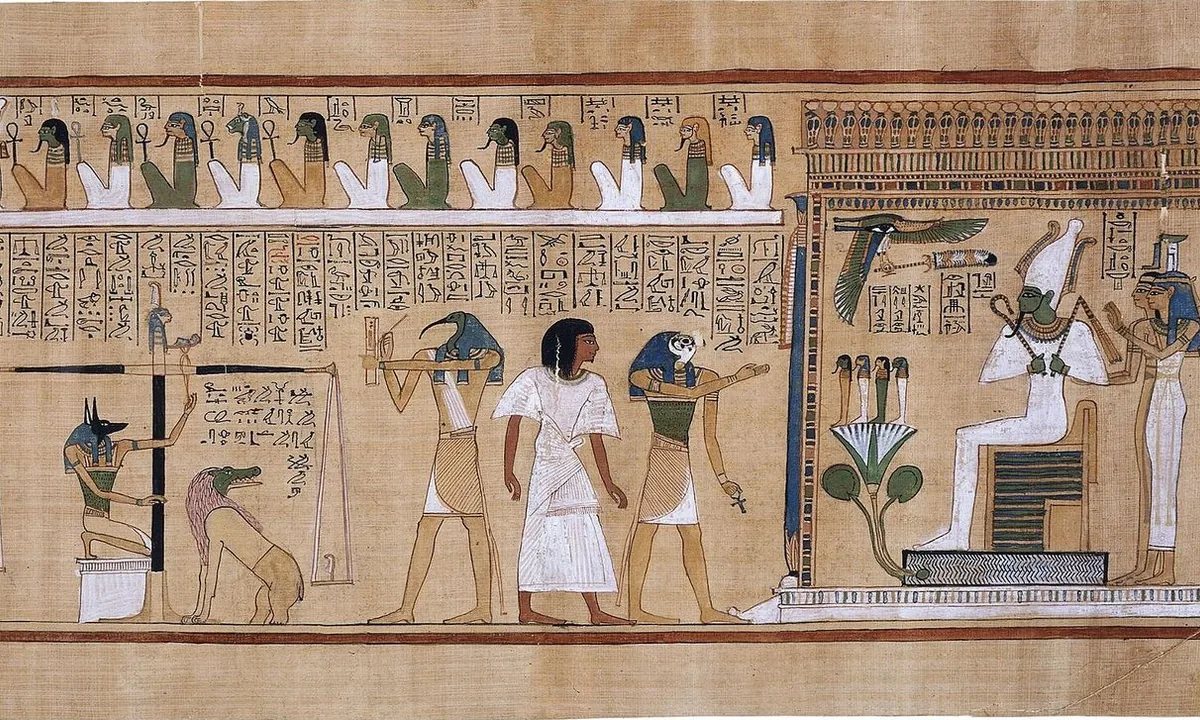
The dead then faced judgement. In the Book of the Dead, a collection of spells buried with the mummy, the heart is weighed against the feather of Maat, truth. A heart heavy with wrongdoing is eaten by Ammit, part crocodile, part lion, part hippopotamus. Spells were included to stop the heart from speaking against its owner.

Not only for kings
Over time, mummification spread from kings to officials and to anyone who could pay; Herodotus describes cheaper methods using cedar oil or a simple purge. Egyptians also mummified animals in their millions: cats for the goddess Bastet, ibises for Thoth, even crocodiles, many sold to pilgrims as offerings.
The practice faded only as Christianity spread in the 4th century CE. Mummies then lived a strange afterlife: Europeans ground them into a medicine called “mummia” for centuries, and Victorian audiences paid to watch them unwrapped. Today CT scanners let researchers look inside without unwrapping anything.

In their own words
“…they first draw out part of the brain through the nostrils with an iron hook… Then, making a cut near the flank with a sharp knife of Ethiopian stone, they take out all the intestines… After doing this, they conceal the body for seventy days, embalmed in saltpetre.”
Herodotus, Histories 2.86, c. 430 BCE
Translation by A. D. Godley (Loeb Classical Library, 1920); his “saltpetre” is natron. Herodotus describes the most expensive of three methods. Egyptian evidence suggests about forty days of drying within a seventy-day process.
Why it happened
- Belief that the ka and ba needed an intact body to return to after death.
- Natural mummies in desert graves showed that bodies could survive if dried.
- Burial in coffins and tombs caused decay, pushing embalmers to develop artificial methods.
What happened next
- Royal mummies hidden by priests survived to be identified in modern times, including Ramses II. Read the story →
- Tutankhamun's mummy, studied by X-ray, CT and DNA, became a key to how he lived and died. Read the story →
- Animal mummification grew into a vast religious industry in the last centuries BCE.
Why it still matters
In 2021 Egypt moved 22 royal mummies, including Ramses II and Hatshepsut, from the old Egyptian Museum to the new National Museum of Egyptian Civilization in a televised night parade through Cairo, each in a climate-controlled capsule on its own truck.
Key people
- Anubis
- Jackal-headed god of embalming and cemeteries, often shown tending the mummy
- Hetepheres I
- Queen, mother of Khufu (c. 2600 BCE); her canopic chest is the oldest evidence of organ removal
- Herodotus
- Greek historian whose account of three grades of embalming is the fullest ancient description
- Hunefer
- Royal scribe under Seti I whose illustrated Book of the Dead shows the weighing of the heart
Key terms
- Natron
- A natural mixture of salts from desert lake beds, used to dry out the body.
- Canopic jars
- Four containers for the embalmed liver, lungs, stomach and intestines, protected by the four sons of Horus.
- Book of the Dead
- A collection of spells written on papyrus and buried with the dead to guide them through the afterlife.
- Ka and ba
- Two parts of the Egyptian soul: the life force and the personality, which needed a preserved body to return to.
Test yourself
Which organ did embalmers deliberately leave inside the body?
- The heart
- The brain
- The liver
- The lungs
Show the answer
The heart. The heart was the seat of thought and memory, and it would be weighed in the judgement of the dead. The brain was thrown away.
The full lesson in the app ends with 5 questions like this one.
Connected stories
- How the Great Pyramid Was Built: The oldest evidence of organ removal comes from the burial of Khufu's mother.
- Tutankhamun: The Boy King and the Hidden Tomb: Tutankhamun's tomb held his canopic shrine, his mummy and more than 5,000 objects for the afterlife.
- Ramses II: Kadesh, a Peace Treaty and a Giant Ego: Ramses II's mummy survived because priests reburied it in a hidden cache, and in 1976 it was flown to Paris for conservation.
Frequently asked questions
Why did the ancient Egyptians mummify their dead?
Belief that the ka and ba needed an intact body to return to after death. Natural mummies in desert graves showed that bodies could survive if dried. Burial in coffins and tombs caused decay, pushing embalmers to develop artificial methods.
What became of Egypt's mummies?
Royal mummies hidden by priests survived to be identified in modern times, including Ramses II. Tutankhamun's mummy, studied by X-ray, CT and DNA, became a key to how he lived and died. Animal mummification grew into a vast religious industry in the last centuries BCE.
Why did Egyptians go to such lengths to preserve the body?
They believed the soul needed the body to return to. The ka and ba survived death but needed a recognisable body to come back to. Without it, the person's eternal life was at risk.
What is the main primary source for “Mummies: Seventy Days to Eternity”?
Herodotus, Histories 2.86 (c. 430 BCE). Translation by A. D. Godley (Loeb Classical Library, 1920); his “saltpetre” is natron. Herodotus describes the most expensive of three methods. Egyptian evidence suggests about forty days of drying within a seventy-day process.
Sources
- Herodotus, Histories, Book 2.85–2.90
- Françoise Dunand and Roger Lichtenberg, Mummies and Death in Egypt (2006)
- Salima Ikram and Aidan Dodson, The Mummy in Ancient Egypt: Equipping the Dead for Eternity (1998)
- R. O. Faulkner (trans.), ed. Carol Andrews, The Ancient Egyptian Book of the Dead (1985)
Images are credited under each picture. Paintings and photographs come from public collections via Wikimedia Commons; scenes with no surviving image are marked as illustrations.
