Medieval Europe · 1095–1099
The First Crusade: Why It Started and What Happened
In short
- A Byzantine appeal for soldiers became, in Urban II's hands, an armed pilgrimage to Jerusalem in 1095.
- Crusaders went mainly for religious reasons, and paid heavily to go; on the way, some massacred Rhineland Jews.
- After the long siege of Antioch, the crusaders stormed Jerusalem on 15 July 1099 and massacred many of its people.
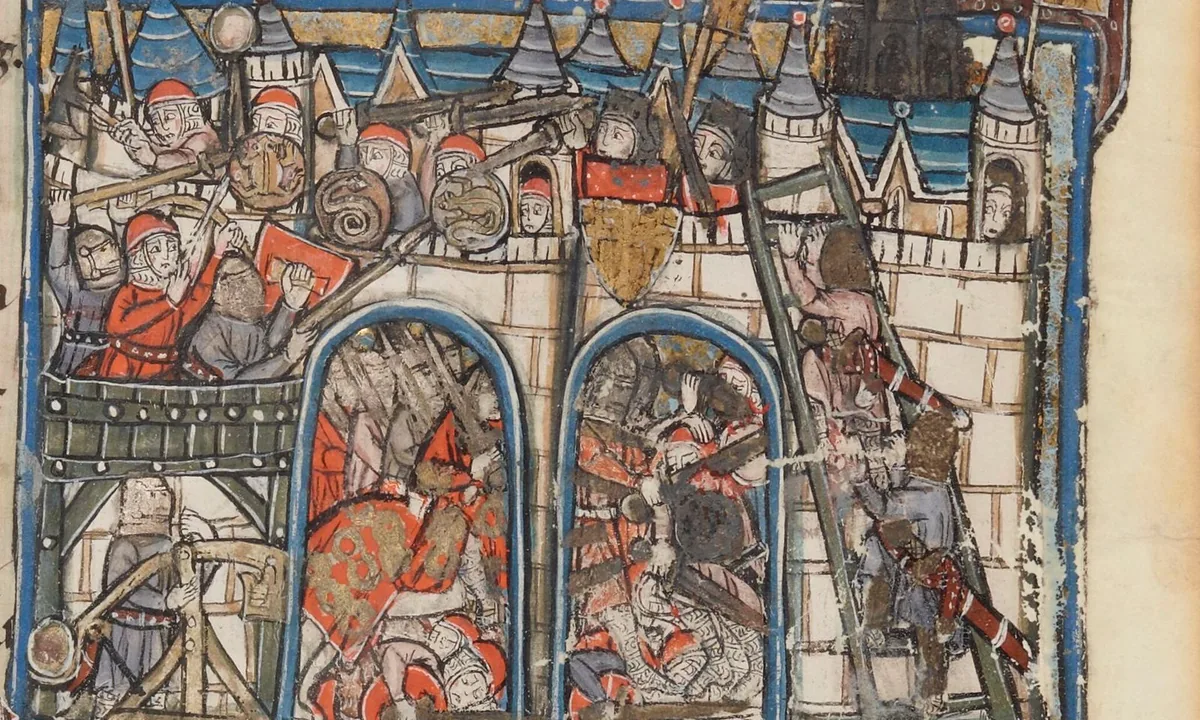
On 27 November 1095, in a field outside Clermont in central France, Pope Urban II urged the knights of the West to march east. No text of his speech survives. Every version we have was written later, by men who already knew that the crusaders had taken Jerusalem.
A request from Constantinople
The call began in the East. After their victory at Manzikert in 1071, Seljuk Turks had overrun most of Anatolia, the heartland of the eastern Roman Empire. In March 1095 envoys of the emperor Alexios I Komnenos asked a church council at Piacenza for Western soldiers.
Urban turned a request for mercenaries into something far larger: an armed pilgrimage to free Jerusalem, in Muslim hands since 638. He offered those who went release from the penance owed for their sins. For a pope whose authority was challenged by an imperial antipope, leading Christendom's knights was also a powerful statement.

Why did they go?
Tens of thousands took the cross, sewing a cloth cross onto their clothes. Historians once assumed they were landless younger sons hoping for loot. Studies of charters by Jonathan Riley-Smith and others show that crusading was ruinously expensive, and families sold or mortgaged land to pay for it. Most went for religious reasons, to do penance and see the holy places, though many hoped for plunder too.
The first to leave were crowds following preachers such as Peter the Hermit. In the spring and summer of 1096, bands of crusaders massacred Jewish communities in the Rhineland cities of Speyer, Worms and Mainz. The popular armies that reached Anatolia were destroyed by the Turks in October 1096.

The long road to Antioch
The main armies, led by great nobles such as Godfrey of Bouillon, Raymond of Toulouse, Bohemond of Taranto and William the Conqueror's son Robert of Normandy, gathered at Constantinople in 1096–97. With Byzantine help they took Nicaea and beat the Turks at Dorylaeum, then suffered terribly crossing Anatolia in the summer heat.
Antioch held out for eight months. Bohemond got in by bribing a tower commander on 3 June 1098, only for the crusaders to be besieged in turn by a huge relief army. Starving, and inspired by the discovery of what they believed was the Holy Lance, they marched out and won on 28 June. Bohemond kept the city, breaking the oaths the leaders had sworn to Alexios.

Jerusalem, July 1099
When the surviving crusaders, perhaps 15,000 of them, reached Jerusalem in June 1099, the city was held not by the Turks but by the Fatimid rulers of Egypt. After a failed first assault they built siege towers, partly from the timbers of Genoese ships, and broke in on 15 July.
A massacre followed. Christian chroniclers boasted of men wading in blood, an image borrowed from the Bible. Later Arab writers put the dead at 70,000, far too many; a near-contemporary Muslim source suggests about 3,000 were killed at the al-Aqsa mosque. Jews who sheltered in a synagogue were burned inside it. Godfrey became ruler of Jerusalem, one of four crusader states in the Levant.
What the crusade was not
The word “crusade” came later; the men of 1099 called themselves pilgrims, or those “signed with the cross”. Arabic writers called them Franks. Nor was this a simple clash of civilisations. The Muslim Near East was divided between rival Seljuk princes and the Fatimids, which helps explain the crusaders' success, and alliances across faith lines were common in the decades that followed.
Arabic historians had no special name for these wars until the 19th century, when writers reading European histories adopted one. Saladin retook Jerusalem in 1187, and no later crusade matched the first.
In their own words
“Let those who have been accustomed unjustly to wage private warfare against the faithful now go against the infidels and end with victory this war which should have been begun long ago. Let those who for a long time have been robbers now become knights.”
Fulcher of Chartres, A History of the Expedition to Jerusalem (Historia Hierosolymitana) 1.3, c. 1101–1127
Translation by Frances Rita Ryan, edited by Harold S. Fink (1969). Fulcher was probably at Clermont and went on the crusade himself, but he wrote this version of Urban's speech several years later, after Jerusalem had fallen.
Why it happened
- Seljuk conquests in Anatolia led the Byzantine emperor to ask the West for soldiers.
- Urban II wanted to assert papal leadership of Western Christendom against an imperial antipope.
- A culture of penance and pilgrimage made an armed pilgrimage to Jerusalem a compelling idea for knights.
What happened next
- Four crusader states were founded in the Levant, the last of which fell in 1291.
- Italian ports such as Venice, Genoa and Pisa expanded their trade with the eastern Mediterranean.
- Saladin retook Jerusalem in 1187, and later crusades failed to hold it for long.
Why it still matters
On 16 September 2001, five days after the attacks on New York and Washington, President George W. Bush called the coming campaign against terrorism a “crusade”. The White House quickly dropped the word after protests from Muslim and European allies, for whom it recalled the slaughter in Jerusalem in 1099 rather than a just cause.
Key people
- Pope Urban II
- Pope (1088–99) who preached the crusade at Clermont in 1095; he died days after Jerusalem fell, before the news reached him
- Alexios I Komnenos
- Byzantine emperor (1081–1118) whose appeal for soldiers set the crusade in motion
- Peter the Hermit
- Popular preacher who led one of the first, ill-fated crusading armies
- Godfrey of Bouillon
- Crusade leader who became the first Latin ruler of Jerusalem in 1099
- Bohemond of Taranto
- Norman leader from southern Italy who won Antioch and kept it for himself
Key terms
- Taking the cross
- Vowing to go on crusade, marked by sewing a cloth cross onto one's clothes; crusaders were crucesignati, “signed with the cross”.
- Indulgence
- Remission of the penance owed for confessed sins; Urban offered it to those who went to Jerusalem.
- Seljuk Turks
- Turkish dynasty that conquered Persia, Iraq and most of Anatolia in the 11th century.
- Fatimids
- Shia Muslim dynasty ruling Egypt, rivals of the Seljuks; they held Jerusalem when the crusaders arrived.
- Crusader states
- The four Latin states founded after the First Crusade: Edessa, Antioch, Tripoli and Jerusalem.
Test yourself
Who held Jerusalem when the crusaders arrived in 1099?
- The Seljuk sultan of Rum
- The Byzantine emperor Alexios
- The Fatimid rulers of Egypt
- The Abbasid caliph of Baghdad
Show the answer
The Fatimid rulers of Egypt. The Fatimids of Egypt had taken Jerusalem from the Seljuks in 1098, the year before the crusaders arrived. The Muslim world's divisions helped the crusaders succeed.
The full lesson in the app ends with 5 questions like this one.
Connected stories
- Canossa: A King in the Snow: Urban II was Gregory VII's successor; leading a crusade strengthened his hand against Henry IV's antipope.
- 1066: The Norman Conquest: William the Conqueror's son Robert pawned Normandy to his brother, King William II of England, to pay for his crusade.
Frequently asked questions
What caused the First Crusade?
Seljuk conquests in Anatolia led the Byzantine emperor to ask the West for soldiers. Urban II wanted to assert papal leadership of Western Christendom against an imperial antipope. A culture of penance and pilgrimage made an armed pilgrimage to Jerusalem a compelling idea for knights.
What were the results of the First Crusade?
Four crusader states were founded in the Levant, the last of which fell in 1291. Italian ports such as Venice, Genoa and Pisa expanded their trade with the eastern Mediterranean. Saladin retook Jerusalem in 1187, and later crusades failed to hold it for long.
Why did the emperor Alexios I ask the West for soldiers in 1095?
The Seljuk Turks had overrun most of Anatolia. After Manzikert in 1071, the Seljuks took most of Anatolia, the empire's heartland. Alexios wanted mercenaries; Urban turned the appeal into a mass armed pilgrimage.
What is the main primary source for “The First Crusade”?
Fulcher of Chartres, A History of the Expedition to Jerusalem (Historia Hierosolymitana) 1.3 (c. 1101–1127). Translation by Frances Rita Ryan, edited by Harold S. Fink (1969). Fulcher was probably at Clermont and went on the crusade himself, but he wrote this version of Urban's speech several years later, after Jerusalem had fallen.
Sources
- Fulcher of Chartres, A History of the Expedition to Jerusalem, 1095–1127, translated by Frances Rita Ryan, edited by Harold S. Fink (1969)
- Thomas Asbridge, The First Crusade: A New History (2004)
- Jonathan Riley-Smith, The First Crusaders, 1095–1131 (1997)
- Edward Peters (ed.), The First Crusade: The Chronicle of Fulcher of Chartres and Other Source Materials (2nd ed., 1998)
Images are credited under each picture. Paintings and photographs come from public collections via Wikimedia Commons; scenes with no surviving image are marked as illustrations.
