Medieval Europe · 1066–1086
What Happened in 1066? The Norman Conquest of England
In short
- Edward the Confessor's death in January 1066 left three men with claims to the English crown.
- Harold beat Hardrada at Stamford Bridge but lost his life and his kingdom at Hastings on 14 October.
- Castles, the Harrying of the North and Domesday Book show how thoroughly the Normans took over England.
In one scene of the Bayeux Tapestry, a group of men point up at a star with a fiery tail. The Latin caption says simply: “These men marvel at the star.” It was Halley's Comet, seen across Europe in April 1066, and before the year was out England had a new king.
Three men, one crown
Edward the Confessor, king of England, died childless on 5 January 1066. The next day Harold Godwinson, the richest earl in England and Edward's brother-in-law, was crowned in Westminster Abbey. He said that Edward had named him on his deathbed.
Across the Channel, William, duke of Normandy and Rollo's great-great-great-grandson, claimed that Edward had promised him the throne years before, and that Harold himself had sworn on holy relics to support him. The Norman sources tell that story; the English Chronicle does not mention it. A third claimant, King Harald Hardrada of Norway, had his own case and an army to back it.

Two invasions in three weeks
Harold spent the summer guarding the south coast against William, but by early September his supplies were exhausted and he sent the levies home. Then Hardrada landed in Yorkshire with Harold's exiled brother Tostig, and on 20 September defeated the northern earls at Fulford, outside York.
Harold marched north at astonishing speed. On 25 September he surprised the Norwegians at Stamford Bridge and destroyed them; Hardrada and Tostig were killed. Three days later, on 28 September, William's fleet landed unopposed at Pevensey in Sussex. Harold hurried south with an army that had just fought one great battle.

A long day at Hastings
On 14 October Harold's army formed a shield wall along a ridge north of Hastings, where Battle Abbey now stands. The English fought on foot with axes, spears and shields. William had archers, infantry and armoured cavalry. The fight lasted most of the day, unusually long for a medieval battle.
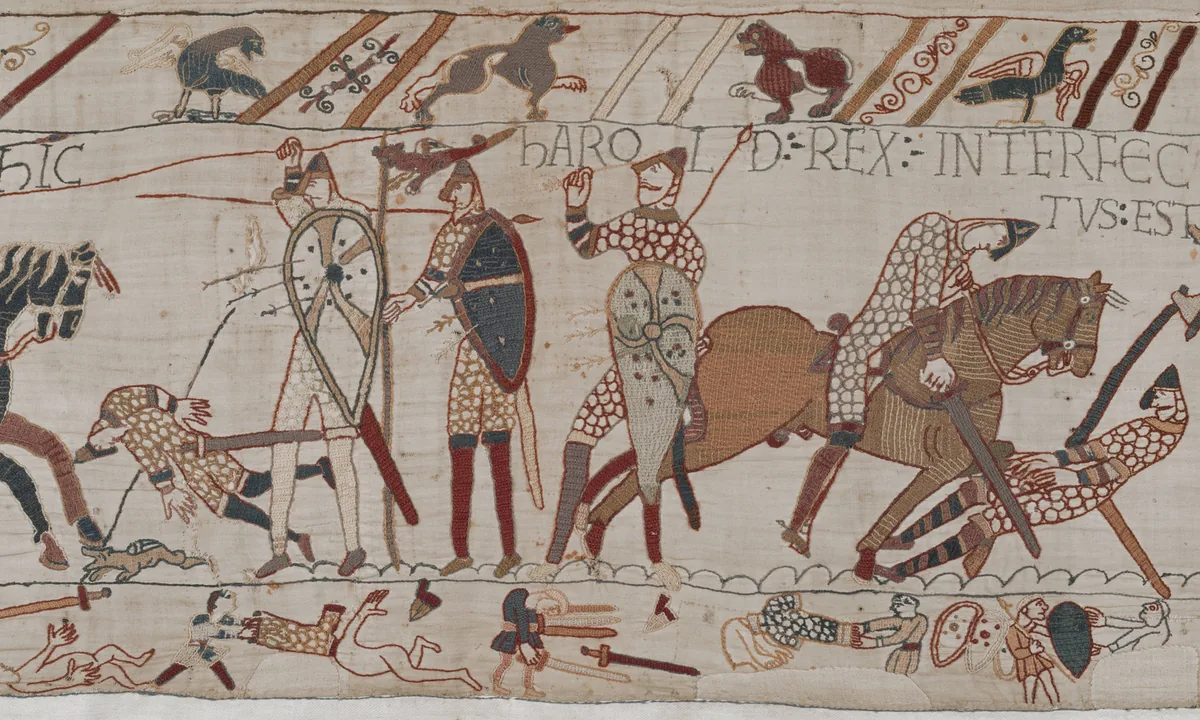
Norman writers say William's knights pretended to flee, drawing English troops off the ridge to be cut down. By dusk Harold was dead, with two of his brothers. How he died is unclear. The tapestry figure pulling at an arrow near his eye may not be Harold, and the arrow may have been altered by later restorers; another early account says Norman knights hacked him down. William was crowned in Westminster Abbey on Christmas Day.
Conquest by castle
England did not submit at once. William answered rebellions with castles, first earth-and-timber mottes and then stone towers like the White Tower in London. In the winter of 1069–70, after a northern revolt, his men destroyed crops, livestock and villages across Yorkshire. The monk Orderic Vitalis, writing some sixty years later, claimed 100,000 people died; the number cannot be checked, but the devastation was real.
By 1086, when William ordered the great survey later called Domesday Book, almost the entire English aristocracy had been replaced by Normans and other incomers. French became the language of the court and the law for centuries, which is why English has “beef” and “pork” for the meat of the cow and the pig.

Who made the tapestry?
The Bayeux Tapestry is not a tapestry at all: it is wool embroidery on linen, about 70 metres long. It was probably made in England, perhaps at Canterbury, within a few years of the conquest, most likely for William's half-brother Odo, bishop of Bayeux, who appears in it at key moments.
It tells the Norman story, yet it was stitched by English hands and leaves room for doubt: Harold appears as a brave warrior, not a villain. It survived the French Revolution, when it was nearly cut up to cover a wagon, and the attention of Nazi researchers in the Second World War.

In their own words
“Then this became known to King Harold, and he gathered a great raiding-army and came against him at the grey apple-tree. And William came upon him by surprise before his people were marshalled… There were killed King Harold, and Earl Leofwine his brother, and Earl Gyrth his brother, and many good men; and the French had possession of the place of slaughter.”
Anglo-Saxon Chronicle, Anglo-Saxon Chronicle, manuscript D, entry for 1066, late 11th century
Translation after Michael Swanton (1996). The D manuscript's writer was English and saw the defeat as God's judgement “for the people's sins”. The “grey apple-tree” was evidently a local landmark where the armies met.
Why it happened
- Edward the Confessor died without children, leaving rival claims to the throne.
- William could call on Normandy's knights, allies across northern France and the pope's blessing.
- Harold had to fight two invasions in three weeks, at opposite ends of his kingdom.
What happened next
- A French-speaking Norman elite replaced the English aristocracy and senior clergy.
- England's kings were now also dukes in France, drawing them into centuries of continental wars. Read the story →
- William's eldest son, Robert of Normandy, became one of the leaders of the First Crusade. Read the story →
Why it still matters
Bayeux was the first sizeable French town liberated after D-Day, on 7 June 1944, by an army that had crossed the Channel in the opposite direction to William's. On the Bayeux Memorial, a Latin inscription reads: “We, once conquered by William, have now set free the Conqueror's native land.”
Key people
- William the Conqueror
- Duke of Normandy from 1035 and king of England from 1066 until his death in 1087
- Harold II (Harold Godwinson)
- Earl of Wessex, crowned king in January 1066 and killed at Hastings
- Harald Hardrada
- King of Norway, who invaded England in 1066 and was killed at Stamford Bridge
- Edward the Confessor
- King of England (1042–66), whose childless death opened the succession crisis
- Odo of Bayeux
- William's half-brother, bishop and warrior, the probable patron of the Bayeux Tapestry
Key terms
- Shield wall
- A close-packed line of foot soldiers with overlapping shields, the standard English battle formation.
- Motte-and-bailey castle
- An earth mound (motte) topped by a timber tower, with a fenced enclosure (bailey) below; quick to build in conquered land.
- Harrying of the North
- William's devastation of northern England in the winter of 1069–70 to crush rebellion.
- Domesday Book
- The survey of English landholding and resources made for William in 1086.
Test yourself
Where did Harold defeat Harald Hardrada in September 1066?
- Fulford
- Pevensey
- Hastings
- Stamford Bridge
Show the answer
Stamford Bridge. Harold destroyed the Norwegian army at Stamford Bridge on 25 September. Hardrada had beaten the northern earls at Fulford five days earlier; William landed at Pevensey on 28 September.
The full lesson in the app ends with 5 questions like this one.
Connected stories
- The Viking Age: Raiders, Traders, Settlers: William descended from Rollo, the Viking granted Normandy in 911, and Hardrada's invasion was a last great Scandinavian bid for England.
- Magna Carta, 1215: Because English kings now also ruled Normandy, King John's loss of the duchy in 1204 set off the crisis that produced Magna Carta.
Frequently asked questions
Why did William of Normandy invade England?
Edward the Confessor died without children, leaving rival claims to the throne. William could call on Normandy's knights, allies across northern France and the pope's blessing. Harold had to fight two invasions in three weeks, at opposite ends of his kingdom.
How did the Norman Conquest change England?
A French-speaking Norman elite replaced the English aristocracy and senior clergy. England's kings were now also dukes in France, drawing them into centuries of continental wars. William's eldest son, Robert of Normandy, became one of the leaders of the First Crusade.
Where did Harold defeat Harald Hardrada in September 1066?
Stamford Bridge. Harold destroyed the Norwegian army at Stamford Bridge on 25 September. Hardrada had beaten the northern earls at Fulford five days earlier; William landed at Pevensey on 28 September.
What is the main primary source for “1066: The Norman Conquest”?
Anglo-Saxon Chronicle, Anglo-Saxon Chronicle, manuscript D, entry for 1066 (late 11th century). Translation after Michael Swanton (1996). The D manuscript's writer was English and saw the defeat as God's judgement “for the people's sins”. The “grey apple-tree” was evidently a local landmark where the armies met.
Sources
- Marc Morris, The Norman Conquest (2012)
- The Anglo-Saxon Chronicles, entry for 1066, translated by Michael Swanton (1996)
- David Bates, William the Conqueror (2016)
- William of Poitiers, The Gesta Guillelmi of William of Poitiers, edited and translated by R. H. C. Davis and Marjorie Chibnall (1998)
Images are credited under each picture. Paintings and photographs come from public collections via Wikimedia Commons; scenes with no surviving image are marked as illustrations.
