Medieval Europe · June 1215
What Is Magna Carta, and Why Does It Matter?
In short
- Losing Normandy and then the battle of Bouvines left King John broke and facing rebel barons.
- Magna Carta, sealed at Runnymede in June 1215, mostly protected the rich, but clauses 39 and 40 promised justice by law.
- Annulled within weeks, it was reissued from 1216 and later became a symbol of limits on power.
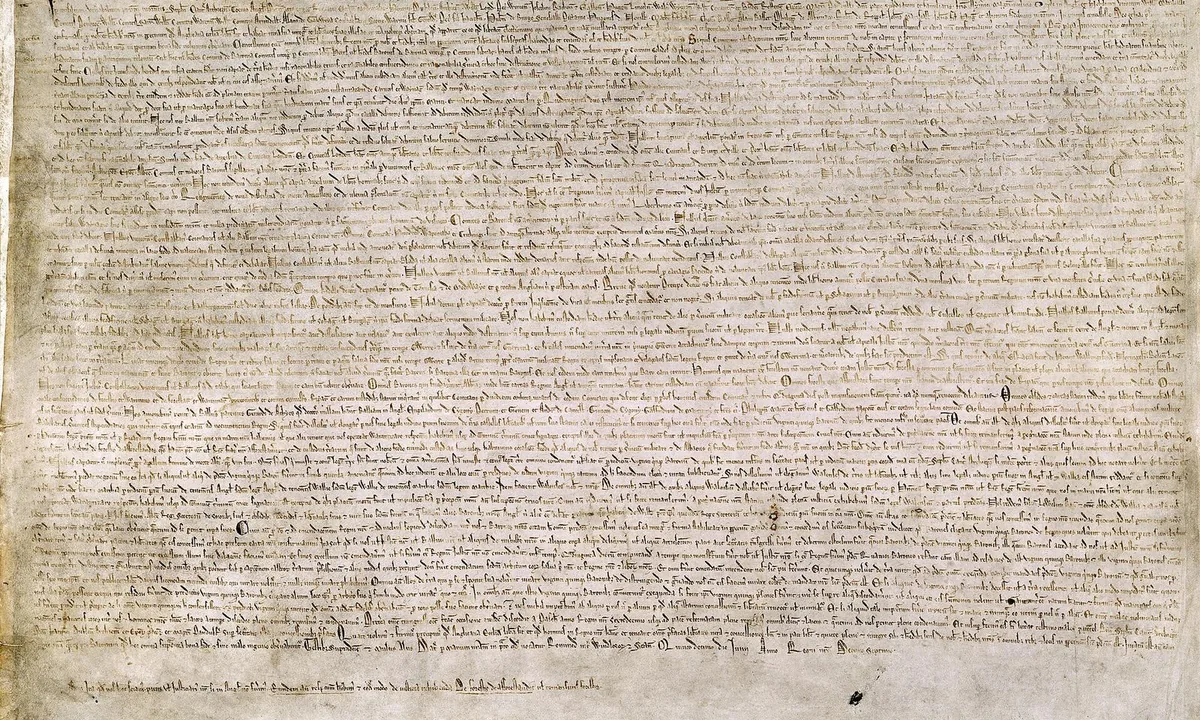
In June 1215, in a meadow beside the Thames called Runnymede, King John agreed to a long list of promises to his rebellious barons. Within three months the pope had declared it void and England was at war again. Four original copies of that failed peace treaty survive, and they are among the most famous documents in the world.
The king who lost Normandy
John became king in 1199. Like his father and brother, he ruled not just England but Normandy, Anjou and Aquitaine. By 1204 he had lost Normandy and Anjou to King Philip II of France. For the next ten years his aim was to win them back, and that took money.
John squeezed it from his barons through the rights a lord had over his vassals: huge payments to inherit land, fines to buy back his favour, and fees for the marriages of heirs and widows. He also quarrelled with the Church. When he refused to accept Stephen Langton as archbishop of Canterbury, Pope Innocent III placed England under an interdict in 1208. In 1213 John submitted, making England a fief of the papacy.

Runnymede
Defeat by Philip at Bouvines in July 1214 ruined John's plans. In May 1215 a group of barons renounced their allegiance and seized London. With Langton mediating, the two sides met at Runnymede, between the royal castle at Windsor and the rebel camp at Staines. Around 15 June John accepted terms, and copies of the charter were written out and sent across the country.
John did not sign Magna Carta. Medieval kings authenticated documents with a wax seal; pictures of him with a quill in his hand are much later inventions.

What it actually said
Most of the charter's 63 clauses deal with the grievances of rich men. It fixed £100 as the payment to inherit an earl's or baron's estate and promised that widows would not be forced to remarry. Others were local: fish-weirs were to be removed from the Thames and the Medway.
Lords really did profit from their tenants' marriages: unfree peasants paid a fee called merchet when a daughter married. There is no reliable evidence for the so-called “right of the first night”, the jus primae noctis of films such as Braveheart. It belongs to later polemic, not medieval law.
Clause 61 was the most radical: a council of 25 barons could seize the king's lands and castles if he broke his word. Clauses 39 and 40 promised justice by law to every “free man”. Most English people were unfree, but the words would outgrow their first meaning.
Dead within weeks
Neither side trusted the other. In August 1215 Innocent III, now John's overlord, declared the charter null and void. The barons invited Louis, son of the French king, to take the throne, and he entered London in 1216. Then John died, in October 1216, leaving a nine-year-old son, Henry III.
Henry's regents, led by William Marshal, reissued a revised charter in 1216 and 1217 to win back the rebels, and in 1225 Henry issued it again in return for a tax. That version entered English law. Three of its clauses are still in force in England and Wales, including the promise of lawful judgment.
A myth that did real work
Magna Carta did not create democracy, Parliament or trial by jury. But in the 17th century the lawyer Sir Edward Coke recast it as an ancient guarantee of English liberty against the Stuart kings. American colonists carried his reading across the Atlantic, and “due process of law”, a phrase that descends from clause 39 through a statute of 1354, entered the Fifth Amendment to the US Constitution.
In 1948 Eleanor Roosevelt hoped the new Universal Declaration of Human Rights might become “the international Magna Carta of all men everywhere”. A peace treaty that failed within weeks became a symbol that the powerful are bound by law.

In their own words
“No free man shall be seized or imprisoned, or stripped of his rights or possessions, or outlawed or exiled, or deprived of his standing in any other way, nor will we proceed with force against him, or send others to do so, except by the lawful judgement of his equals or by the law of the land. To no one will we sell, to no one deny or delay right or justice.”
King John, in the charter agreed with his barons, Magna Carta, clauses 39 and 40, June 1215
Translation published by the British Library, after G. R. C. Davis. The original is in Latin and its clauses were not numbered; the numbering is modern. “Free man” (liber homo) left out the unfree peasants who made up much of the population.
Why it happened
- The loss of Normandy in 1204 drove John to raise money ruthlessly to win it back.
- Defeat at Bouvines in 1214 wrecked his plans and his authority.
- Barons resented arbitrary fines and seizures and the sale of marriages and inheritances.
What happened next
- The pope annulled the charter and civil war broke out, with a French prince invited to take the throne.
- Reissued in 1216, 1217 and 1225, the charter became part of English law.
- Seventeenth-century lawyers and American revolutionaries invoked it against royal power. Read the story →
Why it still matters
The main memorial at Runnymede, a small domed temple above the meadow, was paid for not by Britain but by the American Bar Association and unveiled in 1957. American lawyers wanted to honour a charter they saw as the root of their own constitution's guarantee of due process.
Key people
- King John
- King of England (1199–1216) who lost Normandy and agreed to Magna Carta under pressure
- Stephen Langton
- Archbishop of Canterbury who mediated between the king and the barons
- Pope Innocent III
- Pope (1198–1216) who placed England under interdict and later annulled the charter
- William Marshal
- Veteran knight and regent for Henry III, who reissued the charter in 1216 and 1217
- Philip II Augustus
- King of France who took Normandy in 1204 and defeated John's allies at Bouvines in 1214
Key terms
- Charter
- A formal written grant of rights or property, authenticated with a seal.
- Baron
- A great landholder who held land directly from the king in return for military service.
- Interdict
- A papal ban on most church services in a whole country, used to put pressure on its ruler.
- Merchet
- A fee an unfree peasant paid to his lord when a daughter married; real, unlike the mythical “right of the first night”.
- Due process
- The principle that the state must follow established law before taking a person's life, liberty or property.
Test yourself
How was Magna Carta made official in 1215?
- It was sealed with the king's wax seal
- The king signed it with a quill pen
- Parliament voted it into law that day
- The pope blessed it at Runnymede
Show the answer
It was sealed with the king's wax seal. Royal documents were authenticated with the king's seal, not a signature. Parliament did not yet exist, and the pope condemned the charter rather than blessing it.
The full lesson in the app ends with 5 questions like this one.
Connected stories
- 1066: The Norman Conquest: Since 1066 England's kings had also ruled Normandy, so John's loss of the duchy in 1204 set off the crisis.
- Canossa: A King in the Snow: Innocent III used the papal authority Gregory VII had claimed when he excommunicated John and annulled the charter.
- The Declaration of Independence: American colonists cited Magna Carta, through Coke's reading of it, in their quarrel with king and Parliament.
- The Birth of the Republic: Rome answered the problem of a king above the law by abolishing kings; the barons of 1215 kept their king and tried to bind him with rules.
Frequently asked questions
Why did King John agree to Magna Carta?
The loss of Normandy in 1204 drove John to raise money ruthlessly to win it back. Defeat at Bouvines in 1214 wrecked his plans and his authority. Barons resented arbitrary fines and seizures and the sale of marriages and inheritances.
What happened to Magna Carta after 1215?
The pope annulled the charter and civil war broke out, with a French prince invited to take the throne. Reissued in 1216, 1217 and 1225, the charter became part of English law. Seventeenth-century lawyers and American revolutionaries invoked it against royal power.
How was Magna Carta made official in 1215?
It was sealed with the king's wax seal. Royal documents were authenticated with the king's seal, not a signature. Parliament did not yet exist, and the pope condemned the charter rather than blessing it.
What is the main primary source for “Magna Carta, 1215”?
King John, in the charter agreed with his barons, Magna Carta, clauses 39 and 40 (June 1215). Translation published by the British Library, after G. R. C. Davis. The original is in Latin and its clauses were not numbered; the numbering is modern. “Free man” (liber homo) left out the unfree peasants who made up much of the population.
Sources
- Dan Jones, Magna Carta: The Making and Legacy of the Great Charter (2014)
- J. C. Holt, Magna Carta (3rd ed., revised by George Garnett and John Hudson, 2015)
- David Carpenter, Magna Carta (Penguin Classics, 2015)
- English translation of Magna Carta (1215), British Library
Images are credited under each picture. Paintings and photographs come from public collections via Wikimedia Commons; scenes with no surviving image are marked as illustrations.
