Medieval Europe · 1237–1242 (in Europe)
The Mongol Invasion of Europe: Why Did the Mongols Turn Back?
In short
- In 1206 Genghis Khan united the Mongols; by 1240 his grandson Batu had destroyed Kyiv and entered Europe.
- In April 1241 the Mongols defeated Poland at Legnica and Hungary at Mohi, then withdrew in 1242 for reasons still debated.
- The Mongol peace opened trade routes across Eurasia, which carried the plague to the Black Sea.
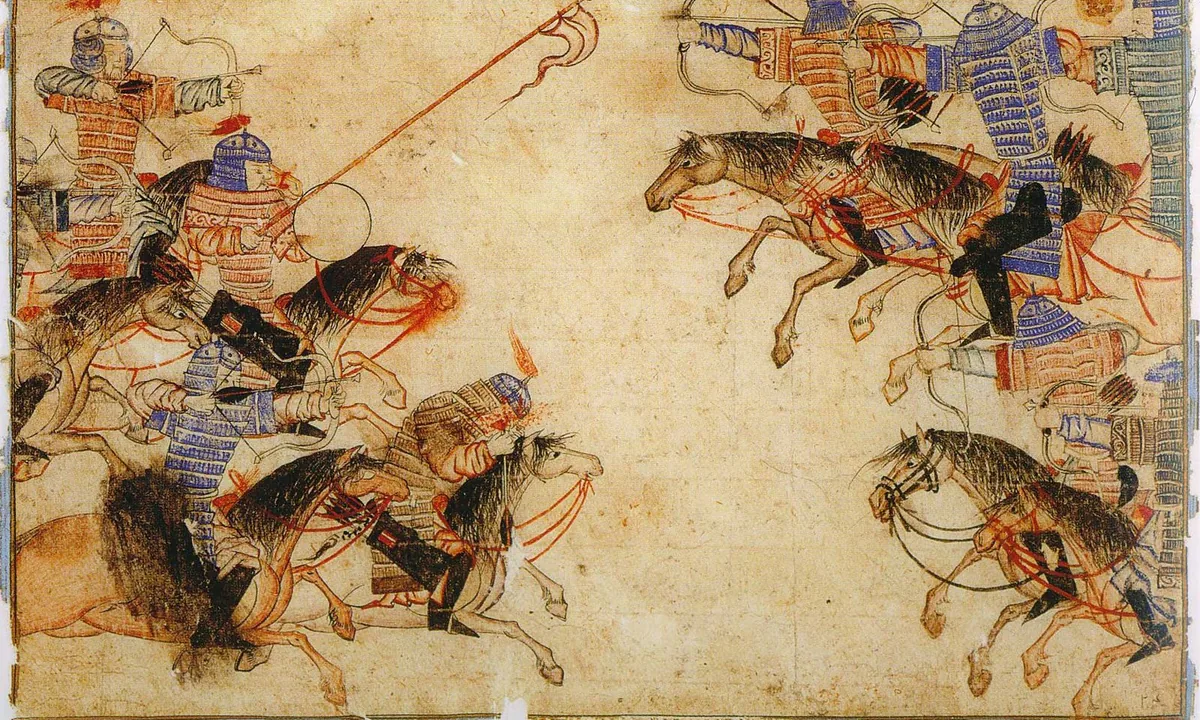
Under the year 1240, an English monk at St Albans entered news from the East that sounded like the end of the world. “An immense horde of that detestable race of Satan, the Tartars,” he wrote, had burst out of their mountains. In the spring of 1241 the horsemen were in Poland and Hungary.
From the steppe to Europe's edge
In 1206 a gathering of Mongol chiefs proclaimed Temüjin their ruler as Genghis Khan, a title whose meaning is debated, though it is often rendered “universal ruler”. In twenty years his armies overran much of northern China, Central Asia and eastern Persia. Their horse-archers could cover great distances, and their commanders coordinated columns by messenger.
After Genghis died in 1227 his empire kept growing under his sons and grandsons. In 1236 his grandson Batu and the veteran general Subutai led a large army, with many Turkic horsemen in its ranks, west to the Volga. Over the next four years they destroyed Rus' cities one after another, and Kyiv fell in December 1240.

Legnica and Mohi
In early 1241 the Mongols split. A smaller force rode through Poland and defeated Duke Henry II of Silesia at Legnica on 9 April; the duke was killed in the battle. Two days later the main army, under Batu and Subutai, destroyed the Hungarian army of King Béla IV at the river Sajó, at Mohi.
Hungary was then ravaged for a year. One modern estimate puts the loss at 15 to 25 per cent of the population, and archaeology shows that most villages on the Great Plain were destroyed, but no exact toll can be known. King Béla fled to the Adriatic coast. Western Europe, divided between a pope and an emperor in open conflict, offered no united response.

Why did they turn back?
In 1242 the Mongols withdrew from Central Europe. The traditional answer is the death of the Great Khan Ögedei in December 1241, which called Mongol princes home to choose a successor. Yet Batu himself did not go to the election: he stopped on the Volga, where his family founded the Golden Horde.
Other explanations are the weather, since a 2016 study of tree rings and written sources argued that a cold, wet early 1242 turned the Hungarian plain to marsh and spoiled the pasture, and the few stone fortresses that held out against the Mongols. Other scholars dispute the climate argument, and historians still disagree.

What Europe thought it saw
Europeans knew almost nothing about the invaders. They called them Tartars, from Tatars, but punned on Tartarus, the classical underworld, so that they could be “demons loosed from Tartarus”, as Matthew Paris wrote. His chronicle claims they drank blood and ate human flesh, which was fear speaking, not reporting.
The panic shaped diplomacy. In 1245 Pope Innocent IV sent the Franciscan John of Plano Carpini to the Great Khan's court in Mongolia, and in 1253 another friar, William of Rubruck, set out with the backing of King Louis IX. Their reports, and later Marco Polo's book, gave Europeans their first eyewitness accounts of the Mongol world.

The Mongol peace, and the plague
Once the conquests ended, the Mongol empires made the trade routes across Eurasia unusually safe. Merchants, missionaries and goods moved from China to the Black Sea. This is sometimes called the Pax Mongolica, the Mongol peace, and it had a darker side.
Batu's descendants ruled the Golden Horde from the Volga. In 1346, a Golden Horde army was besieging the Genoese trading port of Caffa in Crimea when plague struck it. Ships from Caffa and other Black Sea ports carried the disease west, and by October 1347 it had reached Messina in Sicily. The routes that brought silk and silver also brought the Black Death.

In their own words
“An immense horde of that detestable race of Satan, the Tartars, burst forth from their mountain-bound regions, and making their way through rocks apparently impenetrable, rushed forth, like demons loosed from Tartarus.”
Matthew Paris, Chronica Majora, year 1240, c. 1240–1259
Translation by J. A. Giles, Matthew Paris's English History from 1235 to 1273, vol. 1 (Bohn, 1852), p. 312. Matthew Paris was a monk of St Albans in England who never travelled east. His account mixes news from merchants and clergy with rumour and biblical prophecy, and shows how invaders were imagined before anyone had met them.
Why it happened
- Genghis Khan unified the steppe peoples in 1206 and gave the Mongol army a disciplined structure.
- Mongol horse-archers were far more mobile than the armies of Rus', Poland and Hungary, which had divided commands.
- Europe's rulers were preoccupied with their own conflicts and could not mount a joint defence.
What happened next
- Rus' principalities paid tribute to the Golden Horde for some two hundred years.
- Hungary rebuilt with stone castles, and western Europe made its first diplomatic contacts with the Mongols.
- Trade routes opened by the Mongol peace carried the plague to the Black Sea and then Europe. Read the story →
Why it still matters
After the invasion King Béla IV encouraged the building of stone castles and walled towns across Hungary. From about 1247 he fortified the hill above the Danube at Buda and settled there the townspeople of Pest, whose town the Mongols had burned. Budapest's Castle Hill, with its royal palace, grew from that refuge.
Key people
- Genghis Khan
- Founder of the Mongol Empire, proclaimed ruler in 1206
- Batu Khan
- Grandson of Genghis who led the invasion of Rus' and Hungary and founded the Golden Horde
- Subutai
- Veteran Mongol general who directed the campaigns in Rus' and Hungary
- Béla IV
- King of Hungary whose army was destroyed at Mohi in 1241
Key terms
- Golden Horde
- The Mongol state on the Volga and the Black Sea steppes, founded by Batu's family, which ruled the Rus' principalities for two centuries.
- Tartars
- The medieval European name for the Mongols, influenced by Tartarus, the classical underworld.
- Pax Mongolica
- The period of relatively safe overland trade across the Mongol-ruled Eurasian steppe in the 13th–14th centuries.
- Rus'
- The medieval Slavic principalities centred on Kyiv, Vladimir and Novgorod.
Test yourself
Who led the Mongol invasion of Rus' and Hungary in 1236–42?
- Kublai Khan
- Genghis Khan
- Batu, with the general Subutai
- Tamerlane
Show the answer
Batu, with the general Subutai. Genghis Khan had died in 1227, and Kublai belongs to a later generation. Batu, Genghis's grandson, commanded the army, and Subutai planned the campaigns.
The full lesson in the app ends with 5 questions like this one.
Connected stories
- Magna Carta, 1215: The Mongols took the Jin capital, today's Beijing, in 1215, the year of Magna Carta, yet Europe knew nothing of them for another two decades.
- The Black Death: The Golden Horde's siege of Caffa in 1346 was a stage in the plague's journey to Europe.
- The First Crusade: The crusaders went east to take a holy city; the Mongols arrived in Europe unannounced, and Latin Christendom had no army to meet them.
Frequently asked questions
Why were the Mongols able to invade Europe?
Genghis Khan unified the steppe peoples in 1206 and gave the Mongol army a disciplined structure. Mongol horse-archers were far more mobile than the armies of Rus', Poland and Hungary, which had divided commands. Europe's rulers were preoccupied with their own conflicts and could not mount a joint defence.
What were the effects of the Mongol invasion of Europe?
Rus' principalities paid tribute to the Golden Horde for some two hundred years. Hungary rebuilt with stone castles, and western Europe made its first diplomatic contacts with the Mongols. Trade routes opened by the Mongol peace carried the plague to the Black Sea and then Europe.
Who led the Mongol invasion of Rus' and Hungary in 1236–42?
Batu, with the general Subutai. Genghis Khan had died in 1227, and Kublai belongs to a later generation. Batu, Genghis's grandson, commanded the army, and Subutai planned the campaigns.
What is the main primary source for “The Mongols Arrive”?
Matthew Paris, Chronica Majora, year 1240 (c. 1240–1259). Translation by J. A. Giles, Matthew Paris's English History from 1235 to 1273, vol. 1 (Bohn, 1852), p. 312. Matthew Paris was a monk of St Albans in England who never travelled east. His account mixes news from merchants and clergy with rumour and biblical prophecy, and shows how invaders were imagined before anyone had met them.
Sources
- Matthew Paris's English History from the Year 1235 to 1273, translated by J. A. Giles (Bohn, 1852–54)
- David Morgan, The Mongols (1986; 2nd ed. 2005)
- Reuven Amitai-Preiss and David O. Morgan (eds), The Mongol Empire and Its Legacy (1999)
- Christopher Dawson (ed.), The Mongol Mission (1955), including the accounts of John of Plano Carpini and William of Rubruck
Images are credited under each picture. Paintings and photographs come from public collections via Wikimedia Commons; scenes with no surviving image are marked as illustrations.
