Medieval Europe · 1429–1431
Who Was Joan of Arc?
In short
- A farm girl from Domrémy persuaded the Dauphin to let her join the relief of Orléans in 1429.
- The victories at Orléans and Patay opened the way to Charles's coronation at Reims.
- Captured in 1430 and tried by a pro-English court, she was burned at Rouen on 30 May 1431.
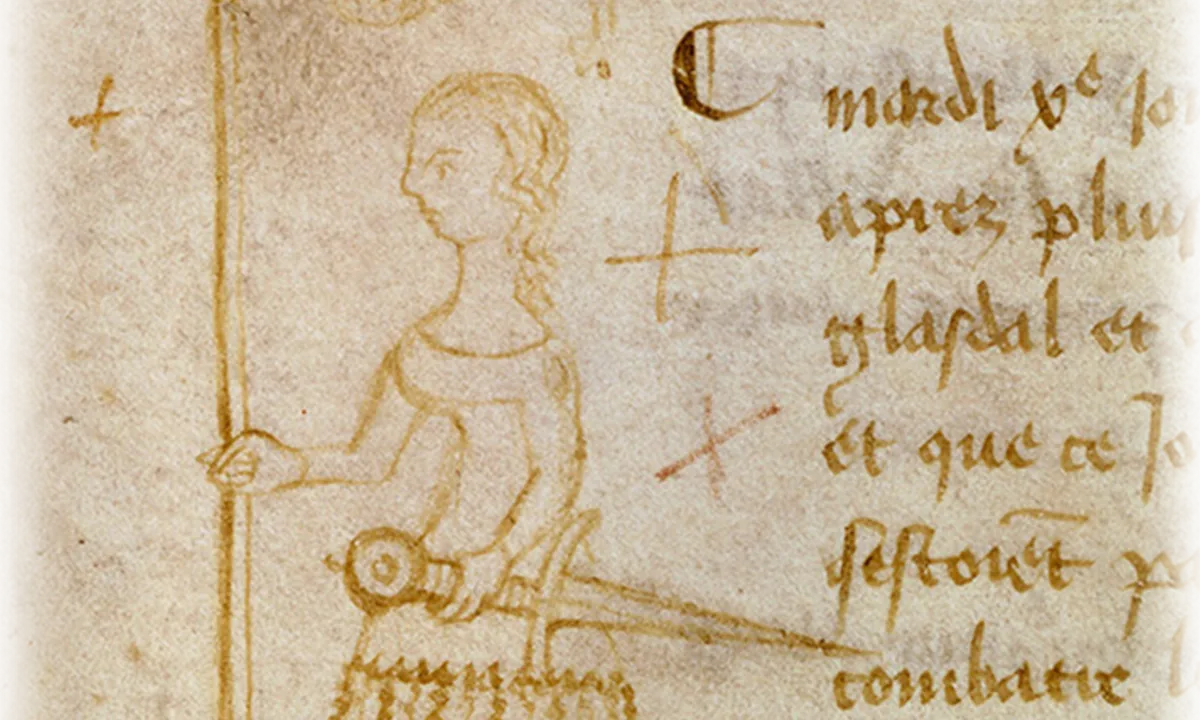
When her voices first told her to go to France, Joan later told her judges, she answered that she was “a poor girl who knew not how to ride a horse nor head a campaign”. In February 1429, aged about seventeen, she persuaded a garrison captain to send her to the Dauphin. Within three months she was riding with his army to Orléans.
A girl from Domrémy
Joan was born around 1412 in Domrémy, a village on the border of Lorraine, to a farming family. She told her judges that when she was thirteen she heard a voice from God in her father's garden, and that later the voices of Saint Michael, Saint Catherine and Saint Margaret told her to go to France and raise the siege of Orléans.
In May 1428 the local captain at Vaucouleurs, Robert de Baudricourt, sent her home. She came back in January 1429, and in February he sent her with an escort across enemy territory to the Dauphin Charles, who was holding court at Chinon. Theologians at Poitiers questioned her for about three weeks and found nothing wrong.

Orléans
The English had been besieging Orléans since October 1428, and if it fell, the road south would be open. Joan reached the city on 29 April 1429 with a relief convoy. Wearing armour and carrying a white banner, she urged the defenders to attack rather than wait behind their walls.
On 7 May an arrow struck her between the neck and shoulder during the assault on Les Tourelles, but she returned to the fight, and the English were driven out. The next day the English abandoned the siege. Experienced commanders such as Jean, the Bastard of Orléans, later known as Dunois, directed the fighting, but at the rehabilitation inquiry Dunois testified that before she came two hundred English could rout eight hundred or a thousand French, and afterwards they could not resist four or five hundred.

Reims
Victory followed victory. At Patay on 18 June an English army was routed. Charles hesitated, but Joan urged him toward Reims, where French kings were crowned. On 17 July 1429 Charles VII was anointed in the cathedral, with Joan and her banner present.
After that her fortunes turned. An attack on Paris in September failed and she was wounded again. Charles's council preferred to negotiate with Burgundy, and her campaigns over the winter achieved little. On 23 May 1430, while defending Compiègne, she was pulled from her horse and captured by Burgundian troops.

The trial at Rouen
Her captor, John of Luxembourg, a Burgundian ally, sold her to the English for 10,000 livres. The English wanted to discredit Charles's coronation by showing that it owed everything to a heretic and sorceress. She was tried for heresy at Rouen in 1431 by a church court led by Pierre Cauchon, Bishop of Beauvais, a supporter of the English. She was kept in a castle prison under English guard, although a prisoner of a church court would normally have been held in a church prison.
For weeks she answered her interrogators with quickness and courage. Asked whether she was in God's grace, a trap since either answer could condemn her, she is recorded as replying that if she was not, may God put her there, and if she was, may God keep her there. On 24 May, threatened with fire, she signed an abjuration, but days later she was again wearing men's clothing, and her judges condemned her as a relapsed heretic.

Fire and rehabilitation
Joan was burned at the stake in the old market square of Rouen on 30 May 1431, aged about nineteen. Her ashes were thrown into the Seine. Charles VII, who owed her his crown, made no known attempt to ransom or rescue her.
In 1456, after the English had been driven out of Normandy, a second trial examined the first and declared its verdict null and void. Joan was named a saint in 1920. The Hundred Years' War ended in 1453, when the French used cannon to destroy the last English army in Gascony at Castillon.

In their own words
“If you were well informed about me, you should wish that I were out of your hands. I have done nothing save by revelation.”
Joan of Arc, Trial of Condemnation, examination of 22 February 1431, 1431
Translation as printed in Charles W. Colby, ed., Selections from the Sources of English History (1920), reproduced in the Internet Medieval Sourcebook. Notaries took down her answers in French; the official Latin record was compiled afterwards under her judges' supervision.
Why it happened
- After Agincourt and the Treaty of Troyes, the Dauphin was disinherited and nearly out of money and soldiers.
- The English siege of Orléans in 1428–29 threatened to cut France in two.
- Charles's court wanted a sign from God, and Joan offered one.
What happened next
- Charles VII's coronation at Reims gave him a legitimacy that the Treaty of Troyes could not take away.
- The English were gradually pushed out of France, and the war ended with the battle of Castillon in 1453.
- Joan became a symbol of French national identity and, in 1920, a saint.
Why it still matters
Every year around 8 May the city of Orléans holds the Fêtes Jeanne d'Arc, with a procession and a service, to mark the lifting of the siege, a tradition that the city traces back to 1430 and that France added to its inventory of intangible cultural heritage in 2018. Her trial record, taken down by notaries and later put into Latin, preserves more of the words of a peasant girl than almost any other medieval source.
Key people
- Joan of Arc
- Peasant visionary who led French troops to relieve Orléans in 1429
- Charles VII
- The Dauphin, crowned at Reims with Joan's help, who finally won the war
- Pierre Cauchon
- Bishop of Beauvais who presided over Joan's trial at Rouen
- Jean de Dunois
- The Bastard of Orléans, French commander who worked with Joan at Orléans
Key terms
- Dauphin
- The title of the heir to the French throne; Charles was still uncrowned in 1429.
- Heresy
- Belief or teaching rejected by the Church; the charge on which Joan was condemned.
- Abjuration
- A formal renunciation of a condemned belief, made to avoid punishment.
- Rehabilitation trial
- The 1455–56 inquiry that reviewed Joan's trial and declared it invalid.
Test yourself
At which city did Joan's presence help lift an English siege in 1429?
- Paris
- Rouen
- Reims
- Orléans
Show the answer
Orléans. The English siege of Orléans, begun in October 1428, was lifted on 8 May 1429. Reims was where Charles was crowned and Rouen the city where she was tried.
The full lesson in the app ends with 5 questions like this one.
Connected stories
- The Hundred Years' War and Agincourt: The collapse of the Dauphin's position after Agincourt and Troyes was the crisis she answered.
- The Wars of the Roses and Richard III: The end of the French war sent English soldiers and magnates home to the conflict over the crown.
- Canossa: A King in the Snow: Gregory VII claimed that the Church stood above kings; at Rouen a church court served a king's politics, condemning Joan to discredit his rival.
- Clovis and the Kingdoms After Rome: Charles was crowned at Reims because tradition held that Clovis had been baptised there more than nine centuries earlier.
Frequently asked questions
Why did Joan of Arc go to the Dauphin?
After Agincourt and the Treaty of Troyes, the Dauphin was disinherited and nearly out of money and soldiers. The English siege of Orléans in 1428–29 threatened to cut France in two. Charles's court wanted a sign from God, and Joan offered one.
What was the legacy of Joan of Arc?
Charles VII's coronation at Reims gave him a legitimacy that the Treaty of Troyes could not take away. The English were gradually pushed out of France, and the war ended with the battle of Castillon in 1453. Joan became a symbol of French national identity and, in 1920, a saint.
At which city did Joan's presence help lift an English siege in 1429?
Orléans. The English siege of Orléans, begun in October 1428, was lifted on 8 May 1429. Reims was where Charles was crowned and Rouen the city where she was tried.
What is the main primary source for “Joan of Arc”?
Joan of Arc, Trial of Condemnation, examination of 22 February 1431 (1431). Translation as printed in Charles W. Colby, ed., Selections from the Sources of English History (1920), reproduced in the Internet Medieval Sourcebook. Notaries took down her answers in French; the official Latin record was compiled afterwards under her judges' supervision.
Sources
- Régine Pernoud and Marie-Véronique Clin, Joan of Arc: Her Story (1998)
- Helen Castor, Joan of Arc: A History (2014)
- The Trial of Joan of Arc, translated by W. S. Scott (1956)
- Selections from the Sources of English History, ed. Charles W. Colby (1920)
Images are credited under each picture. Paintings and photographs come from public collections via Wikimedia Commons; scenes with no surviving image are marked as illustrations.
