Medieval Europe · 1337–1453 (Agincourt, 25 October 1415)
The Battle of Agincourt and the Hundred Years' War
In short
- The Hundred Years' War began in 1337 over the French crown and Gascony and lasted, with truces, until 1453.
- At Crécy in 1346 and Agincourt in 1415, English longbowmen defeated larger French armies.
- Henry V's Treaty of Troyes (1420) made him heir to France, but he died in 1422 with the war undecided.
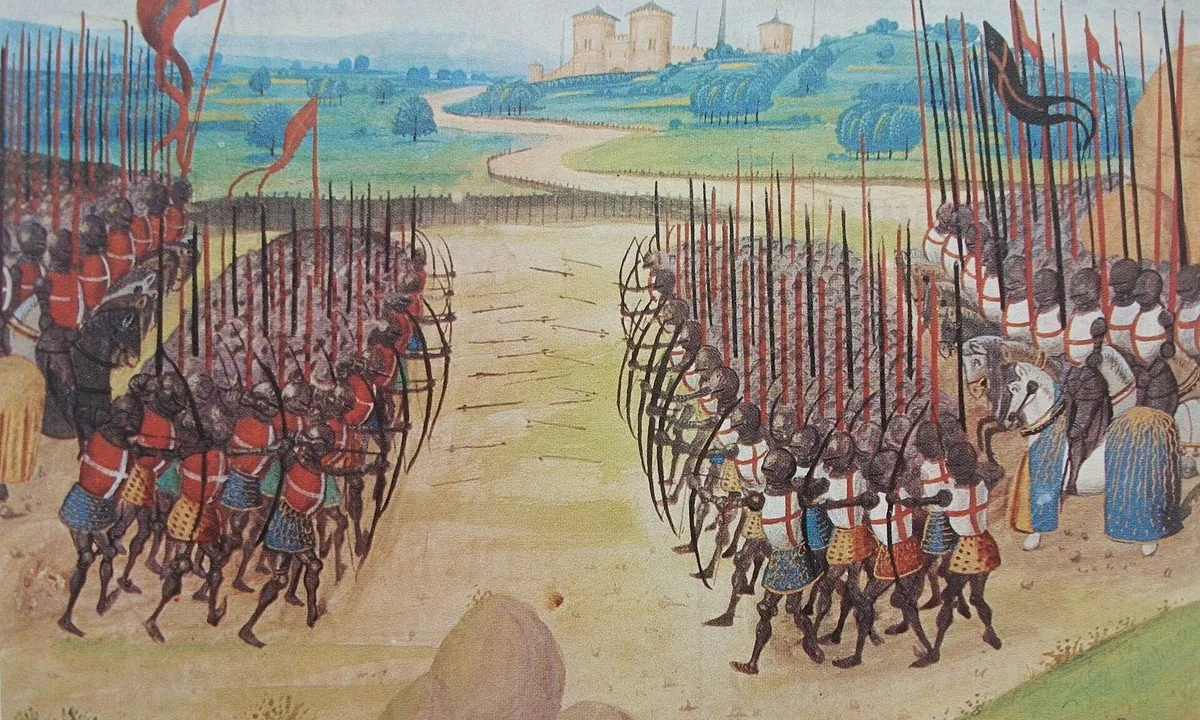
On the morning of 25 October 1415, on a muddy field in northern France, a tired English army, weakened by dysentery and short of food, faced a much larger French force; by how much, historians still argue. By evening thousands of Frenchmen, among them the constable of France and three dukes, were dead, while English chroniclers counted their own dead in dozens.
How a crown became a war
When the last Capetian king of France died in 1328 without a son, the French chose his cousin Philip of Valois over Edward III of England, whose mother Isabella was the dead king's sister. The French magnates held that the crown could not pass through a woman; later lawyers justified this with the old Frankish “Salic law”. A second quarrel was over Gascony, which the English kings held as vassals of the French crown.
In 1337 Philip confiscated Gascony, and in 1340 Edward formally claimed the French throne. The conflict that followed is called the Hundred Years' War, a name invented by 19th-century historians; it lasted, with long truces, 116 years.

Longbows at Crécy
In August 1346 Edward III's army, marching north through Normandy and Picardy with a larger French army in pursuit, turned and fought at Crécy. English and Welsh longbowmen fired into charging French knights, and the hail of arrows broke the attack. Ten years later at Poitiers the army of the Black Prince, Edward's son, took the French king John II prisoner.
France recovered under Charles V, whose general Bertrand du Guesclin avoided battle and retook most of the lost land by the 1370s. The war flickered on with truces, a madness that struck the French king Charles VI, and a civil war in France between the Burgundians and Armagnacs. In 1415 a new English king saw his chance.

Harfleur and the long march
Henry V landed near Harfleur in August 1415 with an army of perhaps 12,000. The siege took five weeks, and dysentery killed many men and sent many more home sick. In October, with a much smaller force, Henry marched toward Calais, found the Somme crossings guarded, and had to detour far inland.
On 24 October a large French army blocked his road near the village of Azincourt. The chronicler Monstrelet, writing a generation later, reckoned they outnumbered the English by more than six to one. Modern estimates vary widely: Anne Curry, working from pay records, suggests about 9,000 English against 12,000 French, while Juliet Barker and others argue for about 6,000 English, outnumbered perhaps four to one. All agree the French had more men.

Mud and arrows
The armies faced each other across a narrow field between two woods, on ploughed land softened by heavy rain. Henry's archers, probably placed on the wings, planted sharpened stakes in the ground. When the French cavalry charged, the stakes and arrows turned it back, and the fleeing horses crashed into the men-at-arms behind. French men-at-arms, packed so tightly they could hardly swing their weapons, floundered in the mud, and the English cut them down with swords, axes and mallets.
Late in the battle, when news came of an attack on the English baggage and the French seemed to be massing again, Henry ordered his men to kill their prisoners. English chroniclers say he feared being overwhelmed. Some historians see a ruthless but understandable decision; others think it broke the customs of war even by the standards of the day. The French dead included the constable, the dukes of Alençon, Bar and Brabant, and hundreds of nobles.

Troyes and the dual monarchy
Henry went back to conquer France. In 1420 the Treaty of Troyes made him heir to the mad Charles VI, disinheriting Charles's son the Dauphin, and Henry married Charles's daughter Catherine. Then, in August 1422, Henry died at 35, probably of dysentery, and Charles followed him seven weeks later.
His baby son Henry VI was proclaimed king of both countries. England and its Burgundian allies held Paris and the north, but the Dauphin refused to accept his disinheritance, and the war was far from over. In 1429 it would be transformed by a farm girl from the borders of Lorraine.

In their own words
“When these battalions were all drawn up, it was a grand sight to view; and they were, on a hasty survey, estimated to be more than six times the number of the English.”
Enguerrand de Monstrelet, Chronicles, Book 1, chapter 146, on the battle of Agincourt, c. 1440s
Translation by Thomas Johnes (first published 1809–10). Monstrelet was a chronicler in Burgundian service who wrote a generation after the battle; his ratio is far higher than any modern estimate.
Why it happened
- The Capetian line ended in 1328, leaving two claimants to the French throne.
- English kings held Gascony from the French crown, a dispute over homage and sovereignty.
- France was divided in the 1400s between the Burgundian and Armagnac factions, which gave Henry V his chance.
What happened next
- Henry V's victory brought him a French crown by treaty, but it did not hold.
- The Dauphin's cause was revived by a young visionary in 1429. Read the story →
- English and British kings kept the title king of France until 1801.
Why it still matters
The words “We few, we happy few, we band of brothers” are Shakespeare's, written around 1599 for his play Henry V, not Henry's own. In 1944 Laurence Olivier filmed the play as wartime propaganda, with government backing, and released it months after D-Day; the St Crispin's Day speech still turns up in speeches by generals and politicians.
Key people
- Henry V
- King of England 1413–22, victor of Agincourt
- Edward III
- King of England who claimed the French throne in 1340
- Charles VI
- King of France 1380–1422, whose bouts of madness weakened his kingdom
- Charles VII
- The Dauphin who became king of France in 1422 and eventually won the war
Key terms
- Longbow
- A tall war bow, usually of yew, that English and Welsh archers could shoot many times a minute.
- Dauphin
- The title of the heir to the French throne.
- Salic law
- An old Frankish law code, cited by French lawyers from the later 14th century to justify the rule that the crown could not pass through a woman.
- Treaty of Troyes
- The 1420 agreement making Henry V heir to the French crown.
Test yourself
Which weapon is most famously associated with English victories at Crécy and Agincourt?
- The crossbow
- The pike
- The longbow
- The halberd
Show the answer
The longbow. A trained English or Welsh longbowman is often said to have shot about ten arrows a minute. The French fielded crossbowmen too, but at Agincourt the arrow storm and the mud halted the cavalry charge.
The full lesson in the app ends with 5 questions like this one.
Connected stories
- The Black Death: The plague arrived in the middle of the war; heavier taxes and labour shortages in both kingdoms followed.
- Eleanor of Aquitaine: Queen of Two Kingdoms: English claims in France date back to the marriage of Eleanor of Aquitaine to Henry II in 1152.
- Joan of Arc: After Agincourt and Troyes, the Dauphin's cause looked lost, until Joan of Arc appeared in 1429.
- 1066: The Norman Conquest: English kings held land in France ever since William's conquest tied England to Normandy.
Frequently asked questions
What caused the Hundred Years' War?
The Capetian line ended in 1328, leaving two claimants to the French throne. English kings held Gascony from the French crown, a dispute over homage and sovereignty. France was divided in the 1400s between the Burgundian and Armagnac factions, which gave Henry V his chance.
What happened after the battle of Agincourt?
Henry V's victory brought him a French crown by treaty, but it did not hold. The Dauphin's cause was revived by a young visionary in 1429. English and British kings kept the title king of France until 1801.
Which weapon is most famously associated with English victories at Crécy and Agincourt?
The longbow. A trained English or Welsh longbowman is often said to have shot about ten arrows a minute. The French fielded crossbowmen too, but at Agincourt the arrow storm and the mud halted the cavalry charge.
What is the main primary source for “The Hundred Years' War and Agincourt”?
Enguerrand de Monstrelet, Chronicles, Book 1, chapter 146, on the battle of Agincourt (c. 1440s). Translation by Thomas Johnes (first published 1809–10). Monstrelet was a chronicler in Burgundian service who wrote a generation after the battle; his ratio is far higher than any modern estimate.
Sources
- The Chronicles of Enguerrand de Monstrelet, translated by Thomas Johnes (1810)
- Jonathan Sumption, The Hundred Years War, vol. IV: Cursed Kings (2015)
- Juliet Barker, Agincourt: The King, the Campaign, the Battle (2005)
- Anne Curry, Agincourt: A New History (2005)
Images are credited under each picture. Paintings and photographs come from public collections via Wikimedia Commons; scenes with no surviving image are marked as illustrations.
