Medieval Europe · 1137–1204
Who Was Eleanor of Aquitaine? Queen of France and England
In short
- Eleanor inherited Aquitaine in 1137 and became queen of France, then queen of England after her annulment and remarriage.
- She backed her sons against Henry II, spent some fifteen years under guard, and worked for Richard and John after Henry's death.
- Her marriages set England and France against each other for centuries.
On 21 March 1152 the marriage of the king and queen of France was annulled. Eight weeks later the queen, Eleanor of Aquitaine, married a nineteen-year-old duke who was her former husband's most dangerous vassal. Two and a half years after that he was crowned king of England, and she was a queen again.
The richest heiress in Europe
When Duke William X of Aquitaine died in April 1137, his lands passed to his teenage daughter Eleanor. Aquitaine, with Poitou and Gascony, covered much of south-western France and was larger than the royal domain of France itself. Within months, Eleanor was married to Louis VII, and when his father died a week later, she became queen.
She brought with her a rich culture. Her grandfather William IX is the earliest troubadour whose songs survive; troubadours were poets who sang of courtly love in the langue d'oc. How far Eleanor herself patronised the arts is hard to say, since the stories about her “courts of love” come from later writers.

Crusade and divorce
In 1147 Louis led the Second Crusade, a failure, and Eleanor went too, with her own vassals. The tale that she rode into battle dressed as an Amazon is a later legend. At Antioch the couple quarrelled openly, and the marriage never recovered. They had two daughters but no son, and in 1152 the Church accepted the argument that they were too closely related to be married.
Two months after the annulment, Eleanor married Henry, Duke of Normandy and Count of Anjou, about ten years younger than she was. In 1154 he became Henry II of England. Together they ruled lands from the Scottish border to the Pyrenees, a realm historians call the Angevin Empire after Henry's family, the counts of Anjou.

A family at war
Eleanor and Henry had eight children. Their sons Henry, Richard, Geoffrey and John grew up quarrelling over their inheritance. In 1173 the eldest, Henry the Young King, rebelled, and Eleanor backed her sons against her husband. She was seized on her way to join them, and the rising failed.
Henry kept Eleanor under guard for some fifteen years, mostly in England, moving her between castles and royal houses. She was freed only after Henry's death in July 1189. By then she was in her mid-sixties, and she was about to enter the busiest years of her life.

The queen mother
When her son Richard I left on crusade, Eleanor helped govern England for him, and in the winter of 1190–91 she crossed the Alps to bring him a bride, Berengaria of Navarre, in Sicily. When Richard was held captive in Austria and Germany in 1192–94, Eleanor helped raise the enormous ransom of 150,000 marks and travelled to Germany to secure his release.
After Richard's death in 1199 she backed her youngest son John, now king. In 1200, well over seventy, she crossed the Pyrenees to fetch her granddaughter Blanche of Castile, who was to marry the French king's heir. In 1202, when her own grandson Arthur besieged her at Mirebeau, John rescued her. She died in 1204 and was buried at Fontevraud, near her husband and Richard.

A reputation made later
Chroniclers who wrote about Eleanor in her lifetime sometimes admired her and sometimes hinted at scandal; Richard of Devizes, writing in the 1190s, praised her in terms that may be partly ironic. Later storytellers added legends, such as the tale that she poisoned Henry's mistress Rosamund Clifford, which have no support in the sources.
What is certain is that she was crowned queen of two kingdoms and shaped the politics of both for half a century. Her descendants included kings of England, Castile and, through Blanche, France.

In their own words
“Queen Eleanor, a matchless woman, beautiful and chaste, powerful and modest, meek and eloquent, which is rarely wont to be met with in a woman.”
Richard of Devizes, Chronicle of the Time of King Richard the First, section 29, 1190s
Translation by J. A. Giles (1841). Richard of Devizes was a monk of Winchester, a witty and often ironic writer, who wrote this in Eleanor's lifetime, describing her journey to bring Berengaria to Richard in 1191.
Why it happened
- Eleanor inherited Aquitaine in 1137, which made her husband a major power and her marriage a matter of state.
- The marriage to Louis VII produced no son and ended in annulment in 1152.
- Her remarriage to Henry of Anjou joined Aquitaine to Normandy, Anjou and, from 1154, England.
What happened next
- The union of Aquitaine with England created the Angevin Empire and a long rivalry with the French kings.
- Eleanor's sons, Richard and John, ruled England in turn, and John lost most of the French lands. Read the story →
- The rivalry between the English and French crowns over her inheritance fed the Hundred Years' War. Read the story →
Why it still matters
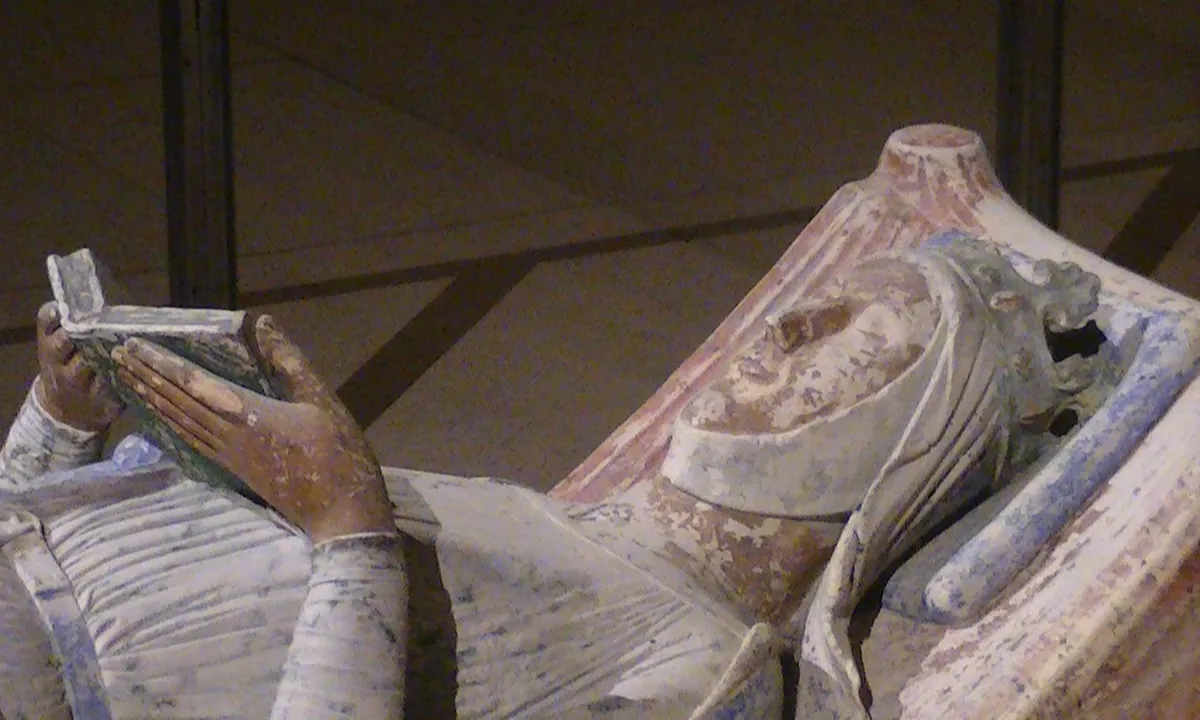
At Fontevraud Abbey, in the Loire valley of France, the painted effigies of Eleanor, her husband Henry II and her son Richard I still lie in the same church. The royal remains were lost, probably when revolutionaries pillaged the abbey in the 1790s, but the effigies survived, and an English king, his queen and their son can still be seen side by side in the heart of France.
Key people
- Eleanor of Aquitaine
- Duchess of Aquitaine, queen of France and then queen of England
- Louis VII
- King of France whose marriage to Eleanor was annulled in 1152
- Henry II
- King of England 1154–89, Eleanor's second husband
- Richard I
- Eleanor's son, king of England 1189–99
Key terms
- Annulment
- A declaration by the Church that a valid marriage never existed, here because the spouses were too closely related.
- Troubadour
- A poet-musician of southern France who composed songs of courtly love in Occitan.
- Angevin Empire
- The lands ruled by Henry II and his sons, from Scotland to the Pyrenees.
- Regent
- A person who governs a kingdom while the king is absent or underage.
Test yourself
Whom did Eleanor of Aquitaine marry after her marriage to Louis VII was annulled?
- Richard I
- Philip Augustus
- Henry, Duke of Normandy
- Frederick Barbarossa
Show the answer
Henry, Duke of Normandy. She married Henry, Duke of Normandy and Count of Anjou, in May 1152. Two years later he became Henry II of England. Richard was her son, and Philip Augustus was Louis VII's son.
The full lesson in the app ends with 5 questions like this one.
Connected stories
- The First Crusade: The Second Crusade, which Eleanor joined, was called to defend the crusader states founded after the First.
- Richard, Saladin and the Third Crusade: Her son Richard led the Third Crusade and her efforts won his release from captivity.
- Magna Carta, 1215: Her son John lost Normandy in 1204, the year she died, and the crisis it caused led to Magna Carta.
- The Hundred Years' War and Agincourt: The English kings' claims in France, first created by her marriage, became the cause of the Hundred Years' War.
Frequently asked questions
How did Eleanor of Aquitaine become queen of two kingdoms?
Eleanor inherited Aquitaine in 1137, which made her husband a major power and her marriage a matter of state. The marriage to Louis VII produced no son and ended in annulment in 1152. Her remarriage to Henry of Anjou joined Aquitaine to Normandy, Anjou and, from 1154, England.
What was the legacy of Eleanor of Aquitaine?
The union of Aquitaine with England created the Angevin Empire and a long rivalry with the French kings. Eleanor's sons, Richard and John, ruled England in turn, and John lost most of the French lands. The rivalry between the English and French crowns over her inheritance fed the Hundred Years' War.
Whom did Eleanor of Aquitaine marry after her marriage to Louis VII was annulled?
Henry, Duke of Normandy. She married Henry, Duke of Normandy and Count of Anjou, in May 1152. Two years later he became Henry II of England. Richard was her son, and Philip Augustus was Louis VII's son.
What is the main primary source for “Eleanor of Aquitaine: Queen of Two Kingdoms”?
Richard of Devizes, Chronicle of the Time of King Richard the First, section 29 (1190s). Translation by J. A. Giles (1841). Richard of Devizes was a monk of Winchester, a witty and often ironic writer, who wrote this in Eleanor's lifetime, describing her journey to bring Berengaria to Richard in 1191.
Sources
- Alison Weir, Eleanor of Aquitaine: A Life (1999)
- D. D. R. Owen, Eleanor of Aquitaine: Queen and Legend (1993)
- The Chronicle of Richard of Devizes, translated by J. A. Giles (1841)
- W. L. Warren, Henry II (1973)
Images are credited under each picture. Paintings and photographs come from public collections via Wikimedia Commons; scenes with no surviving image are marked as illustrations.
