Medieval Europe · 1187–1192
Richard the Lionheart and Saladin: The Third Crusade
In short
- Saladin crushed the crusader army at Hattin in 1187 and took Jerusalem.
- Richard captured Acre and won at Arsuf, but could not take Jerusalem.
- A truce in 1192 left the coast to the Christians and Jerusalem to the Muslims, and Richard was captured on the way home.
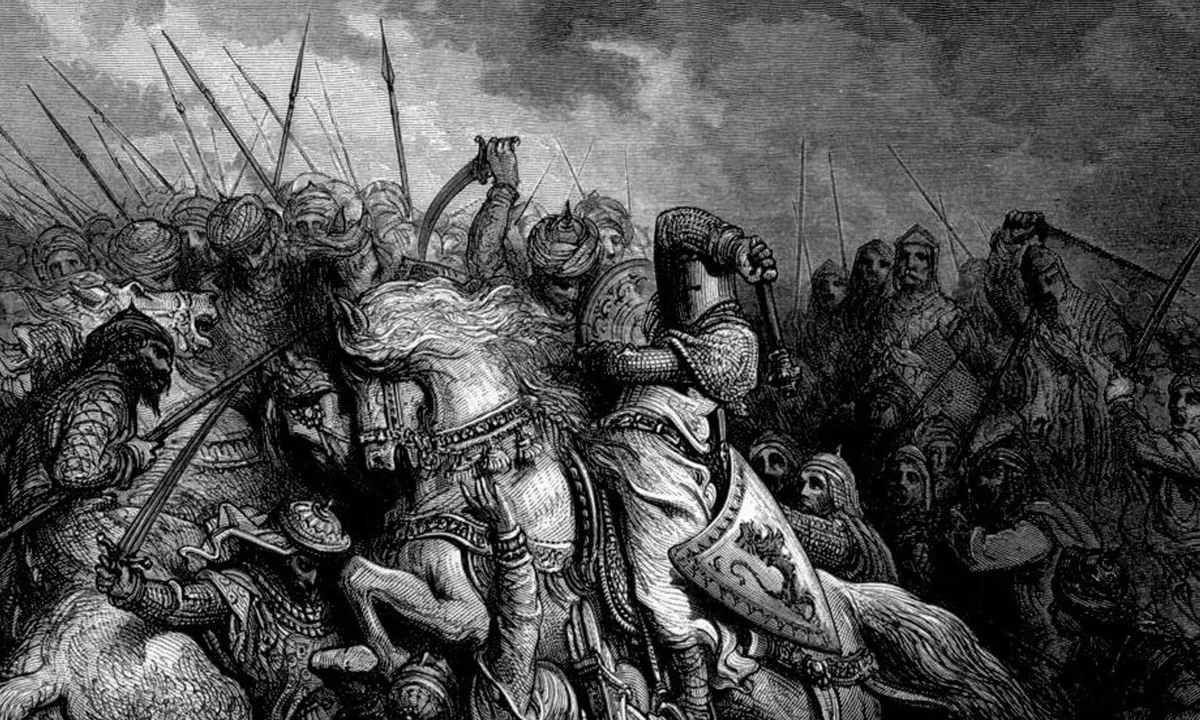
On 7 September 1191, a crusader column marched south along the Palestinian coast for hours under a rain of arrows, with orders not to charge. Saladin's horse-archers rode alongside, waiting for it to break. The king of England kept it moving. Richard would never take Jerusalem, but at Arsuf he showed the sultan's army could be beaten.
Hattin and Jerusalem
In 1187 Saladin, sultan of Egypt and Syria, led an army into the Kingdom of Jerusalem. On 4 July at the Horns of Hattin, above the Sea of Galilee, he destroyed the main Frankish army, which had marched into the summer heat and run out of water. The True Cross, the sacred relic they had carried, was captured. Within weeks most of the kingdom had fallen, and on 2 October Jerusalem itself surrendered.
Saladin did not repeat the massacre of 1099. Inhabitants who could pay a ransom, about ten dinars for a man, five for a woman and less for a child, were allowed to go. Many poor people were enslaved, but he released some without payment. The pope called for a new crusade, and in England a special tax, the Saladin tithe, was raised to pay for it.

Three kings
Three rulers took the cross: Emperor Frederick Barbarossa, Philip II of France and Richard I of England. Frederick, an old man leading a huge army overland, drowned crossing a river in Anatolia in June 1190, and most of his army went home.
Philip and Richard arrived at Acre, a port under siege by the Christians since 1189. Richard, who had stopped to conquer Cyprus on the way, reached it in June 1191. The city fell in July. Philip soon left for France, and Richard remained as the leader of the crusade.

A hard king
When the deadline passed for Saladin to pay the agreed ransom for the garrison of Acre, Richard had the prisoners led out and killed on 20 August 1191. The crusader chronicle known as the Itinerarium gives 2,700 dead; Baha ad-Din says more than 3,000. Writers on both sides recorded it, and neither side forgot it.
He marched south along the coast. At Arsuf on 7 September Saladin's archers harassed the column for hours while Richard held the knights back. When some of the Hospitallers finally broke ranks and charged, Richard sent in the rest, and they broke the Muslim army. Baha ad-Din, Saladin's adviser and later biographer, was with the sultan's army and wrote about Richard with respect.

Within sight of Jerusalem
Twice, in the winter of 1191–92 and again that summer, Richard came within a few miles of Jerusalem and turned back. His commanders pointed out that the city would be hard to take and harder to hold, with Saladin's army ready to cut them off from the coast. More than a century later, the French chronicler Joinville told a story that Richard refused even to look at Jerusalem, praying never to see a city he could not deliver; it is a legend, not a record.
Instead he and Saladin bargained, often through Saladin's brother al-Adil. In August 1192 Richard won a bold victory at Jaffa; on 2 September the two sides agreed a truce. The coast from Tyre to Jaffa stayed in Christian hands, Jerusalem stayed in Muslim hands, and unarmed pilgrims could visit it.

Afterwards
Richard sailed home in October 1192 but was shipwrecked and, in December, seized near Vienna by Duke Leopold of Austria, whom he had insulted at Acre. Handed over to Emperor Henry VI, he was freed in February 1194 only after England agreed a ransom of 150,000 marks and paid two-thirds of it. Saladin died in March 1193, and his empire fractured among his relatives.
Richard spent only about six months of his ten-year reign in England. He died in April 1199 of a crossbow wound at the siege of a small castle in the Limousin. His brother John inherited the crown, and the kingdom's problems.

In their own words
“The king of England was very powerful, very brave, and full of resolution. He had distinguished himself in many a battle, and displayed the greatest boldness in all his campaigns.”
Baha ad-Din ibn Shaddad, The Life of Saladin, chapter 98, c. 1195–1228
Translation by C. W. Wilson (Palestine Pilgrims' Text Society, 1897), from the chapter introducing Richard's arrival in 1191. Baha ad-Din served Saladin as judge and adviser and was present during the negotiations with Richard's envoys.
Why it happened
- Saladin united Egypt and Syria and turned his armies on the divided crusader states.
- The crusaders' defeat at Hattin in 1187 lost them their field army and the True Cross.
- The loss of Jerusalem shocked Western Europe and brought the three leading kings into the field.
What happened next
- The crusaders kept a narrow coastal kingdom based at Acre for another century.
- Richard's absence and ransom burdened England, and his brother John inherited the strain. Read the story →
- A Fourth Crusade, launched a decade later, never reached Jerusalem and sacked Constantinople instead.
Why it still matters
Both men are still on public pedestals. Carlo Marochetti's bronze of Richard, sword raised, has stood outside the Houses of Parliament in London since 1860, and in 1992 Syria put up a mounted Saladin outside the citadel of Damascus, celebrating him as the man who retook Jerusalem. Each statue honours a legend; Baha ad-Din's record shows two hard-headed commanders who ended by making a deal.
Key people
- Saladin
- Sultan of Egypt and Syria who took Jerusalem in 1187
- Richard I
- King of England 1189–99, leader of the Third Crusade
- Philip II Augustus
- King of France who left the crusade in 1191
- Baha ad-Din ibn Shaddad
- Saladin's adviser and biographer, an eyewitness of the crusade
Key terms
- True Cross
- The relic believed to be a piece of the cross on which Jesus died, lost to Saladin at Hattin.
- Saladin tithe
- An income tax of one-tenth levied in England and France in 1188 to fund the crusade.
- Treaty of Jaffa
- The September 1192 truce, also called the Treaty of Ramla, that left the coast to the crusaders and Jerusalem to Saladin, with pilgrim access.
- Ayyubid
- The dynasty of Saladin's family, which ruled Egypt and Syria.
Test yourself
Where did Saladin destroy the crusader army in July 1187?
- Acre
- Arsuf
- Hattin
- Jaffa
Show the answer
Hattin. At the Horns of Hattin on 4 July 1187 the crusaders, short of water, were surrounded and defeated. Arsuf and Jaffa were Richard's later battles, and Acre was a siege.
The full lesson in the app ends with 5 questions like this one.
Connected stories
- The First Crusade: The crusader states founded after the First Crusade were the kingdom Saladin conquered.
- Eleanor of Aquitaine: Queen of Two Kingdoms: Richard's mother Eleanor, who had been on the Second Crusade, raised his ransom.
- Magna Carta, 1215: Richard's wars and ransom drained England's finances; John inherited both the debts and the crisis.
Frequently asked questions
What caused the Third Crusade?
Saladin united Egypt and Syria and turned his armies on the divided crusader states. The crusaders' defeat at Hattin in 1187 lost them their field army and the True Cross. The loss of Jerusalem shocked Western Europe and brought the three leading kings into the field.
What were the results of the Third Crusade?
The crusaders kept a narrow coastal kingdom based at Acre for another century. Richard's absence and ransom burdened England, and his brother John inherited the strain. A Fourth Crusade, launched a decade later, never reached Jerusalem and sacked Constantinople instead.
Where did Saladin destroy the crusader army in July 1187?
Hattin. At the Horns of Hattin on 4 July 1187 the crusaders, short of water, were surrounded and defeated. Arsuf and Jaffa were Richard's later battles, and Acre was a siege.
What is the main primary source for “Richard, Saladin and the Third Crusade”?
Baha ad-Din ibn Shaddad, The Life of Saladin, chapter 98 (c. 1195–1228). Translation by C. W. Wilson (Palestine Pilgrims' Text Society, 1897), from the chapter introducing Richard's arrival in 1191. Baha ad-Din served Saladin as judge and adviser and was present during the negotiations with Richard's envoys.
Sources
- Baha ad-Din ibn Shaddad, The Rare and Excellent History of Saladin, translated by D. S. Richards (2001)
- Behâ ed-Dîn, The Life of Saladin, translated by C. W. Wilson (1897)
- Jonathan Riley-Smith, The Crusades: A History (2005)
- John Gillingham, Richard I (1999)
Images are credited under each picture. Paintings and photographs come from public collections via Wikimedia Commons; scenes with no surviving image are marked as illustrations.
