Ancient Greece · 508/7 BCE
Who Was Cleisthenes? The Birth of Democracy in Athens
In short
- After the tyrants were expelled in 510 BCE, Cleisthenes won the people's backing and reorganised Athens in 508/7 BCE.
- Ten new tribes mixed citizens from city, coast and inland, and a Council of 500 prepared business for the Assembly.
- Only free adult male citizens took part, and leaders could be exiled by ostracism.
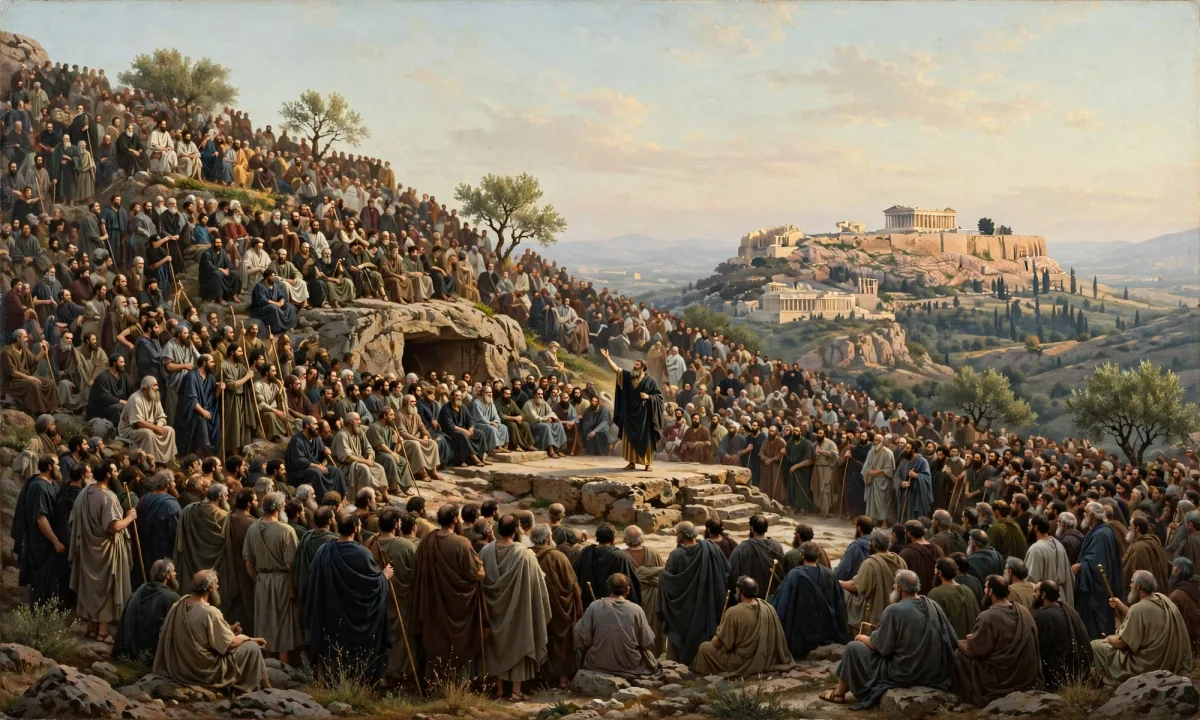
In 508 BCE a Spartan king found himself trapped on the Acropolis of Athens. No army had cornered him: the ordinary people of the city had. On the third day he gave up and marched home, and the Athenians set about inventing a new way to govern themselves.
The tyrant-slayers
For most of the 6th century BCE Athens was run by a tyrant: Peisistratus, and after him his sons. To the Greeks a tyrant was a man who had seized sole power, not necessarily a cruel one, and Peisistratus was remembered as a fairly mild ruler.
In 514 BCE two Athenians, Harmodius and Aristogeiton, stabbed the tyrant's brother Hipparchus to death at a festival. Athens later honoured them with statues as the tyrant-slayers, but Thucydides says the motive was a private quarrel over a love affair, and that the surviving brother, Hippias, only became harsher. He was driven out in 510 BCE by a Spartan army, sent after the oracle at Delphi kept telling Sparta to free Athens. Herodotus says an exiled Athenian family, the Alcmaeonids, had bribed the oracle.

Two days on the Acropolis
With the tyrants gone, two nobles fought for control. Isagoras won the top office for 508/7 BCE. His rival Cleisthenes, an Alcmaeonid, was losing among the aristocratic clubs, so he did something new: in Herodotus' words, he took the common people into partnership.
Isagoras called in his friend Cleomenes, king of Sparta. Cleomenes expelled 700 Athenian families as polluted by an old curse and tried to dissolve the city's council. The council refused, the people rose, and Cleomenes and Isagoras fled to the Acropolis. After a two-day siege they were allowed to leave, and Cleisthenes came home as the people's leader.
Ten new tribes
Cleisthenes rebuilt the citizen body from the ground up. The basic unit became the deme, a village or city district; there were about 140. Every man registered in his deme and was known by its name rather than his father's.
The demes were grouped into ten new tribes, each made up of one piece of the city, one of the coast and one of the inland. Old local loyalties, which aristocratic families had used to build followings, were mixed together. Each tribe sent fifty men to a new Council of 500, which prepared business for the Assembly, and each provided a regiment for the army.
Power in many hands
The Assembly of all citizens, meeting on the Pnyx hill, decided laws, war and peace. Over the next decades Athens filled more and more posts by lot, on the principle that any citizen could serve: from 487 BCE even its chief magistrates, the archons, were picked this way.
Athenians at first described the new order as isonomia, “equality under the law”. The word demokratia, “power of the people”, is first found in writers of the later 5th century BCE.

Who counted, and how to remove a leader
Power of the people meant power of some of the people. Only free adult men of Athenian families were citizens, perhaps 30,000 around 500 BCE, and far more by Pericles' day. Women, slaves and resident foreigners had no vote.
Cleisthenes is also credited with ostracism. Once a year the Assembly could choose to hold one; each citizen scratched a name on a piece of broken pottery, an ostrakon, and the man named most often left Athens for ten years, keeping his property. It was first used in 487 BCE. Herodotus thought the new equality made Athens strong: in 506 BCE its citizen army beat Thebes and Chalcis on the same day.
In their own words
“…his first step was to distribute the whole population into ten tribes in place of the existing four, with the object of intermixing the members of the different tribes, and so securing that more persons might have a share in the franchise.”
Aristotle (attributed), The Athenian Constitution 21.2, c. 330 BCE
Translation by F. G. Kenyon. The treatise was written in Aristotle's school; whether Aristotle himself or a pupil wrote it is debated.
Why it happened
- The expulsion of the tyrant Hippias in 510 BCE left a gap at the top that rival aristocrats fought to fill.
- Losing among the nobles, Cleisthenes won the support of ordinary citizens with a programme of reform.
- Sparta's attempt to install Isagoras provoked the people into besieging the Acropolis, and they did not want to hand power back.
What happened next
- The new citizen army beat Thebes and Chalcis on one day in 506 BCE.
- Sixteen years later, the democracy had to face the Persian Empire at Marathon. Read the story →
- Ostracism became a weapon in Athenian politics, sending Aristides and Themistocles into exile. Read the story →
Why it still matters
Choosing citizens by lot, the Athenian way, is back in use. Ireland's Citizens' Assembly of 2016–18 brought together 99 randomly selected citizens; their recommendation on abortion law led to the 2018 referendum that removed the Eighth Amendment from the Irish constitution.
Key people
- Cleisthenes
- Athenian aristocrat of the Alcmaeonid family who reorganised the citizen body in 508/7 BCE
- Isagoras
- Cleisthenes' rival, chief magistrate in 508/7 BCE, who called in a Spartan army
- Cleomenes I
- King of Sparta who expelled Hippias in 510 BCE and was besieged on the Acropolis in 508 BCE
- Harmodius and Aristogeiton
- Killers of the tyrant's brother Hipparchus in 514 BCE, later honoured as the tyrant-slayers
Key terms
- Tyrant
- A ruler who had seized sole power outside the normal rules; not necessarily a cruel one.
- Deme
- A village or city district: the basic unit of Athenian citizenship after Cleisthenes. There were about 140.
- Council of 500
- Fifty men from each of the ten tribes, who prepared the business the Assembly voted on.
- Ostracism
- A yearly option to exile one citizen for ten years by writing his name on pieces of pottery (ostraka).
- Isonomia
- “Equality under the law”: how Athenians first described the new order, before the word democracy came into use.
Test yourself
What became the basic unit of Athenian citizenship under Cleisthenes?
- The family clan
- The deme, a village or city district
- The army regiment
- The temple of the city's goddess
Show the answer
The deme, a village or city district. Every citizen registered in his deme and was officially named after it. Demes were then grouped into trittyes and ten new tribes.
The full lesson in the app ends with 5 questions like this one.
Connected stories
- The Birth of the Republic: Rome's traditional date for expelling its last king, 509 BCE, falls within a year of Athens expelling its tyrant.
- Pericles and the Golden Age of Athens: Pericles' Athens paid jurors and gave poor citizens a real share in the democracy Cleisthenes founded.
- The Trial and Death of Socrates: A jury of 500 citizens, chosen by lot, condemned Socrates to death in 399 BCE.
- The Declaration of Independence: The American founders admired Greek liberty but chose a representative republic over direct democracy.
Frequently asked questions
Why did Athens become a democracy?
The expulsion of the tyrant Hippias in 510 BCE left a gap at the top that rival aristocrats fought to fill. Losing among the nobles, Cleisthenes won the support of ordinary citizens with a programme of reform. Sparta's attempt to install Isagoras provoked the people into besieging the Acropolis, and they did not want to hand power back.
What happened after Cleisthenes' reforms?
The new citizen army beat Thebes and Chalcis on one day in 506 BCE. Sixteen years later, the democracy had to face the Persian Empire at Marathon. Ostracism became a weapon in Athenian politics, sending Aristides and Themistocles into exile.
What became the basic unit of Athenian citizenship under Cleisthenes?
The deme, a village or city district. Every citizen registered in his deme and was officially named after it. Demes were then grouped into trittyes and ten new tribes.
What is the main primary source for “Cleisthenes and the Birth of Democracy in Athens”?
Aristotle (attributed), The Athenian Constitution 21.2 (c. 330 BCE). Translation by F. G. Kenyon. The treatise was written in Aristotle's school; whether Aristotle himself or a pupil wrote it is debated.
Sources
- Herodotus, Histories, Book 5.55–78
- Aristotle (attributed), The Athenian Constitution, chapters 20–22
- Thucydides, History of the Peloponnesian War 6.53–59
- Paul Cartledge, Democracy: A Life (2016)
Images are credited under each picture. Paintings and photographs come from public collections via Wikimedia Commons; scenes with no surviving image are marked as illustrations.
