Tudors and Reformation Quiz
This Tudors and Reformation quiz has 25 questions, from Luther’s 95 theses and Henry VIII’s break with Rome to Lady Jane Grey, Mary Queen of Scots, the Armada and the Gunpowder Plot, ending with the Peace of Westphalia. Every answer is explained.
Tap an answer to start, or use the keys A to D. No sign-up.
-
1. What did Pope Pius V's 1570 bull declare?
Show the answer
A. That Elizabeth was excommunicated and her subjects freed from obedience. The bull, Regnans in Excelsis, declared Elizabeth a heretic and freed her subjects from loyalty to her. This made Catholic plots against her seem justified to some.
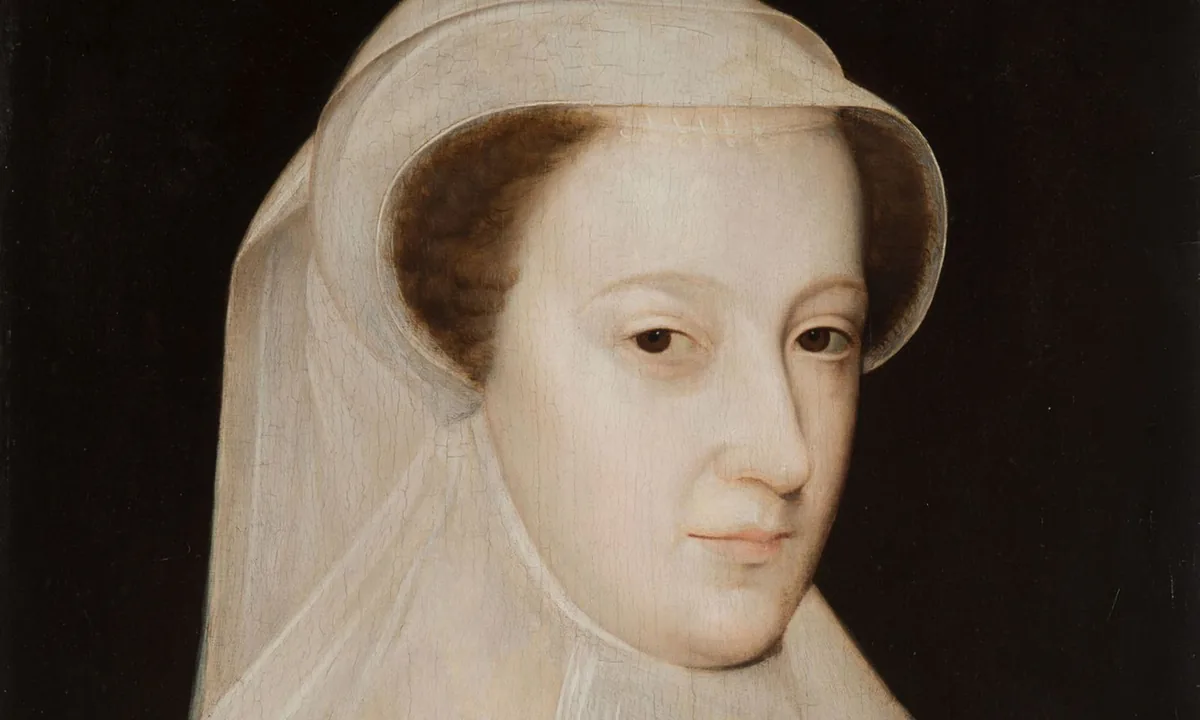
François Clouet, Mary Queen of Scots in the white mourning of French queens, c. 1559–60, Royal Collection: a likeness made in France when Mary was in her late teens. François Clouet (attributed), Royal Collection Trust · Public domain · Wikimedia Commons -
2. Which of Henry VIII's former ministers refused the oath to the new succession and was beheaded in 1535?
Show the answer
C. Thomas More. Thomas More refused the oath and was imprisoned in the Tower of London. He was later convicted of treason for denying the king's supremacy over the Church, and beheaded in July 1535. Cromwell was executed in 1540, Wolsey died in 1530 and Cranmer was burned in 1556.
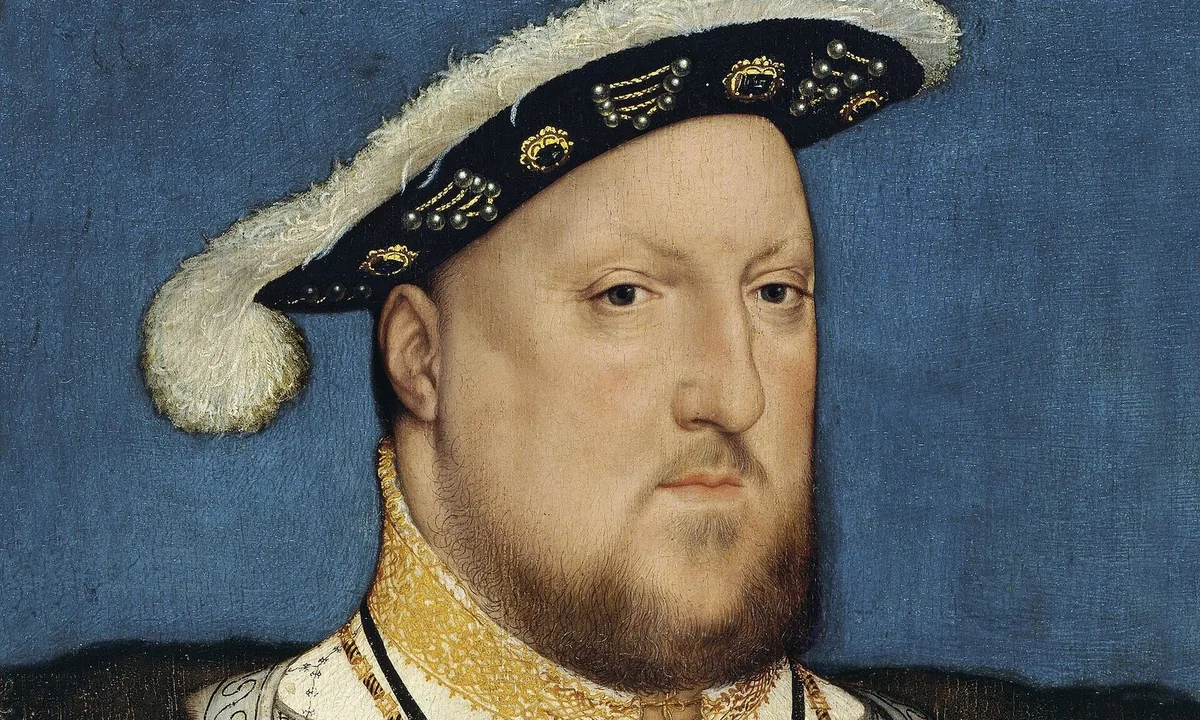
Hans Holbein the Younger, Henry VIII, c. 1537, Museo Thyssen-Bornemisza, Madrid: the king at about forty-six, in a jewelled doublet and feathered hat, painted by the court artist who also designed his Whitehall mural. Hans Holbein the Younger · Public domain · Wikimedia Commons -
3. Historians have found solid evidence that Robert Cecil invented the Gunpowder Plot.
Show the answer
B. False. The theory is old, but historians have found no solid evidence for it. The conspiracy was real, though Cecil used it to make the laws against Catholics harsher.
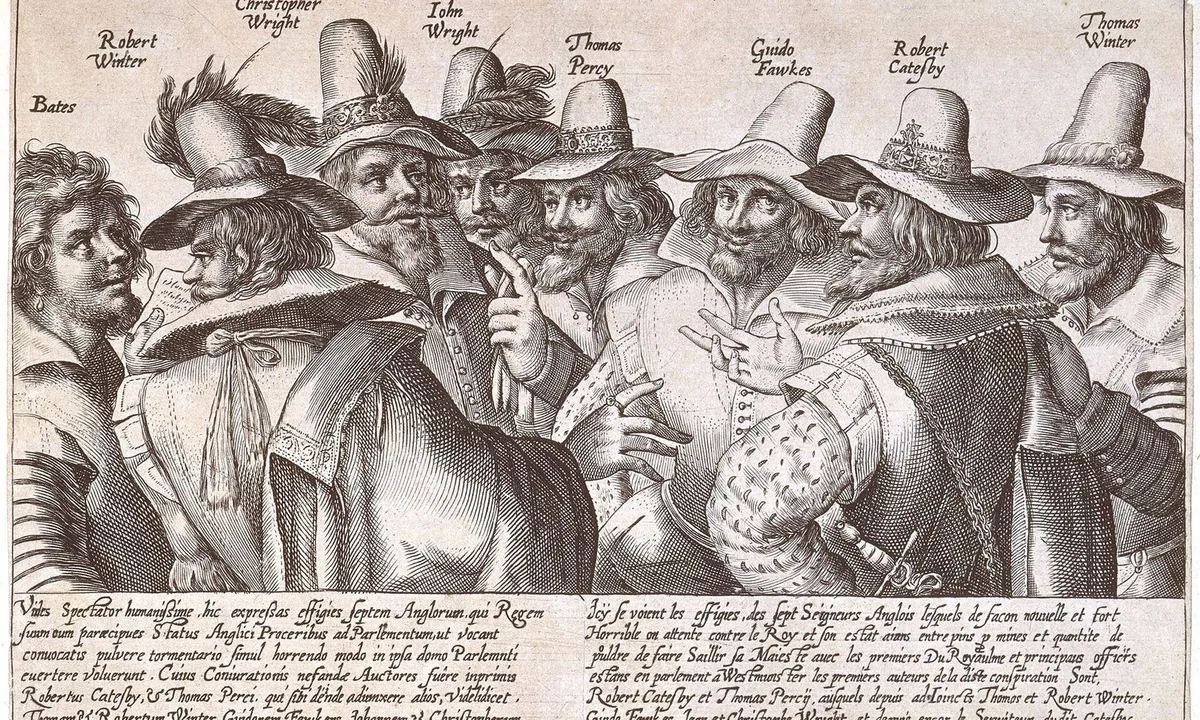
Crispijn van de Passe the Elder, The Gunpowder Plot conspirators, engraving, 1605, National Portrait Gallery, London: eight plotters, each named above his head, with Guido Fawkes third from the right. The Dutch engraver probably never met them. Crispijn van de Passe the Elder · Public domain · Wikimedia Commons -
4. In Luther's time, what was an indulgence?
Show the answer
C. A certificate reducing the punishment owed for sins. An indulgence reduced the punishment still owed for sins that were already forgiven, in this life or in purgatory. Luther objected to selling them as if forgiveness could be bought.
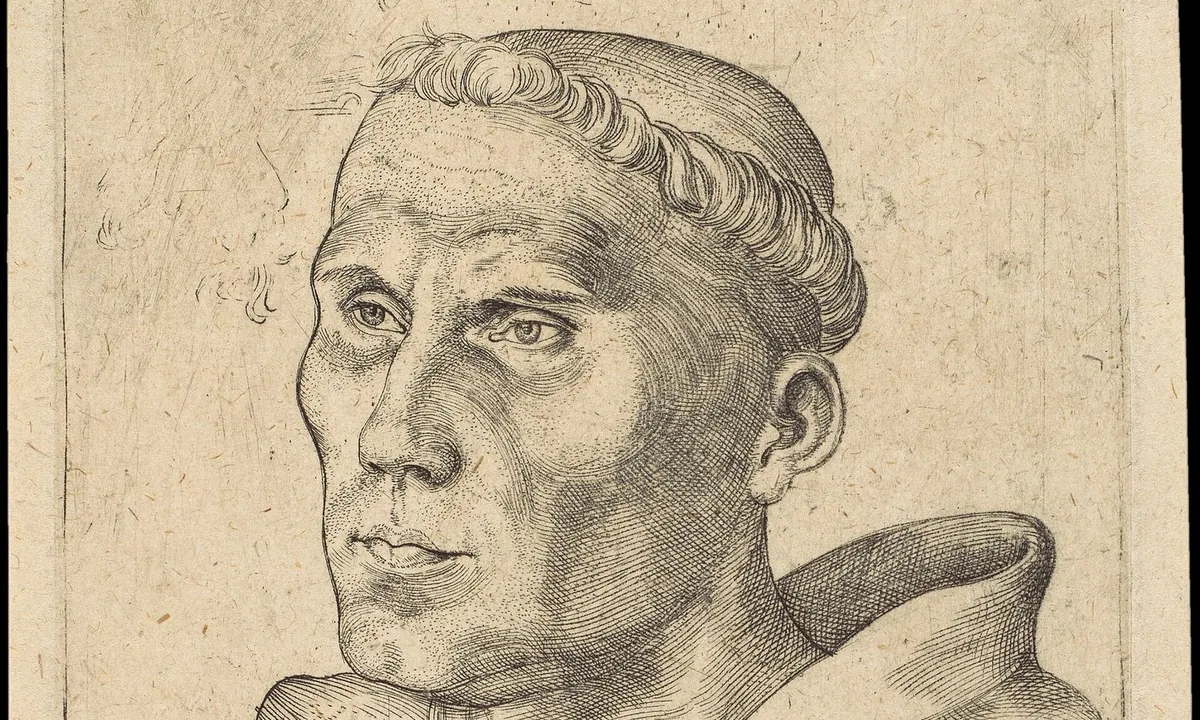
Lucas Cranach the Elder, Martin Luther as an Augustinian Monk, engraving, 1520, Metropolitan Museum of Art, New York: the friar who challenged the pope, portrayed by the Wittenberg painter just as the quarrel with Rome became unavoidable. Lucas Cranach the Elder · Metropolitan Museum of Art, CC0 · Wikimedia Commons -
5. Why did the Armada fail to link up with Parma's army?
Show the answer
C. It had no deep-water port in Flanders and no way to communicate with him. The big ships had no safe harbour near Parma's army, and no way to coordinate with him. Dutch ships also threatened Parma's barges.
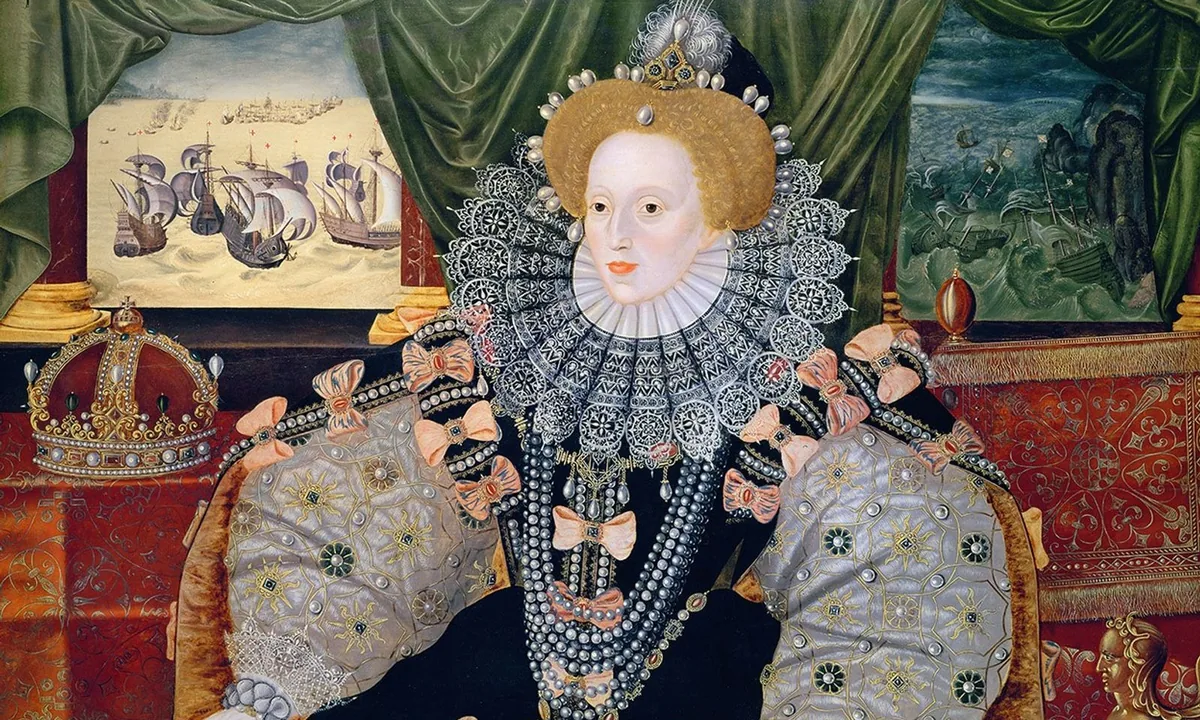
The Armada Portrait of Elizabeth I, c. 1588, Woburn Abbey version (formerly attributed to George Gower): her hand rests on a globe, and the windows behind show English fireships and Spanish ships wrecked in a storm. Unknown artist, formerly attributed to George Gower (Woburn Abbey) · Public domain · Wikimedia Commons -
6. “Here I stand, I can do no other” appears in the earliest records of Luther's speech at Worms.
Show the answer
B. False. The line is traditional. It is not in the notes taken at the hearing and may have been added when the speech was printed.
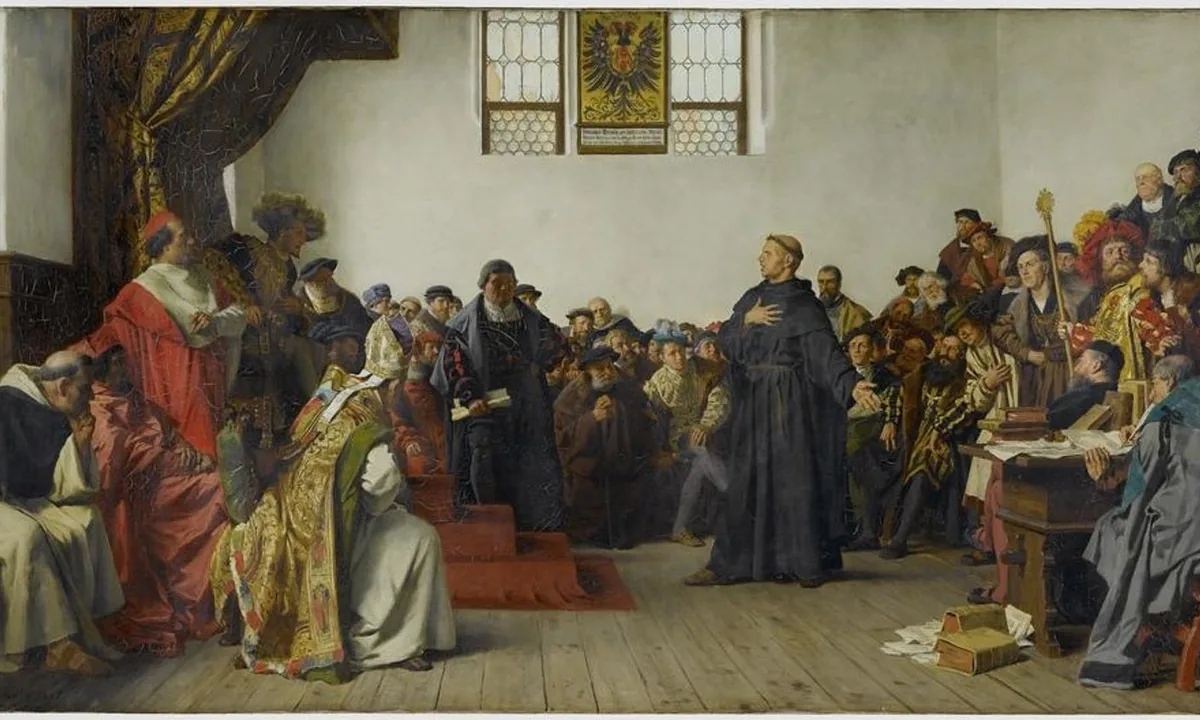
Anton von Werner, Luther at the Diet of Worms, 1877, Staatsgalerie Stuttgart: a painting made more than 350 years later, imagining Luther with his hand on his heart answering the assembly on 18 April 1521. The faces and room are the artist's invention. Anton von Werner · Public domain · Wikimedia Commons -
7. What was Elizabeth's Act of Uniformity of 1559?
Show the answer
B. It required use of the English Book of Common Prayer and fined absence from church. The Act of Uniformity enforced one form of worship, the Prayer Book. It fined those who did not attend church.
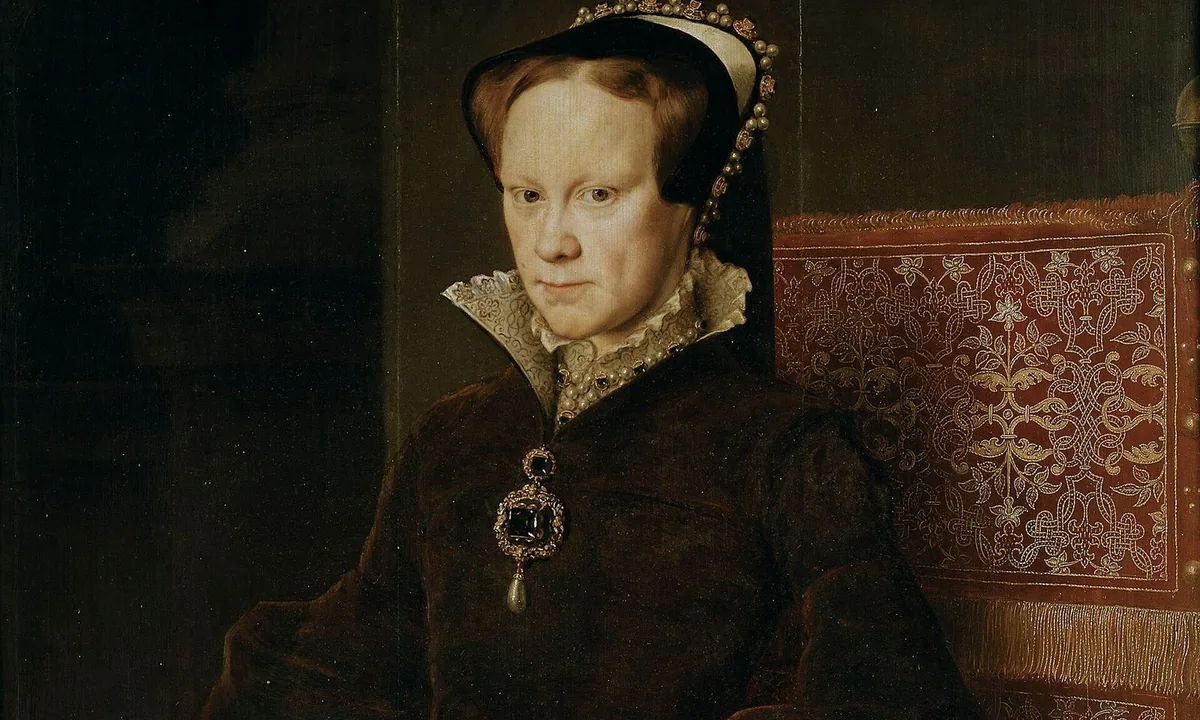
Antonis Mor, Mary I of England, 1554, Museo del Prado, Madrid: painted in the year she married Philip of Spain, by the Habsburg court painter, who shows the queen holding a rose. Antonis Mor · Public domain · Wikimedia Commons -
8. Why was Mary Queen of Scots so dangerous to Elizabeth?
Show the answer
D. Catholics saw her as the rightful heir to the English throne. As Henry VII's great-granddaughter, Mary had a strong claim. Catholics thought Henry VIII's second marriage was invalid, so they saw Elizabeth as illegitimate.
François Clouet, Mary Queen of Scots in the white mourning of French queens, c. 1559–60, Royal Collection: a likeness made in France when Mary was in her late teens. François Clouet (attributed), Royal Collection Trust · Public domain · Wikimedia Commons -
9. Why did Pope Clement VII fail to grant Henry an annulment?
Show the answer
A. Charles V, Catherine's nephew, held power over him after the sack of Rome. After Imperial troops sacked Rome in 1527, Clement was in practice under Charles V's control. Charles would not let his aunt be put aside.
Hans Holbein the Younger, Henry VIII, c. 1537, Museo Thyssen-Bornemisza, Madrid: the king at about forty-six, in a jewelled doublet and feathered hat, painted by the court artist who also designed his Whitehall mural. Hans Holbein the Younger · Public domain · Wikimedia Commons -
10. Why did some Catholics start plotting against James I?
Show the answer
B. He disappointed hopes of toleration and kept fining Catholics. Catholics hoped for toleration, the freedom to practise their faith, from a king whose mother was Catholic. Instead the fines continued and priests were banished. This pushed a few to violence.
Crispijn van de Passe the Elder, The Gunpowder Plot conspirators, engraving, 1605, National Portrait Gallery, London: eight plotters, each named above his head, with Guido Fawkes third from the right. The Dutch engraver probably never met them. Crispijn van de Passe the Elder · Public domain · Wikimedia Commons -
11. The one thing we know for certain about 31 October 1517 is that Luther sent his theses in a letter to Archbishop Albrecht.
Show the answer
A. True. The letter to Albrecht is recorded in documents. The nailing story comes from Melanchthon after Luther's death, and Luther never mentioned it.
Lucas Cranach the Elder, Martin Luther as an Augustinian Monk, engraving, 1520, Metropolitan Museum of Art, New York: the friar who challenged the pope, portrayed by the Wittenberg painter just as the quarrel with Rome became unavoidable. Lucas Cranach the Elder · Metropolitan Museum of Art, CC0 · Wikimedia Commons -
12. Elizabeth's “heart and stomach of a king” speech at Tilbury was written down at the time she gave it.
Show the answer
B. False. The famous wording comes from a letter written by Leonel Sharp some thirty-five years later, and earlier versions differ.
The Armada Portrait of Elizabeth I, c. 1588, Woburn Abbey version (formerly attributed to George Gower): her hand rests on a globe, and the windows behind show English fireships and Spanish ships wrecked in a storm. Unknown artist, formerly attributed to George Gower (Woburn Abbey) · Public domain · Wikimedia Commons -
13. Why could Charles V not enforce the Edict of Worms in Germany?
Show the answer
B. He was fighting France and the Ottomans and needed the German princes. Charles needed the princes' money and soldiers for his wars, so he could not afford civil war in Germany. Many princes ignored the Edict.
Anton von Werner, Luther at the Diet of Worms, 1877, Staatsgalerie Stuttgart: a painting made more than 350 years later, imagining Luther with his hand on his heart answering the assembly on 18 April 1521. The faces and room are the artist's invention. Anton von Werner · Public domain · Wikimedia Commons -
14. Who did the Duke of Northumberland try to put on the throne after Edward VI's death?
Show the answer
A. Lady Jane Grey. Northumberland named Lady Jane Grey to keep Protestant rule. She lasted nine days before Mary took the throne.
Antonis Mor, Mary I of England, 1554, Museo del Prado, Madrid: painted in the year she married Philip of Spain, by the Habsburg court painter, who shows the queen holding a rose. Antonis Mor · Public domain · Wikimedia Commons -
15. Mary Queen of Scots was executed because she took part in the murder of Lord Darnley.
Show the answer
B. False. She was executed in 1587 for plotting against Elizabeth, in the Babington plot. Her part in Darnley's murder in 1567 is still argued about.
François Clouet, Mary Queen of Scots in the white mourning of French queens, c. 1559–60, Royal Collection: a likeness made in France when Mary was in her late teens. François Clouet (attributed), Royal Collection Trust · Public domain · Wikimedia Commons -
16. A painted portrait of Anne Boleyn made during her lifetime survives.
Show the answer
B. False. The well-known portraits are later copies of lost originals. A lead medal of 1534 in the British Museum is the only likeness generally accepted as made in her lifetime.
Hans Holbein the Younger, Henry VIII, c. 1537, Museo Thyssen-Bornemisza, Madrid: the king at about forty-six, in a jewelled doublet and feathered hat, painted by the court artist who also designed his Whitehall mural. Hans Holbein the Younger · Public domain · Wikimedia Commons -
17. Why did Luther's theses spread across Germany in weeks rather than years?
Show the answer
A. Printers copied and translated them quickly. Printers in Nuremberg, Leipzig and Basel reprinted the Latin text and had it translated into German. Luther had meant a debate among scholars, but the press made it public.
Lucas Cranach the Elder, Martin Luther as an Augustinian Monk, engraving, 1520, Metropolitan Museum of Art, New York: the friar who challenged the pope, portrayed by the Wittenberg painter just as the quarrel with Rome became unavoidable. Lucas Cranach the Elder · Metropolitan Museum of Art, CC0 · Wikimedia Commons -
18. What broke the Armada's formation at Calais?
Show the answer
A. English fireships. Eight fireships were sent into the anchored fleet. They panicked the Spaniards, who cut their anchor cables and scattered.
The Armada Portrait of Elizabeth I, c. 1588, Woburn Abbey version (formerly attributed to George Gower): her hand rests on a globe, and the windows behind show English fireships and Spanish ships wrecked in a storm. Unknown artist, formerly attributed to George Gower (Woburn Abbey) · Public domain · Wikimedia Commons -
19. Why did Luther travel to Worms in 1521?
Show the answer
B. Emperor Charles V summoned him to answer for his writings. Charles V summoned him to the Diet and gave him a safe-conduct, a promise of safe travel. Luther had already been excommunicated by the pope in January 1521.
Anton von Werner, Luther at the Diet of Worms, 1877, Staatsgalerie Stuttgart: a painting made more than 350 years later, imagining Luther with his hand on his heart answering the assembly on 18 April 1521. The faces and room are the artist's invention. Anton von Werner · Public domain · Wikimedia Commons -
20. Elizabeth's 1559 Act of Supremacy made her “Supreme Governor” rather than “Supreme Head” of the Church.
Show the answer
A. True. The title “Governor” avoided the objection that a woman could not be “head” of the Church, as her father had been.
Antonis Mor, Mary I of England, 1554, Museo del Prado, Madrid: painted in the year she married Philip of Spain, by the Habsburg court painter, who shows the queen holding a rose. Antonis Mor · Public domain · Wikimedia Commons -
21. How did Walsingham's agents intercept the letters of Mary Queen of Scots in 1586?
Show the answer
B. By copying letters smuggled in and out of her prison in a beer barrel. Mary's letters were hidden in a brewer's barrel at Chartley Hall. Walsingham's team intercepted them, decoded them and copied them before sending them on.
François Clouet, Mary Queen of Scots in the white mourning of French queens, c. 1559–60, Royal Collection: a likeness made in France when Mary was in her late teens. François Clouet (attributed), Royal Collection Trust · Public domain · Wikimedia Commons -
22. What did Henry VIII's Act of Supremacy of 1534 declare?
Show the answer
C. That Henry was supreme head of the Church of England. The Act made the king supreme head of the English Church. The closing of the monasteries began in 1536.
Hans Holbein the Younger, Henry VIII, c. 1537, Museo Thyssen-Bornemisza, Madrid: the king at about forty-six, in a jewelled doublet and feathered hat, painted by the court artist who also designed his Whitehall mural. Hans Holbein the Younger · Public domain · Wikimedia Commons -
23. Why did Catholic France enter the war on the Protestant side in 1635?
Show the answer
A. Richelieu wanted to weaken the Habsburgs, who surrounded France. Richelieu put the interests of the state above religion. Breaking Habsburg power mattered more to France than the faith of its allies.
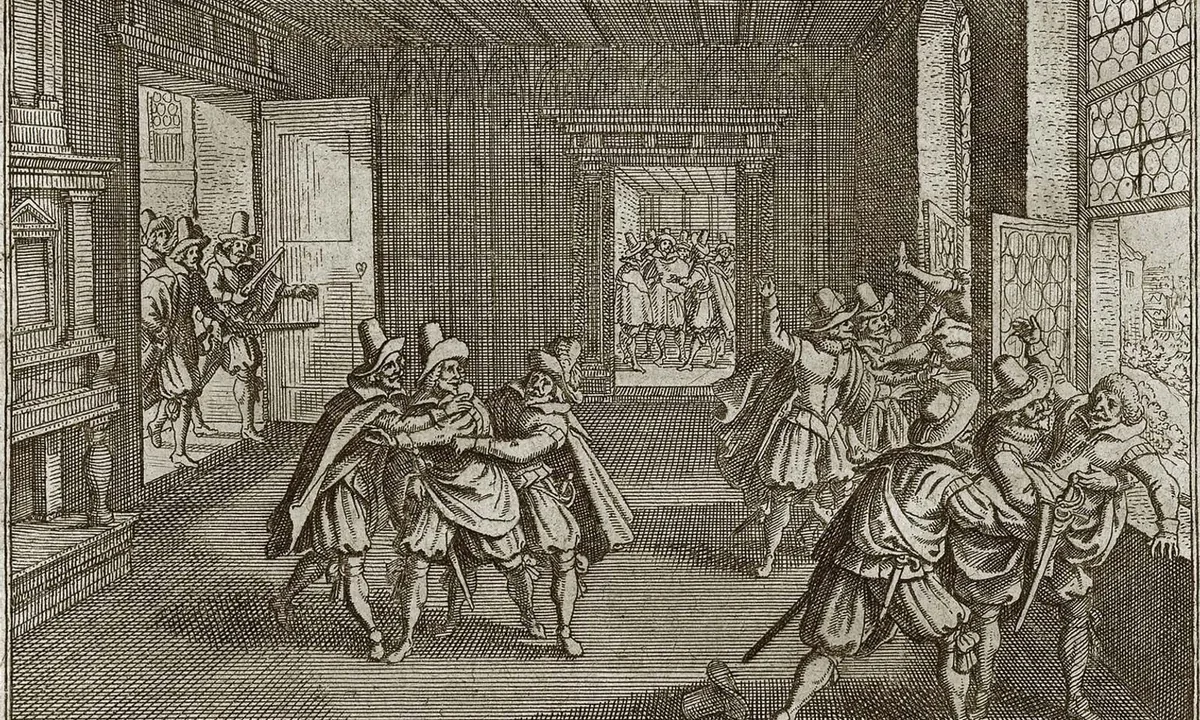
Matthäus Merian, The Defenestration of Prague, 23 May 1618, engraving from the Theatrum Europaeum, vol. 1 (first published 1635; this copy from the 1662 edition): Bohemian nobles seize the royal officials in a room before throwing them from the window. Matthäus Merian the Elder (engraver), in Theatrum Europaeum · Public domain · Wikimedia Commons -
24. Which event is traditionally seen as starting the Thirty Years' War?
Show the answer
B. The Defenestration of Prague. Bohemian nobles threw royal officials from a window of Prague Castle in May 1618. White Mountain came in 1620 and Magdeburg in 1631.
Matthäus Merian, The Defenestration of Prague, 23 May 1618, engraving from the Theatrum Europaeum, vol. 1 (first published 1635; this copy from the 1662 edition): Bohemian nobles seize the royal officials in a room before throwing them from the window. Matthäus Merian the Elder (engraver), in Theatrum Europaeum · Public domain · Wikimedia Commons -
25. What did the Peace of Westphalia change about the 1555 Peace of Augsburg?
Show the answer
C. It extended its terms to Calvinists. The Augsburg rule that each ruler chose his territory's religion was confirmed and extended to Calvinists.
Matthäus Merian, The Defenestration of Prague, 23 May 1618, engraving from the Theatrum Europaeum, vol. 1 (first published 1635; this copy from the 1662 edition): Bohemian nobles seize the royal officials in a room before throwing them from the window. Matthäus Merian the Elder (engraver), in Theatrum Europaeum · Public domain · Wikimedia Commons
Your score
You got right. Want the stories behind them?
Aurelius: Learn History has 700+ more questions like these, each one after the five-minute illustrated story it comes from, across 18 eras. Free to try.
Play next: French Revolution and Napoleon Quiz · Medieval History Quiz · History Quiz
About this quiz
Many questions test the stories everyone half-knows: whether Luther nailed the theses to the door, whether “Here I stand” was ever said, and how Elizabeth’s Tilbury speech was recorded.
The questions come from 8 lessons in the app: Mary Queen of Scots and the Plot Against Elizabeth, Henry VIII, Anne Boleyn and the Break with Rome, The Gunpowder Plot, 1605, Luther and the 95 Theses, The Armada, 1588, The Diet of Worms and a Europe Split, Bloody Mary and Elizabeth's Settlement, The Thirty Years' War.
Questions are labelled easy, medium or hard by the level of the lesson they come from, and the quiz plays in that order, medium to hard. There are 700+ more in the Aurelius: Learn History app.
Frequently asked questions
How many questions are in the Tudors and Reformation Quiz?
25: 22 medium and 3 hard, played medium to hard. 18 are multiple choice and 7 true or false. Every answer is explained, with the picture of the story behind it, and at the end you see your score by level.
Is the Tudors and Reformation Quiz free?
Yes. It plays in your browser with no account and no sign-up. For more, Aurelius: Learn History has 700+ questions like these, each after a short illustrated lesson. The app is free to download and try on iPhone, iPad and Android.
Where do the questions come from?
From the lessons in Aurelius: Learn History. Every question follows a short illustrated story in the app and is written and checked by the Aurelius editorial team. The easy, medium and hard labels are the levels of those lessons. See how lessons are checked.
Which quiz should I play next?
Try the French Revolution and Napoleon Quiz, the Medieval History Quiz and the History Quiz. All quizzes are listed at the end of this page.
More history quizzes
- French Revolution and Napoleon QuizFrom the Bastille to Waterloo.
- Medieval History Quiz: The Middle AgesFrom Charlemagne and the Vikings to the Black Death.
- History QuizThe all-round history quiz across many eras.
- World War 2 QuizFrom the invasion of Poland to Bastogne.
- WW1 Quiz: World War 1 Questions and AnswersFrom the Archduke’s assassination to Versailles.
- American History QuizThe Revolution and the Civil War: US history trivia.
- Cold War QuizBerlin, Cuba, Vietnam and the space race.
- Ancient Egypt QuizPharaohs, pyramids, mummies and the Rosetta Stone.
- Ancient Rome QuizRepublic, Caesar and empire.
- Ancient Greece QuizAthens, Sparta, Persia and Alexander.
- World History QuizOne game across world history.
- 100 History Trivia Questions and Answers100 questions with answers for quiz nights and classrooms.