WW1 Quiz: World War 1 Questions and Answers
This WW1 quiz has 35 questions, from the assassination of Franz Ferdinand and the taxis of the Marne to Verdun, the Somme, poison gas, the Lusitania and the Treaty of Versailles. It starts easy and gets harder, and every answer is explained.
Tap an answer to start, or use the keys A to D. No sign-up.
-
1. Britain had promised to protect a neutral country. Germany’s invasion of which country brought Britain into the war?
Show the answer
A. Belgium. In the 1839 Treaty of London, Britain had promised to protect Belgium’s neutrality. When German troops crossed into Belgium on 4 August 1914, Britain went to war to keep that promise.
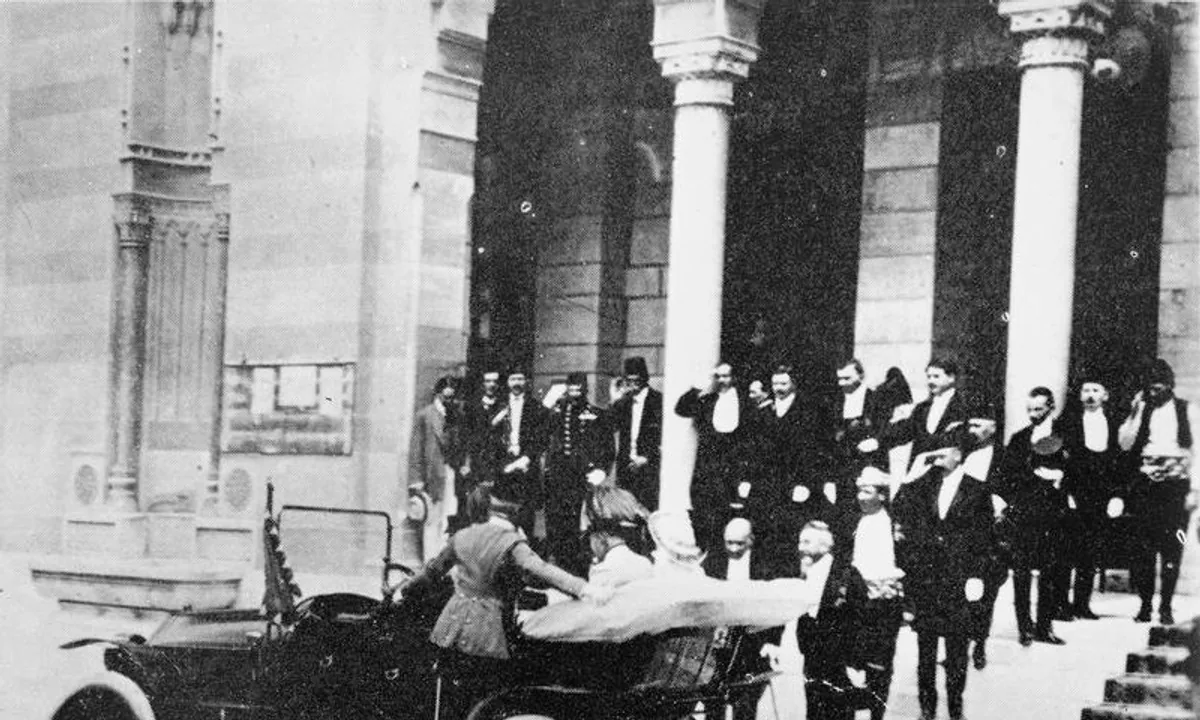
Archduke Franz Ferdinand and his wife Sophie get into their car outside Sarajevo City Hall on 28 June 1914, minutes before Gavrilo Princip shot them both. Unknown photographer, 1914 · Public domain · Wikimedia Commons -
2. The Ottoman Empire fought on the side of the Allies in the First World War.
Show the answer
B. False. The Ottoman Empire joined the Central Powers, Germany and Austria-Hungary, in 1914. The Allies included France, Russia, Britain and, later, Italy and the United States.
Archduke Franz Ferdinand and his wife Sophie get into their car outside Sarajevo City Hall on 28 June 1914, minutes before Gavrilo Princip shot them both. Unknown photographer, 1914 · Public domain · Wikimedia Commons -
3. Why did Gavrilo Princip and his group want to kill Archduke Franz Ferdinand?
Show the answer
D. They wanted Bosnia freed and joined to Serbia. Princip was a Bosnian Serb nationalist. Austria-Hungary ruled Bosnia, and he wanted Bosnia to leave the empire and join Serbia. Killing the heir to the throne was meant to strike at the empire itself.
Archduke Franz Ferdinand and his wife Sophie get into their car outside Sarajevo City Hall on 28 June 1914, minutes before Gavrilo Princip shot them both. Unknown photographer, 1914 · Public domain · Wikimedia Commons -
4. Why did Germany declare war on France as well as on Russia in August 1914?
Show the answer
B. Germany’s plan was to beat France first, then Russia. German generals feared a war on two fronts. France was Russia’s ally, so once Russia mobilised, Germany’s war plan was to knock France out quickly and then turn east against Russia.
Archduke Franz Ferdinand and his wife Sophie get into their car outside Sarajevo City Hall on 28 June 1914, minutes before Gavrilo Princip shot them both. Unknown photographer, 1914 · Public domain · Wikimedia Commons -
5. Why did convoys help to defeat the U-boats?
Show the answer
B. Grouped ships with warship escorts were harder to attack. On a wide ocean, one group of ships was much harder to find than many ships sailing alone. Warships guarding the group could attack any U-boat with depth charges.
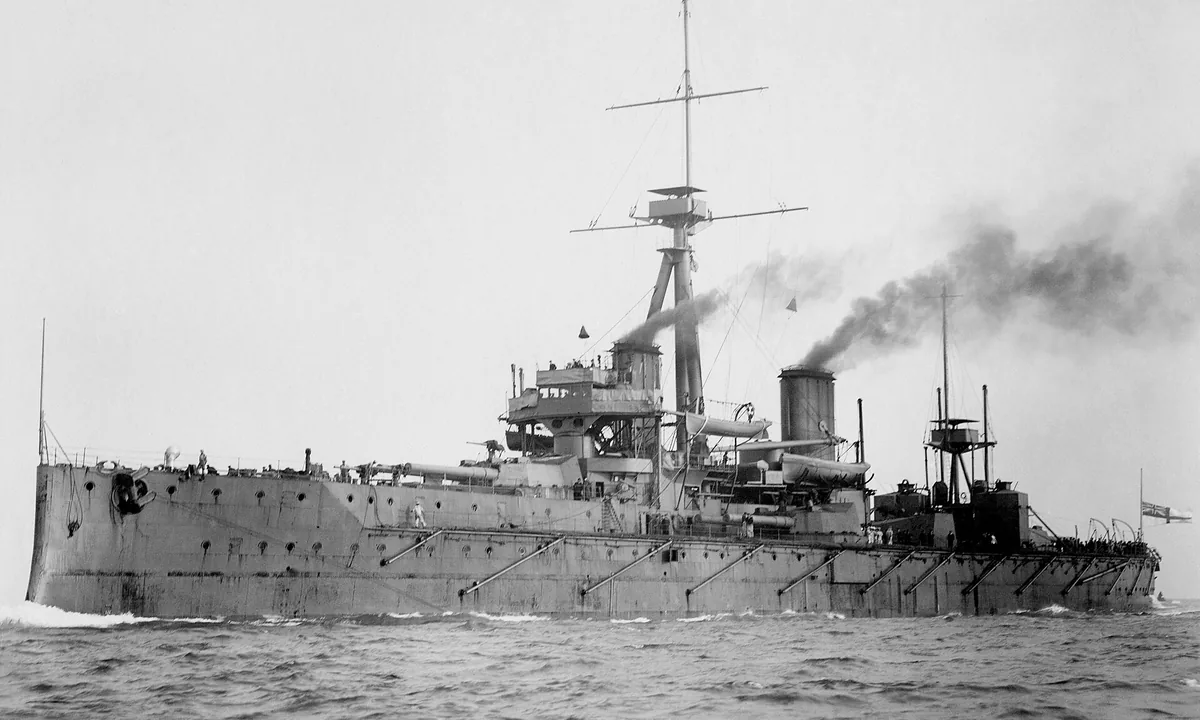
HMS Dreadnought, the revolutionary all-big-gun battleship of 1906 that sparked the Anglo-German naval race; fleets of 'dreadnoughts' clashed at Jutland in 1916. U.S. Naval History and Heritage Command · Public domain · Wikimedia Commons -
6. Why did many Americans turn against Germany between 1915 and 1917?
Show the answer
A. German U-boats sank ships and Germany courted Mexico. U-boats sank the Lusitania in 1915, killing 128 Americans, and from 1917 attacked any ship near Britain. The Zimmermann Telegram then showed Germany offering Mexico an alliance against the United States.
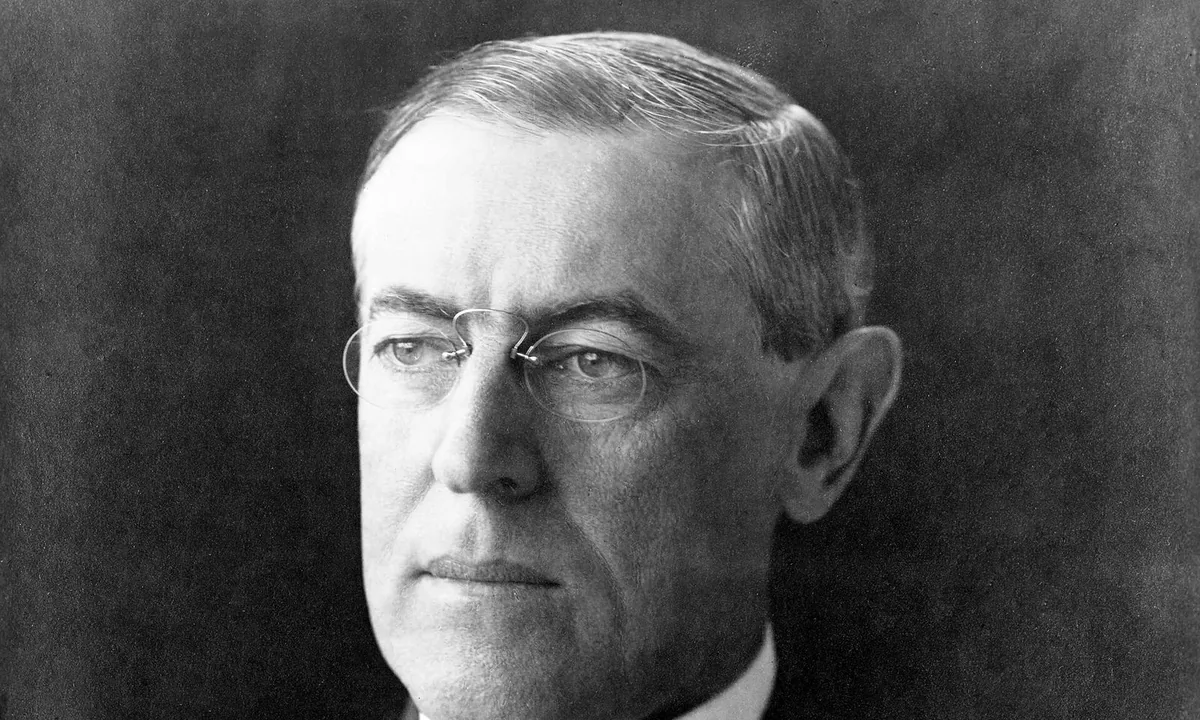
Woodrow Wilson, photographed by Pach Brothers in December 1912, shortly after his election as the 28th President of the United States. Pach Brothers, 1912 · Public domain · Wikimedia Commons -
7. Poison gas and tanks quickly ended the trench stalemate as soon as they were first used.
Show the answer
B. False. For years the new weapons mostly added to the killing. Only in 1918 did the Allies learn to use tanks, aircraft and artillery together and break through, as at Amiens.
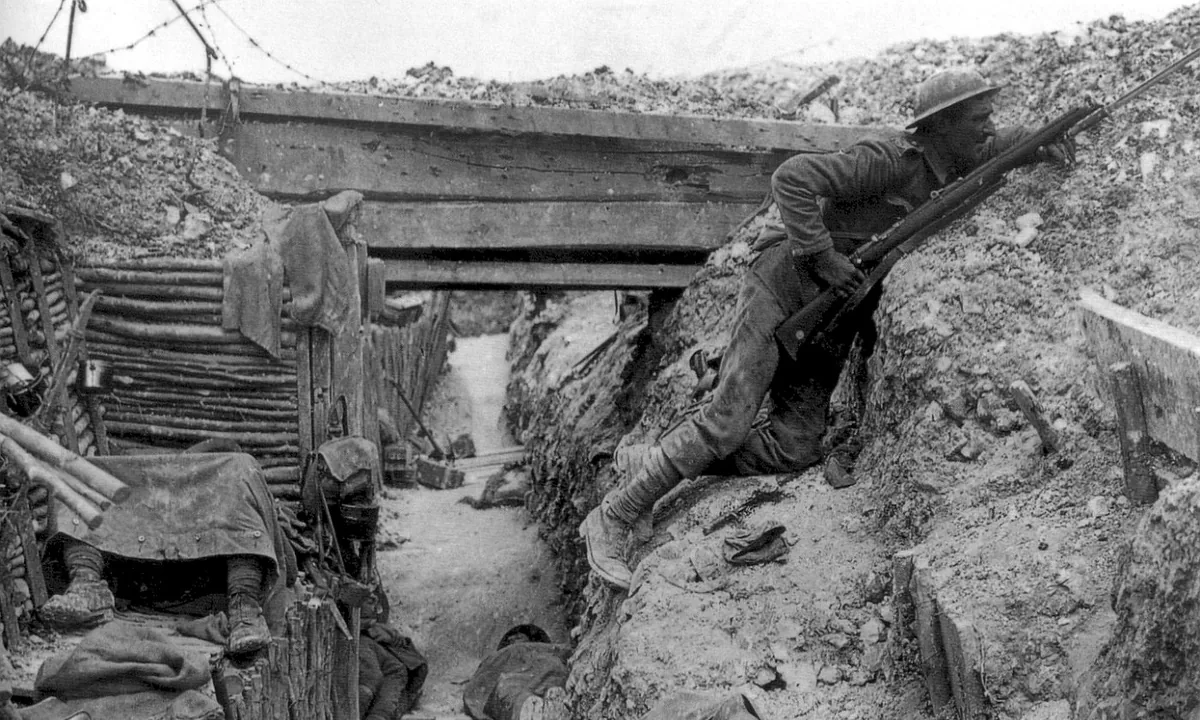
A sentry keeps watch while comrades sleep in a captured German trench at Ovillers-la-Boisselle on the Somme, July 1916 (A Company, 11th Battalion, Cheshire Regiment). John Warwick Brooke, 1916 · Public domain · Wikimedia Commons -
8. After the Battle of the Marne, Germany’s plan for a quick victory had failed.
Show the answer
A. True. The German retreat to the Aisne saved Paris and ended the Schlieffen Plan. Both sides dug in, and years of trench warfare followed.
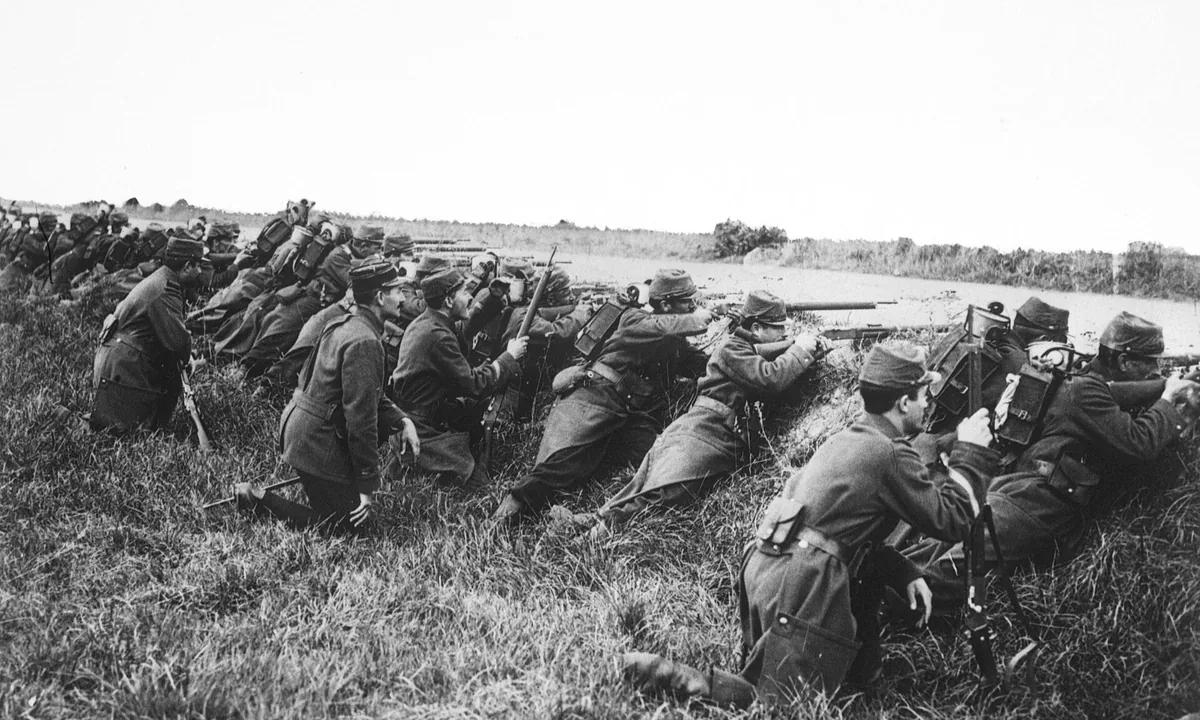
French infantry fire from a roadside ditch in September 1914, during the fighting on the Marne that stopped the German advance on Paris. Unknown photographer, 1914 · Public domain · Wikimedia Commons -
9. How was Kaiser Wilhelm II related to King George V of Britain?
Show the answer
B. Cousin. Both men were grandsons of Queen Victoria, so they were cousins. Wilhelm was also a more distant cousin of Tsar Nicholas II.
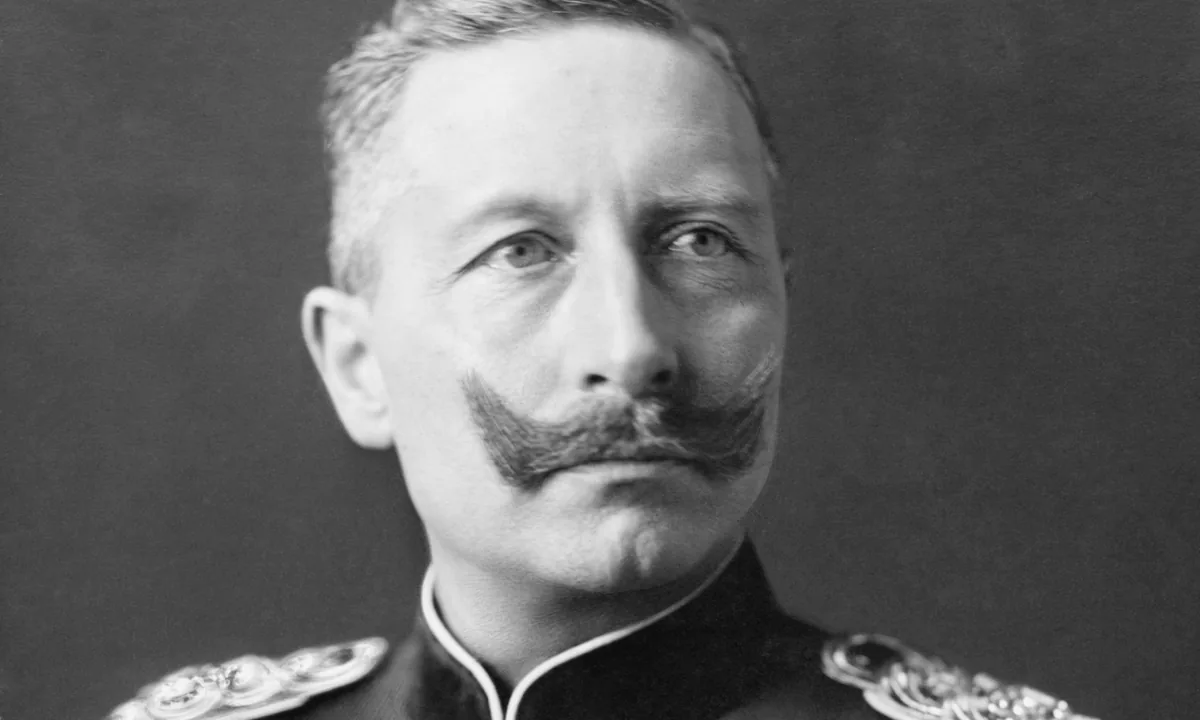
Kaiser Wilhelm II, German Emperor and King of Prussia, in uniform with his famous upturned moustache, photographed in 1902. T. H. Voigt, 1902 · Public domain · Wikimedia Commons -
10. Why did Germany restart unrestricted submarine warfare in February 1917?
Show the answer
C. To starve Britain before an American army could arrive. German leaders gambled that U-boats could force Britain to give up quickly. The gamble failed: U-boats killed American sailors, and the United States declared war on 6 April 1917.
HMS Dreadnought, the revolutionary all-big-gun battleship of 1906 that sparked the Anglo-German naval race; fleets of 'dreadnoughts' clashed at Jutland in 1916. U.S. Naval History and Heritage Command · Public domain · Wikimedia Commons -
11. What was the name of Woodrow Wilson's plan for peace, set out in January 1918?
Show the answer
C. The Fourteen Points. The Fourteen Points included free trade, self-determination and, as the last point, a League of Nations where countries would settle disputes peacefully.
Woodrow Wilson, photographed by Pach Brothers in December 1912, shortly after his election as the 28th President of the United States. Pach Brothers, 1912 · Public domain · Wikimedia Commons -
12. Why did most attacks across No Man’s Land fail before 1918?
Show the answer
D. Machine guns and barbed wire favoured the defenders. Attackers had to cross open ground under machine-gun and artillery fire and get through barbed wire. Even then, the defenders had more trench lines behind the first one.
A sentry keeps watch while comrades sleep in a captured German trench at Ovillers-la-Boisselle on the Somme, July 1916 (A Company, 11th Battalion, Cheshire Regiment). John Warwick Brooke, 1916 · Public domain · Wikimedia Commons -
13. Why did a gap open between the German First and Second Armies on the Marne?
Show the answer
B. Kluck turned his army west to meet a French attack. The French Sixth Army attacked Kluck’s open side from the direction of Paris. When Kluck turned west to face it, he pulled away from Bülow’s Second Army, and British and French troops moved into the gap.
French infantry fire from a roadside ditch in September 1914, during the fighting on the Marne that stopped the German advance on Paris. Unknown photographer, 1914 · Public domain · Wikimedia Commons -
14. Why did Britain come to see Kaiser Wilhelm II's Germany as a threat before World War I?
Show the answer
D. Germany was building a large battle fleet. Britain was an island that depended on its navy. When Germany built a large battle fleet from 1898, with Wilhelm's strong support, the British saw a direct challenge to their control of the seas.
Kaiser Wilhelm II, German Emperor and King of Prussia, in uniform with his famous upturned moustache, photographed in 1902. T. H. Voigt, 1902 · Public domain · Wikimedia Commons -
15. Why did many Americans turn against Germany in 1915?
Show the answer
D. A U-boat sank a liner without warning, killing Americans. On 7 May 1915 a U-boat sank the British liner Lusitania without warning. About 128 of the 1,198 dead were Americans, citizens of a country that was still neutral.
HMS Dreadnought, the revolutionary all-big-gun battleship of 1906 that sparked the Anglo-German naval race; fleets of 'dreadnoughts' clashed at Jutland in 1916. U.S. Naval History and Heritage Command · Public domain · Wikimedia Commons -
16. When Woodrow Wilson asked Congress for war in 1917, what did he say America would fight for?
Show the answer
D. A world safe for democracy. Wilson said America had no selfish aims and wanted no conquest. “The world must be made safe for democracy,” he told Congress.
Woodrow Wilson, photographed by Pach Brothers in December 1912, shortly after his election as the 28th President of the United States. Pach Brothers, 1912 · Public domain · Wikimedia Commons -
17. Gallieni needed fresh troops at the front fast. Which civilian vehicles famously carried some of them?
Show the answer
A. Paris taxis. About 600 Paris taxis carried several thousand soldiers. Most reinforcements came by train, but the taxis became a symbol of French determination.
French infantry fire from a roadside ditch in September 1914, during the fighting on the Marne that stopped the German advance on Paris. Unknown photographer, 1914 · Public domain · Wikimedia Commons -
18. Kaiser Wilhelm II himself announced his abdication in Berlin on 9 November 1918.
Show the answer
B. False. Wilhelm was at army headquarters at Spa, in Belgium. In Berlin, the chancellor, Prince Max of Baden, announced the abdication without his agreement.
Kaiser Wilhelm II, German Emperor and King of Prussia, in uniform with his famous upturned moustache, photographed in 1902. T. H. Voigt, 1902 · Public domain · Wikimedia Commons -
19. What was the most important result of the Battle of Jutland in 1916?
Show the answer
A. Britain kept control of the seas. Britain lost more ships and men, but Scheer’s fleet escaped home and never again risked a full battle. So the British blockade of Germany went on.
HMS Dreadnought, the revolutionary all-big-gun battleship of 1906 that sparked the Anglo-German naval race; fleets of 'dreadnoughts' clashed at Jutland in 1916. U.S. Naval History and Heritage Command · Public domain · Wikimedia Commons -
20. Where did the Germans launch the war’s first large-scale chlorine gas attack, in April 1915?
Show the answer
D. Second Battle of Ypres. On 22 April 1915, at the start of the Second Battle of Ypres in Belgium, the Germans released about 150 tonnes of chlorine from some 6,000 cylinders. Britain’s own first chlorine attack came later, at Loos in September 1915.
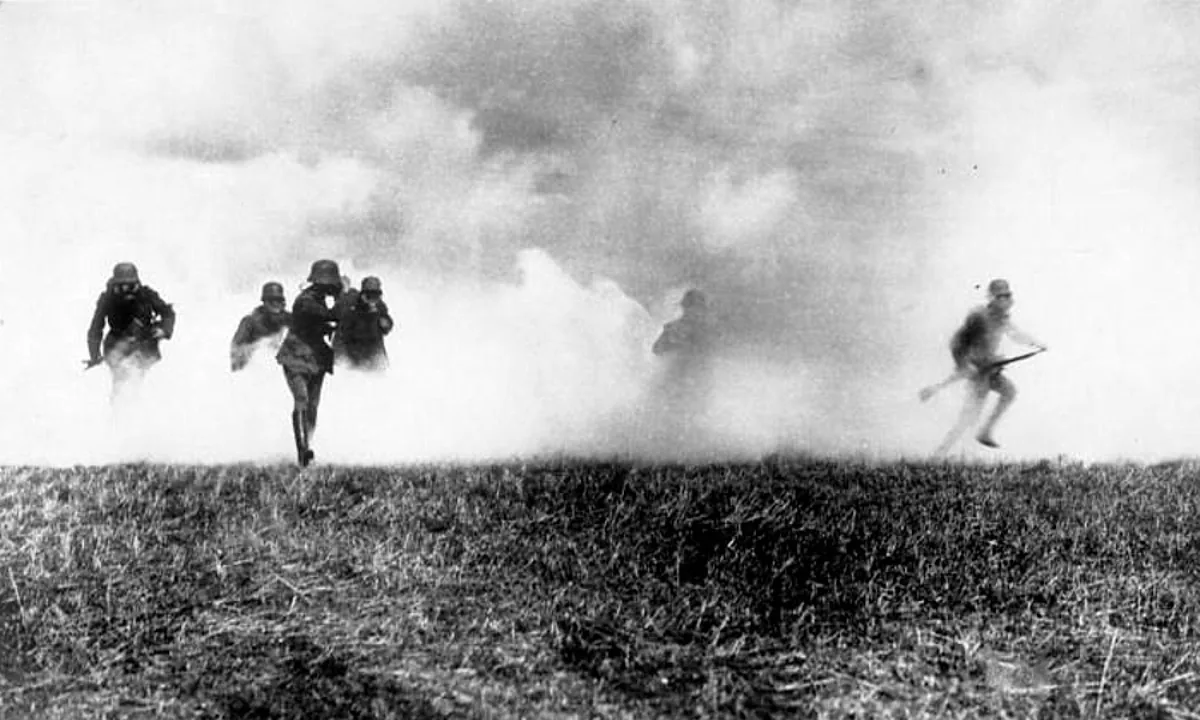
German soldiers in gas masks advance through a cloud of gas on the Western Front, about 1916–17 (possibly a training exercise). Bundesarchiv, Bild 183-R05923 · CC BY-SA 3.0 DE · Wikimedia Commons -
21. According to his own later account, why did Erich von Falkenhayn attack Verdun?
Show the answer
C. To bleed France white by forcing it to defend the city. In his memoirs Falkenhayn wrote that he wanted France to defend Verdun at any cost and lose so many men that it could not go on. Many historians think he wrote this afterwards to justify the battle.
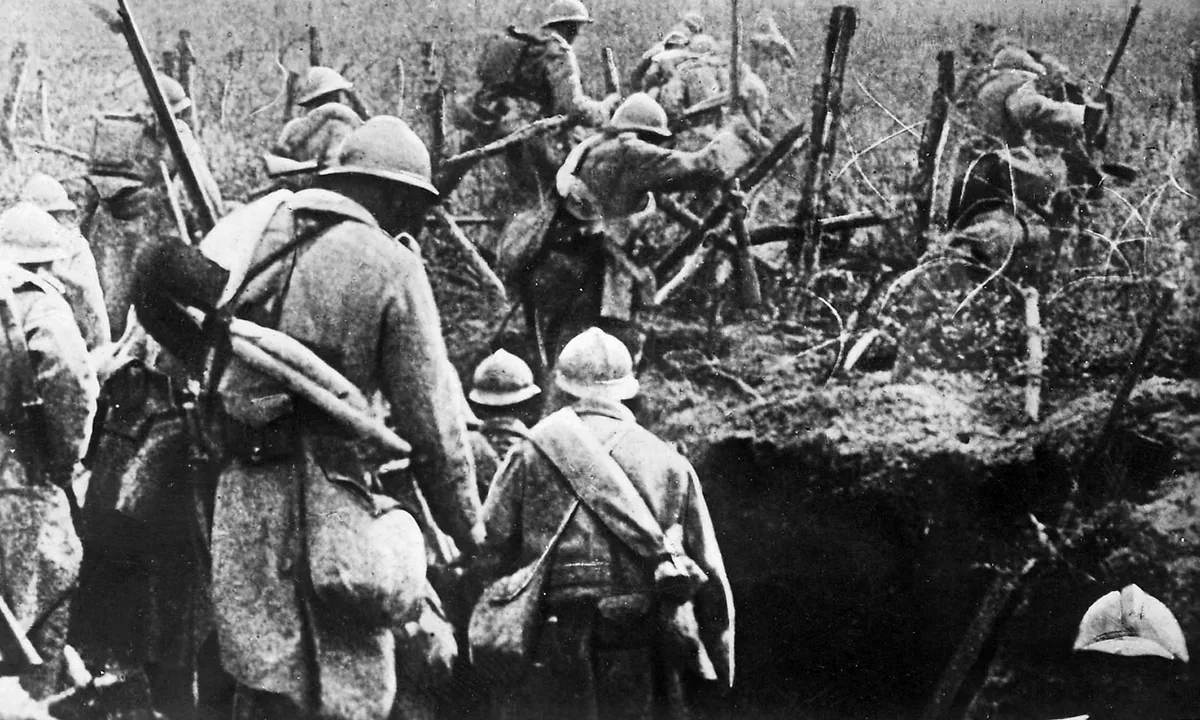
A widely reproduced photograph said to show French infantry in 'Adrian' helmets attacking at Verdun in 1916; it may have been staged. Unknown photographer, 1916 · Public domain · Wikimedia Commons -
22. After five months of fighting and over a million killed or wounded, how far had the Allies moved the front line on the Somme?
Show the answer
B. A few miles. The front moved only a few miles, about six at the deepest point. Machine guns, artillery and deep defences made every attack slow and costly.
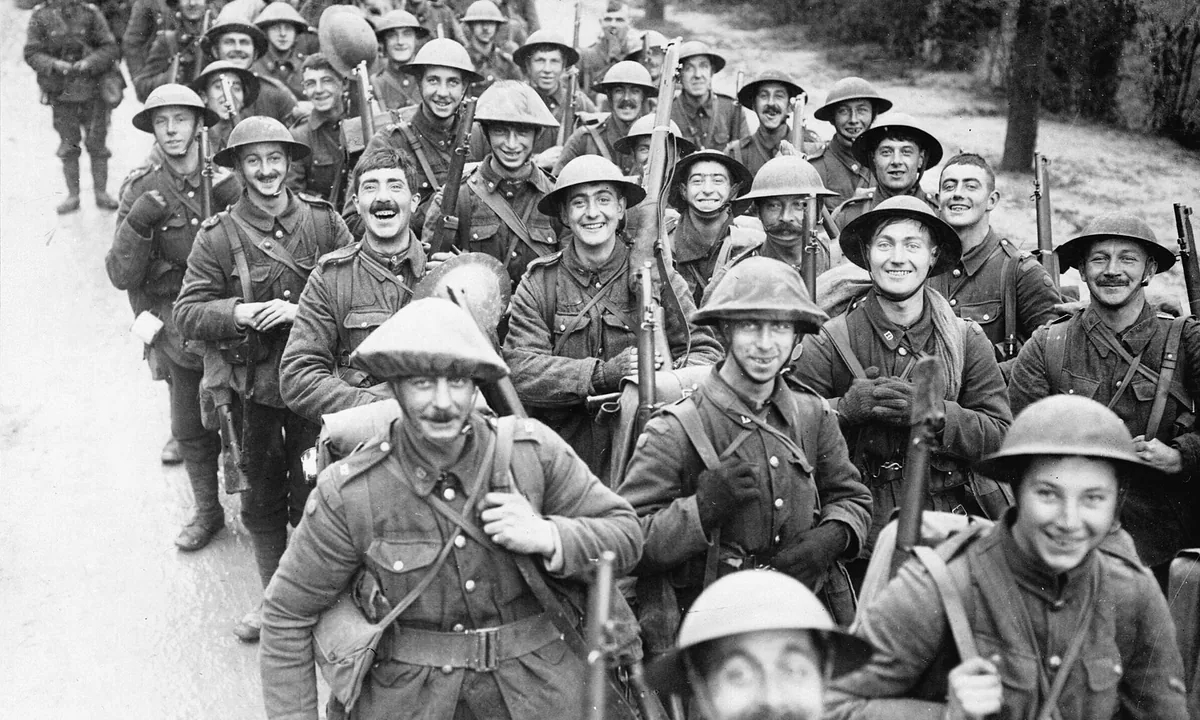
Cheerful men of the Royal Fusiliers march up to the trenches during the Battle of the Somme, 1916. More than a million soldiers would be killed or wounded there. British official photographer, 1916 · Public domain · Wikimedia Commons -
23. By the calendar used in most of Europe, Russia's February Revolution of 1917 took place in March.
Show the answer
A. True. In 1917 Russia's old Julian calendar ran 13 days behind. The women's march of 8 March was 23 February in Russia, so the revolution is named after February.
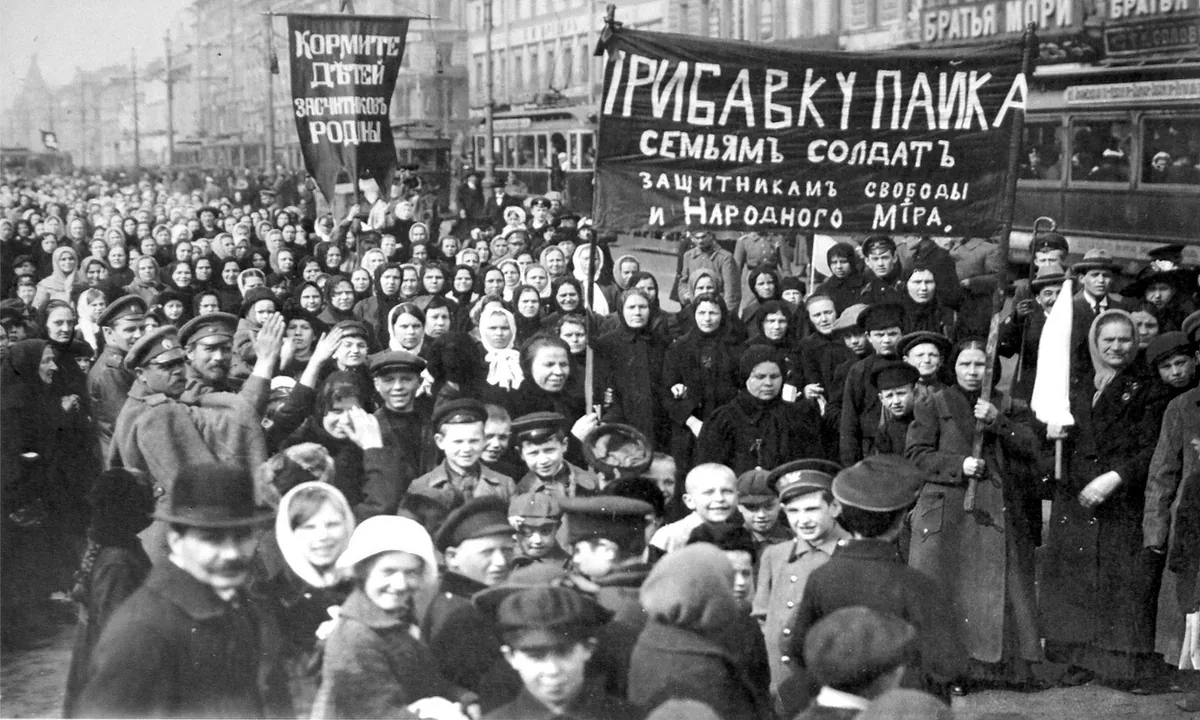
Women workers from the Putilov factory march in Petrograd in 1917 with banners demanding larger rations for soldiers' families – hunger and war-weariness drove the February Revolution. Unknown photographer, 1917 · Public domain · Wikimedia Commons -
24. How did the Allies finally break the German lines in the Hundred Days Offensive of 1918?
Show the answer
D. By using tanks, aircraft and artillery together. From 8 August 1918 the Allies combined their weapons: shells fell just ahead of the infantry, tanks crushed the wire and planes found targets, so attacks no longer stalled.
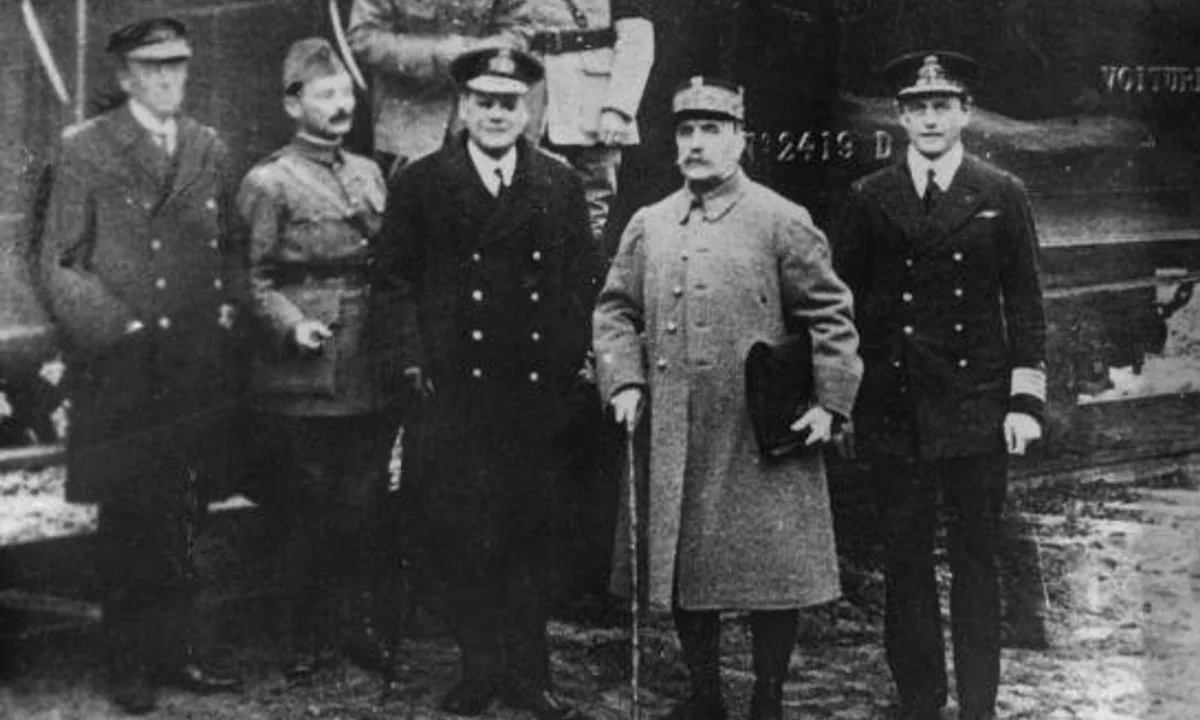
Marshal Ferdinand Foch (second from right) and Allied officers outside the railway carriage in the forest of Compiègne where the Armistice was signed on 11 November 1918. Unknown photographer, 1918 · Public domain · Wikimedia Commons -
25. Which gas, first used in July 1917, was especially feared because it caused severe burns, blisters and temporary blindness?
Show the answer
A. Mustard gas. Mustard gas burned the skin, eyes and lungs, and it stayed in the soil for days or weeks. Many of its victims, like the men in Sargent’s “Gassed”, were blinded for a time.
German soldiers in gas masks advance through a cloud of gas on the Western Front, about 1916–17 (possibly a training exercise). Bundesarchiv, Bild 183-R05923 · CC BY-SA 3.0 DE · Wikimedia Commons -
26. Which French words became the motto of the defenders of Verdun?
Show the answer
D. Ils ne passeront pas. “Ils ne passeront pas” means “They shall not pass”. The words are linked with General Nivelle, who took over at Verdun in May 1916.
A widely reproduced photograph said to show French infantry in 'Adrian' helmets attacking at Verdun in 1916; it may have been staged. Unknown photographer, 1916 · Public domain · Wikimedia Commons -
27. Why did Britain and France launch the Battle of the Somme in July 1916?
Show the answer
D. To take pressure off the French army at Verdun. Since February 1916 the Germans had been attacking Verdun. A big British and French attack on the Somme would force Germany to move men and guns away from Verdun, and might break through.
Cheerful men of the Royal Fusiliers march up to the trenches during the Battle of the Somme, 1916. More than a million soldiers would be killed or wounded there. British official photographer, 1916 · Public domain · Wikimedia Commons -
28. After Tsar Nicholas II gave up the throne in March 1917, what did Russia's new Provisional Government decide to do?
Show the answer
A. Keep fighting the war beside Britain and France. The Provisional Government stayed loyal to Russia's allies and kept fighting. The war stayed unpopular and food stayed short, so the government lost support, and the Bolsheviks' promise of peace won it.
Women workers from the Putilov factory march in Petrograd in 1917 with banners demanding larger rations for soldiers' families – hunger and war-weariness drove the February Revolution. Unknown photographer, 1917 · Public domain · Wikimedia Commons -
29. Why did many Germans feel humiliated after World War I?
Show the answer
C. The Treaty of Versailles made Germany take the blame. Germany was not invited to the talks. Article 231, the war guilt clause, made it accept responsibility for the war's loss and damage, and it had to pay reparations, lose land and cut its army.
Marshal Ferdinand Foch (second from right) and Allied officers outside the railway carriage in the forest of Compiègne where the Armistice was signed on 11 November 1918. Unknown photographer, 1918 · Public domain · Wikimedia Commons -
30. Which 1925 international agreement banned the use of poison gas in war?
Show the answer
C. Geneva Protocol. The Geneva Protocol, signed on 17 June 1925, banned the use of poison gas in war. It did not ban making or keeping poison gas; a much later treaty did that.
German soldiers in gas masks advance through a cloud of gas on the Western Front, about 1916–17 (possibly a training exercise). Bundesarchiv, Bild 183-R05923 · CC BY-SA 3.0 DE · Wikimedia Commons -
31. Because Pétain rotated units through the battle, a large part of the French army fought at Verdun.
Show the answer
A. True. Pétain kept sending fresh troops in and taking tired ones out. This stopped units being destroyed, but it meant that many French soldiers lived through Verdun.
A widely reproduced photograph said to show French infantry in 'Adrian' helmets attacking at Verdun in 1916; it may have been staged. Unknown photographer, 1916 · Public domain · Wikimedia Commons -
32. What new weapon did the British use for the first time on the Somme, in September 1916?
Show the answer
A. Tanks. Tanks first went into battle at Flers-Courcelette on 15 September 1916. There were too few of them, and too many broke down, to change the battle.
Cheerful men of the Royal Fusiliers march up to the trenches during the Battle of the Somme, 1916. More than a million soldiers would be killed or wounded there. British official photographer, 1916 · Public domain · Wikimedia Commons -
33. Why did many hungry, war-weary Russians support Lenin's Bolsheviks in 1917?
Show the answer
B. They promised peace, land and bread. The Provisional Government kept fighting an unpopular war while people went hungry. The Bolsheviks' slogan “Peace, Land, and Bread” offered exactly what soldiers, peasants and workers wanted.
Women workers from the Putilov factory march in Petrograd in 1917 with banners demanding larger rations for soldiers' families – hunger and war-weariness drove the February Revolution. Unknown photographer, 1917 · Public domain · Wikimedia Commons -
34. Why did gas attacks from cylinders depend on the weather?
Show the answer
B. The gas cloud moved with the wind. A gas cloud drifted wherever the wind took it. The Germans at Ypres waited for a wind towards the enemy, and at Loos the wind blew some British gas back into their own trenches.
German soldiers in gas masks advance through a cloud of gas on the Western Front, about 1916–17 (possibly a training exercise). Bundesarchiv, Bild 183-R05923 · CC BY-SA 3.0 DE · Wikimedia Commons -
35. In the Treaty of Brest-Litovsk, which took Russia out of the war in March 1918, what did Russia give up?
Show the answer
D. Poland and the Baltic lands. Lenin's government had promised peace, so it accepted Germany's harsh terms: it gave up Poland, Lithuania, Latvia and Estonia and accepted that Finland and Ukraine were independent.
Women workers from the Putilov factory march in Petrograd in 1917 with banners demanding larger rations for soldiers' families – hunger and war-weariness drove the February Revolution. Unknown photographer, 1917 · Public domain · Wikimedia Commons
Your score
You got right. Want the stories behind them?
Aurelius: Learn History has 700+ more questions like these, each one after the five-minute illustrated story it comes from, across 18 eras. Free to try.
Play next: World War 2 Quiz · Cold War Quiz · History Quiz
About this quiz
Kaiser Wilhelm II, Woodrow Wilson and the Bolsheviks all feature, alongside the soldiers in the trenches.
The questions come from 11 lessons in the app: The Shot That Started a World War, Naval Warfare: Jutland and U-Boats, Woodrow Wilson: America Enters the War, Trench Warfare and Stalemate, The Battle of the Marne: Saving Paris, Kaiser Wilhelm II: The Last German Emperor, Chemical Warfare: The Horror of Gas, The Battle of Verdun: The Hell of War, The Battle of the Somme: The Bloodiest Day, The Russian Revolution and Exit from War, The End and Consequences of World War I.
Questions are labelled easy, medium or hard by the level of the lesson they come from, and the quiz plays in that order, easy to hard. There are 700+ more in the Aurelius: Learn History app.
Frequently asked questions
How many questions are in the WW1 Quiz?
35: 4 easy, 15 medium and 16 hard, played easy to hard. 29 are multiple choice and 6 true or false. Every answer is explained, with the picture of the story behind it, and at the end you see your score by level.
Is the WW1 Quiz free?
Yes. It plays in your browser with no account and no sign-up. For more, Aurelius: Learn History has 700+ questions like these, each after a short illustrated lesson. The app is free to download and try on iPhone, iPad and Android.
Where do the questions come from?
From the lessons in Aurelius: Learn History. Every question follows a short illustrated story in the app and is written and checked by the Aurelius editorial team. The easy, medium and hard labels are the levels of those lessons. See how lessons are checked.
Which quiz should I play next?
Try the World War 2 Quiz, the Cold War Quiz and the History Quiz. All quizzes are listed at the end of this page.
More history quizzes
- World War 2 QuizFrom the invasion of Poland to Bastogne.
- Cold War QuizBerlin, Cuba, Vietnam and the space race.
- History QuizThe all-round history quiz across many eras.
- American History QuizThe Revolution and the Civil War: US history trivia.
- Ancient Egypt QuizPharaohs, pyramids, mummies and the Rosetta Stone.
- Medieval History Quiz: The Middle AgesFrom Charlemagne and the Vikings to the Black Death.
- Ancient Rome QuizRepublic, Caesar and empire.
- Ancient Greece QuizAthens, Sparta, Persia and Alexander.
- French Revolution and Napoleon QuizFrom the Bastille to Waterloo.
- Tudors and Reformation QuizHenry VIII, Elizabeth I, Luther and the Armada.
- World History QuizOne game across world history.
- 100 History Trivia Questions and Answers100 questions with answers for quiz nights and classrooms.